Event 1
Elizabeth Bennet’s first meeting with Lady Pentland

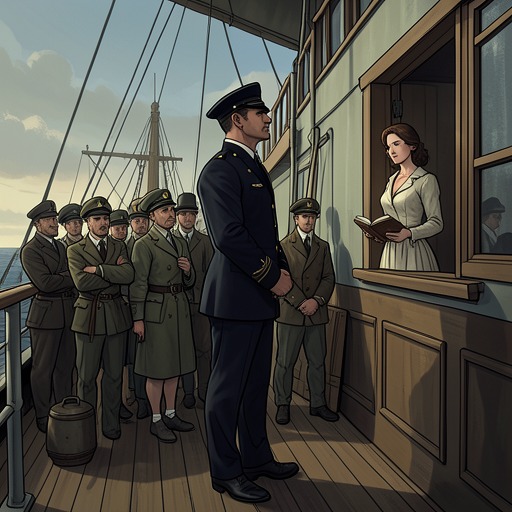
[Elizabeth Bennet’s first meeting with Lady Pentland](entity:event-recall-event-elizabeth-bennet-s-firs-4a558f575d0f) is a brief encounter beside the brook near [Longbourn](entity:location-recall-location-longbourn-09a641b38d11) that becomes the beginning of one of Elizabeth’s most formative relationships. What initially appears to be a chance meeting with an unusual neighbour introduces Elizabeth to [Radha Bhimani Pentland](entity:character-recall-character-radha-bhimani-pentl-686fbe966898)’s independence, difference, and guarded dignity; retrospectively, it also opens the narrative’s central history of forced migration, enslavement, religious coercion, piracy, rescue, and chosen belonging.
## The Encounter Beside the Brook
Elizabeth comes upon the meeting while walking through the Longbourn estate, a place where she knows the tenant farmers and their families and ordinarily feels safe and at peace. She hears a horse before seeing its rider and finds the animal drinking from the shallow summer stream. Because the brook is narrow at that time of year, she and the rider are unexpectedly close when the rider finally comes into view.
The sight startles and excites Elizabeth: the rider is an Indian lady, a rare presence in Britain in [1804](entity:time-recall-time-1804-f49df1bd40ab), and the woman is Lady Pentland, the mistress of [Grenadine Reef](entity:location-recall-location-grenadine-reef-ad0be7a0e4a4), the estate north of Longbourn. Elizabeth has heard of her but has never met her. She removes her bonnet, curtsies, and offers the formal greeting, “Good morning Lady Pentland.” Lady Pentland’s face briefly freezes into a blank expression before she returns the courtesy, revealing an immediate reserve that contrasts with the courtesy of the exchange.
Lady Pentland assumes that Elizabeth must be one of [Thomas Bennet](entity:character-recall-character-thomas-bennet-fdb1df6a4cdd)’s daughters and asks whether she is [Jane Bennet](entity:character-recall-character-jane-bennet-1913002c8ec6), whom she has heard described as beautiful. Elizabeth flushes, stammers that Jane is her older sister, and identifies herself as the second daughter. The exchange is socially ordinary, but the contrast between the expected beauty of Jane and Elizabeth’s startled self-consciousness gives the meeting a small emotional turn: Elizabeth is seen, named, and distinguished before she has had time to control her response.
## A Woman Outside Conventional Rules
The meeting becomes especially memorable when Lady Pentland prepares to leave for Grenadine Reef. Elizabeth watches her lead the horse to a large stump, climb onto it, and mount astride. What had seemed to be a skirt is revealed as a pair of wide riding trousers. Lady Pentland does not ride side saddle, the convention Elizabeth has been taught to accept without explanation.
This detail has unusual force for Elizabeth. She began riding lessons at seven but quickly abandoned them because side-saddle riding felt neither comfortable nor safe. Jane Bennet and [Mary Bennet](entity:character-recall-character-mary-bennet-3ad0e066a036) are competent riders, while Elizabeth generally walks because the Bennet estate has only a few horses and they are normally needed for fieldwork. Her fascination with Lady Pentland’s posture is therefore not merely admiration of an exotic spectacle. It gives visible form to a question Elizabeth has never found satisfactory: why men may ride astride while women are required to ride differently simply because custom says that this is how ladies ride.
Lady Pentland’s freedom is not presented as a speech or manifesto. It appears in the practical fact of how she occupies a horse and moves through the landscape. Two mounted grooms wait to escort her back to the Manor House, and the three riders soon diminish into dots on the horizon. Yet the image remains with Elizabeth after Lady Pentland has gone, transforming a short diversion into an early encounter with a woman whose conduct does not fit the rules governing respectable femininity.
## The Hidden History Revealed Later
The significance of the first meeting deepens when Lady Pentland later tells Elizabeth part of her history. She explains that she was born Radha Bhimani in [Kutch](entity:location-recall-location-kutch-9cd484dc0f71) in western India. Her mother died in childbirth, and she was raised by her paternal grandmother and aunts while her family repeatedly moved because of conflict involving the Mughals, the Marathas, and the British. Her Hindu family lived through changing political control and religious divisions, returning and fleeing as local power shifted.
When Radha was only a year older than Elizabeth is at the time of the first encounter, she was kidnapped to be sold into slavery. She was rescued before the sale, but the rescue did not return her to India. A Spanish ship found her off the coast of the [Arabian Peninsula](entity:location-recall-location-arabian-peninsula-f00d52e55f25) while transporting priests; they protected her and taught her rudimentary Spanish, but she was then forced into a nunnery outside [Cadiz](entity:location-recall-location-cadiz-6779628989a5). She remained cloistered there for six years, and at twenty-one was sent, without a meaningful choice, with twenty-nine other members of her order on a mission from Cadiz to [Cartagena](entity:location-recall-location-cartagena-a586cc897c9b) on the Spanish Main.
The ship was captured by pirates. Radha suffered four days of pirate violence and was stabbed in the stomach by the pirate captain, an injury considered nearly always fatal. She received the last rites and was left behind because she was too ill to be moved when the surviving members of the order were landed under a white flag of neutrality. Her survival therefore carries a chain of reversals: kidnapping does not end in enslavement, rescue does not produce freedom, religious protection becomes confinement, and apparent death becomes the beginning of another life.
## From Rescue to Grenadine Reef
Radha’s survival depends on [Sir David Pentland](entity:character-recall-character-sir-david-pentland-9d7df8c780b8). He took her into his large house in Bridgetown on [Barbados](entity:location-recall-location-barbados-a285bae3d98a) and cared for her with the help of his housekeeper and a nurse. She nearly died twice even under this personal care, but eventually recovered from the infection. At that point she was an Indian woman who spoke Spanish, a forced nun abandoned by her order, and a survivor of piracy living in the home of a British naval hero.
For Sir David, the violence committed against Radha did not cancel her worth. Radha moved into the home of a widow known to him for the sake of propriety, and he began to court her. When she alluded to what had happened during the four days before her rescue, he took her hand and told her that it did not matter. His response becomes a decisive contrast to the social judgement that later follows her. Although he had been knighted for naval service, he resigned his commission after Radha was subjected to barbed comments and claims that she would have been better off dying. The cruelty directed at her treated survival itself as an embarrassment and blamed her for being captured because she had lived near the coast.
Radha converted willingly, though superficially, to the [Church of Scotland](entity:organization-recall-organization-church-of-scotla-c72c453213dc), and she and Sir David married near Edinburgh. After their wedding trip they moved to [London](entity:location-recall-location-london-420923d4a60a), learned of the estate, and bought Grenadine Reef, where they lived thereafter. By the time of the first meeting near Longbourn, the apparently unconventional rider is therefore also the survivor of a trans-imperial passage through Kutch, the Arabian Peninsula, [Spain](entity:location-recall-location-spain-336a02c89dc7), the Caribbean, and Britain, and the mistress of a [Hertfordshire](entity:location-recall-location-hertfordshire-3be0dd22bb53) estate shaped by chosen rather than inherited belonging.
## A Formative Model for Elizabeth
Elizabeth’s later understanding of what it means to be a lady is explicitly formed through Lady Radha and [Madeline Gardiner](entity:character-recall-character-madeline-gardiner-932ce19b654c). Elizabeth contrasts Madeline, the wife of a tradesman, mother of four young children, and active hostess for [Edward Gardiner](entity:character-recall-character-edward-gardiner-ff481a4f187c)’s business, with Lady Radha, a shy woman born in India, kidnapped three times, horribly abused by pirates, unable to bear children because of her injuries, and rarely visible in society. Their circumstances and public roles could hardly be more different, yet Elizabeth finds that both teach closely related lessons about love and the practical realities of living.
The first meeting supplies the earliest image of those lessons. Elizabeth sees a woman who is courteous without being submissive, visibly marked by a foreign history yet secure in her place, and physically free enough to ride astride despite the conventions that have made Elizabeth herself give up riding. Later knowledge prevents the scene from remaining a picturesque encounter with an unusual neighbour. Lady Pentland’s control of the horse becomes part of a larger pattern of endurance and self-possession: a life repeatedly directed by war, kidnapping, religious authority, pirates, and social judgement, yet finally redirected through survival, marriage, property, and residence at Grenadine Reef.
As a narrative event, the meeting moves from curiosity to recognition and then, through retrospective revelation, to moral education. Elizabeth does not yet know the violence behind Lady Pentland’s guarded expression, nor the cost of the independence represented by her riding trousers. She knows only that the woman is different and that the difference feels compelling rather than threatening. That first impression prepares Elizabeth to receive Radha’s later testimony and helps establish the relationship through which Elizabeth learns to judge women not by conformity, reputation, fertility, or social display, but by courage, care, and the practical work of making a life after coercion.
Event 2
Radha Bhimani’s kidnapping and attempted enslavement
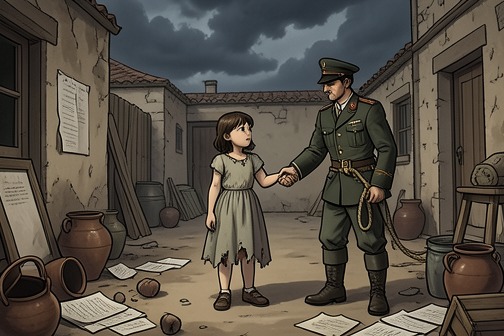
[Radha Bhimani’s kidnapping and attempted enslavement](entity:event-recall-event-radha-bhimani-s-kidnapp-1c26107c8af6) is the decisive rupture in the life later lived by [Lady Radha Pentland](entity:character-recall-character-lady-radha-pentland-8550d21cca9a). It transforms a childhood already shaped by war and religious displacement into a forced passage through slavery, piracy, religious confinement, and imperial society, while also establishing the experience that informs her compassion for vulnerable women.
## Childhood in [Kutch](entity:location-recall-location-kutch-9cd484dc0f71) and Forced Displacement
Radha was born Radha Bhimani in Kutch in western India. Her mother died in childbirth, and she was raised by her paternal grandmother and aunts while her father served as a minor district-government official. Her family was Hindu, but the region repeatedly changed hands amid fighting involving the Mughals, the Marathas, and the British. The family fled when the Muslim Mughals conquered the district and returned after their defeat, only to face further upheaval when the Christian British arrived. Radha later described her childhood memories as fragmented, with the order of events difficult to recover, because political conquest and flight had made instability part of ordinary life.
The kidnapping occurred when Radha was only a year older than [Elizabeth Bennet](entity:character-recall-character-elizabeth-bennet-f97b53a479cc). She was taken with the intention of being sold into slavery, making her a victim of organized exploitation rather than merely a casualty of wartime disorder. The event also severed her from the family structure that had raised her: her father had remarried, she had never lived with his new household, and she had several half-siblings whom she had never met. Her original home therefore became inaccessible not only through geography but through the violence that converted a child into movable property.
## Rescue Before Sale and the Next Captivity
Radha was fortunate in one immediate respect: she was rescued before she could be sold. The rescue took place off the coast of the [Arabian Peninsula](entity:location-recall-location-arabian-peninsula-f00d52e55f25), and she never returned to the land of her birth. A Spanish ship carrying several priests brought her to safety and taught her rudimentary Spanish during the remainder of the voyage. Rescue consequently became another form of displacement. It saved her from sale while carrying her into a language, culture, and religious world wholly different from the one in which she had been born.
When the ship reached [Spain](entity:location-recall-location-spain-336a02c89dc7), Radha was forced to enter a nunnery outside [Cadiz](entity:location-recall-location-cadiz-6779628989a5). She spent six years cloistered there and had no say when, at the age of twenty-one, she was selected for a mission to South America. In the spring of [1772](entity:time-recall-time-1772-7fea1bc90391), she and twenty-nine other members of the order sailed from Cadiz toward [Cartagena](entity:location-recall-location-cartagena-a586cc897c9b) on the Spanish Main. Her passage from India to Spain and then toward the Caribbean thus combined rescue, coercion, religious authority, and imperial movement; freedom from one danger did not restore control over her life.
The mission ship was captured by pirates during the voyage. Radha later indicated that the consequences were grim and that she suffered horrific treatment at their hands for four days. The kidnapping in India was therefore the beginning rather than the end of her exposure to forced movement and predation. Her later account deliberately withheld some details from Elizabeth, acknowledging the darkness of what had happened without making a young listener bear its full weight.
## Survival and Reinterpretation of the Trauma
After the pirate attack, Radha sustained a stomach wound that was considered nearly uniformly fatal. She received the last rites and continued to fight the infection, while the surviving members of her order were landed under a white flag of neutrality and proceeded onward. Too sick to be moved, Radha was left behind. Her survival depended on persistence under circumstances in which other people had already treated her as someone who would die.
[Sir David Pentland](entity:character-recall-character-sir-david-pentland-9d7df8c780b8) took her into his large house in Bridgetown, [Barbados](entity:location-recall-location-barbados-a285bae3d98a), where his housekeeper and a nurse helped care for her. She nearly succumbed twice even with that personal attention, but eventually recovered from the final infection. By then she was an Indian woman who spoke Spanish, a forced nun abandoned by her order, and a survivor of four days of piracy living in the household of a British naval hero. The rescue from intended enslavement had led through further captivity and violence, yet it also brought her into the care of the man who recognized her survival as a human reality rather than a social embarrassment.
Radha moved into the home of a widow known to Sir David for the sake of propriety, and he began to court her. She told him enough about the four days before her rescue to make the violence impossible to ignore. His response was acceptance: he took her hand and told her that what had happened did not matter to him. Their relationship allowed Radha to be regarded as a person with a future rather than as a damaged remnant of the crimes committed against her.
## Social Consequences and Legacy
Radha’s recovery did not end the injury inflicted by the kidnapping. Although Sir David had been knighted for naval service, Radha was subjected almost immediately to barbed comments once it became clear that she would survive. Some people said that it would have been better if she had died of her wounds. The social judgment placed blame upon the survivor, treating her capture near the coast of India as an original sin for which she should bear shame. Her survival, rather than the crimes of the slavers and pirates, became an alleged source of embarrassment.
The treatment of Radha was the last straw in Sir David’s uncertainty about continuing his naval career. He resigned his commission, and the couple returned to Britain. Radha willingly, though superficially, converted to the [Church of Scotland](entity:organization-recall-organization-church-of-scotla-c72c453213dc), and they married in his home town outside Edinburgh before moving to [London](entity:location-recall-location-london-420923d4a60a) after their wedding trip. They eventually purchased the estate where they lived thereafter. Her attempted enslavement thus shaped the household, marriage, and social position that later connected her with Elizabeth Bennet.
Radha’s injuries prevented her from bearing children, and she and Sir David were rarely present in society. Nevertheless, Elizabeth regarded her as one of the two principal models from whom she learned what it meant to be a gentle-born lady, the other being [Madeline Gardiner](entity:character-recall-character-madeline-gardiner-932ce19b654c). Radha’s example joined personal endurance to practical responsibility: lessons learned from her and from visits to tenants at [Grenadine Reef](entity:location-recall-location-grenadine-reef-ad0be7a0e4a4) helped Elizabeth and [Jane Bennet](entity:character-recall-character-jane-bennet-1913002c8ec6) conduct more effective visits at [Longbourn](entity:location-recall-location-longbourn-09a641b38d11). The woman whom society had treated as a disgrace became, in Elizabeth’s judgment, an instructor in love, duty, and the day-to-day work of improving other people’s lives.
The kidnapping therefore carries significance beyond Radha’s private biography. It exposes the vulnerability of women caught between slavery, piracy, imperial power, religious institutions, and respectable society, while showing that rescue does not automatically restore agency. Radha’s later life gives the event a second meaning: her survival becomes the foundation of a durable marriage, a cross-cultural household, and an ethical example through which Elizabeth learns to defend women’s dignity and welfare.
Event 3
The rescue of Radha from pirates

[The rescue of Radha from pirates](entity:event-recall-event-the-rescue-of-radha-fro-6e892fff3b2d) is both a physical deliverance and the turning point through which Radha Bhimani’s fractured identity becomes connected to [Sir David Pentland](entity:character-recall-character-sir-david-pentland-9d7df8c780b8), [Grenadine Reef](entity:location-recall-location-grenadine-reef-ad0be7a0e4a4), and the later ethic of refuge for abused women. It interrupts a chain of forced movements—kidnapping in [Kutch](entity:location-recall-location-kutch-9cd484dc0f71), captivity at sea, and involuntary religious confinement—and replaces abandonment with deliberate care, even though the rescue itself does not erase the violence that preceded it.
## Causes and Background
Radha was born in Kutch in western India. Her mother died in childbirth, and Radha was raised by her paternal grandmother and aunts while her father served as a minor district official. Fighting among the Mughals, the Marathas, and the British repeatedly displaced her family: because they were Hindu in a district conquered by the Muslim Mughals, they had to flee, and they returned when that power was defeated. The subsequent arrival of the British created another period of instability. Radha’s memories of the sequence were fragmented, but the pattern was clear: political conquest repeatedly turned home into a place from which her family might have to escape.
Her father remarried, yet Radha never lived with him and his new household, and she never met the siblings born from that union. When she was only a year older than [Elizabeth Bennet](entity:character-recall-character-elizabeth-bennet-f97b53a479cc) was during their conversation, Radha was kidnapped for sale into slavery. She was rescued before the sale could occur, but this first deliverance did not return her to India. The rescuing ship was Spanish, carried several priests, and took her away from the coast of the [Arabian Peninsula](entity:location-recall-location-arabian-peninsula-f00d52e55f25). Its passengers taught her rudimentary Spanish, but safety came with coercive conditions: after landing in [Spain](entity:location-recall-location-spain-336a02c89dc7), Radha was forced into a nunnery and remained cloistered for six years outside [Cadiz](entity:location-recall-location-cadiz-6779628989a5).
At twenty-one, Radha was selected for a mission to South America without being given any say in the decision. In the spring of [1772](entity:time-recall-time-1772-7fea1bc90391), she and twenty-nine other members of the order sailed from Cadiz toward [Cartagena](entity:location-recall-location-cartagena-a586cc897c9b) on the Spanish Main. Her movement across the sea therefore remained shaped by other people’s decisions. The voyage was not a voluntary journey toward a chosen future but another imperial and religious passage in which Radha’s body, labor, and destination were controlled by institutions around her.
## The Pirate Capture and Naval Intervention
During the voyage, pirates captured the ship. The immediate value at stake was not merely freedom but survival: Radha and the other members of the order were placed in a situation she later described as extremely grim. The rescue came when Sir David Pentland and the crew of the appropriately named HMS Glory engaged the pirates. Their intervention freed the surviving captives and transformed the ship from a site of forced transport into the scene of a military deliverance.
The reversal was nevertheless brutal. During the battle, the pirate captain dragged Radha onto the deck and stabbed her with his sword. The blade passed through her womb, leaving her with a wound that was nearly always fatal. As she fell with severe pain in her torso, her last apparent sight was Sir David striking the pirate captain through the neck. The rescue thus contained both liberation and renewed bodily destruction: Radha was freed from the pirates at the very moment that their captain inflicted the injury expected to kill her.
Radha was given the last rites, and the other survivors of the order were landed under a white flag of neutrality so that they could continue onward. Radha, however, was too ill to be moved and was left behind. The group’s departure made her rescue incomplete. She had escaped enslavement and pirate captivity, but she was now an isolated, gravely wounded survivor separated from the order that had carried her across the Atlantic.
## Survival Beyond the Rescue
Radha’s continued life became an act of resistance against the apparent finality of the wound. Despite stomach injuries being nearly uniformly fatal, she lingered and fought the infection. She nearly succumbed twice even after receiving personal care, but eventually overcame the last infection and recovered. The story presents survival not as an effortless miracle but as a prolonged struggle in which rescue creates the possibility of life while Radha’s own endurance completes it.
Sir David had a large house in Bridgetown on [Barbados](entity:location-recall-location-barbados-a285bae3d98a), and he took Radha into it when the survivors reached the island. His housekeeper and a nurse helped care for her, and Radha believed that without this sustained attention she would have died. The rescue therefore extended beyond the naval attack. HMS Glory removed her from immediate pirate control; the household in Barbados kept her alive through the long aftermath of stabbing, infection, and abandonment.
Her circumstances after recovery remained radically displaced. She was an Indian woman who spoke Spanish, a forced nun left behind by the rest of her order, and a survivor of four days of pirate depredations living in the home of a British naval hero in Barbados. This combination of identities links the event to the book’s wider history of migration, empire, religion, maritime violence, and social judgment. Radha’s rescue does not restore a single original identity. Instead, it begins the difficult formation of a life across several languages, continents, and imposed affiliations.
## From Rescue to Marriage
The rescue acquired a second meaning when Radha understood that she was alive partly because of Sir David’s personal decency. After eleven weeks had passed since the capture of the original ship, she moved for propriety into the home of a widow known to him, and Sir David began to court her. Radha disclosed what had happened during the four days before her rescue rather than allowing silence to conceal the violence imposed on her. Sir David took her hand and told her that it did not matter. His response did not undo the stabbing, captivity, or forced confinement, but it refused the judgment that those experiences had made her unworthy of affection or marriage.
The rescue also exposed the double standard surrounding Radha’s survival. Sir David had been knighted for naval service, while Radha, despite surviving nearly ten years of crimes and a wound that was almost always fatal, encountered barbed remarks from the moment her recovery seemed possible. Some people said that it would have been better if she had died. She was treated as though her survival were an embarrassment, and her supposed offense was merely having lived near the coast in India, where slavers could seize her. The naval action therefore saved her from immediate violence without protecting her from the social punishment directed at its victim.
## Consequences for Sir David and Radha
The treatment of Radha became the final reason Sir David abandoned his naval career. He resigned his commission, and the couple returned to Britain. Radha willingly converted, though only superficially, to the [Church of Scotland](entity:organization-recall-organization-church-of-scotla-c72c453213dc), and they married in Sir David’s home region outside Edinburgh. After their wedding journey they moved to [London](entity:location-recall-location-london-420923d4a60a), where they learned of an estate they could purchase. The wealth that had accompanied Sir David’s reputation made that new life materially possible, but the decision to leave the navy also shows that the rescue changed the rescuer: he rejected a career whose surrounding society could celebrate his heroism while degrading the woman he had saved.
The couple eventually acquired Grenadine Reef and lived there for thirty-two years. Its name commemorated another episode in Sir David’s maritime history. In [1770](entity:time-recall-time-1770-48b20ad9bba3), as the newly appointed captain of HMS Glory, he had been sent to the West Indies after a refit at Plymouth. The ship survived the edge of the first hurricane of the season, losing spars and suffering minor injuries among the crew, while a Spanish treasure galleon attempting to reach Havana ran aground on a reef near the [Grenadine Islands](entity:location-recall-location-grenadine-islands-7ca836dbcab2). Nearly all of that ship’s crew died when it wrecked in the hurricane. Two days later, Sir David’s crew recovered a significant portion of the treasure before the remaining hull was destroyed and sank. The exploit brought Sir David his knighthood and provided the share of treasure used to purchase the estate, joining the rescue narrative to the imperial maritime economy that sustained Radha’s later household.
## Radha’s Lasting Legacy
Radha’s experience became a practical source of moral instruction for Elizabeth Bennet. Elizabeth later placed Radha beside [Madeline Gardiner](entity:character-recall-character-madeline-gardiner-932ce19b654c) as one of the two people from whom she had learned what it meant to be a gentle-born lady. Madeline was the wife of a London tradesman, the mother of four young children, and an active hostess supporting [Edward Gardiner](entity:character-recall-character-edward-gardiner-ff481a4f187c)’s business. Radha was a shy woman born in India, kidnapped three times, subjected to horrific pirate violence, rendered unable to bear children by her injuries, and rarely present in society. Their lives could hardly have been more different, yet Elizabeth found that both taught closely related lessons about love and the everyday work of living responsibly.
Those lessons were expressed through estate management and care rather than ceremony. Elizabeth accompanied [Jane Bennet](entity:character-recall-character-jane-bennet-1913002c8ec6) on tenant visits from childhood, and the knowledge learned through Radha and through visits to tenants at Grenadine Reef made the later work at [Longbourn](entity:location-recall-location-longbourn-09a641b38d11) more efficient and more attentive to tenants’ welfare. In this sense, the rescue’s consequences spread beyond Radha’s survival and marriage. The care that had once been directed toward a wounded, isolated woman became part of an ethic in which the master of an estate bore responsibility for the people dependent upon it.
The wider household continued to convert the history of Grenadine Reef into institutional refuge. After later expansion and financial planning, the original estate was divided among the next generation, while the final 1,000 acres around the dower house were retained for a lodge and the refuge connected with it. Elizabeth and [Fitzwilliam Darcy](entity:character-recall-character-fitzwilliam-darcy-ad3b1ecc1d50) built St. Vincent Lodge there after consulting an atlas and nautical charts; its name referred to the nearest large island to the place where Sir David had discovered the wrecked treasure ship. The family used the lodge during visits, while the dower house remained associated with women’s protection and recovery. Radha’s rescue thus survives not only as a remembered naval action but as the beginning of a chain by which maritime violence, private care, estate wealth, and a durable refuge became linked.
## Narrative Significance
The event follows the structure of a rescue plot but complicates the expected return to safety. Radha is freed from pirates, yet she is stabbed, separated from her religious companions, and left behind as too sick to travel. Her survival depends first on the intervention of HMS Glory, then on her own struggle against infection, and finally on the sustained care provided in Bridgetown. Each stage shifts the value of the event from captivity to precarious freedom, from apparent death to recovery, and from rescue as a single action to rescue as an extended obligation.
Its decisive significance lies in the refusal to treat deliverance as erasure. Radha remains marked by forced migration, religious coercion, sexualized violence, bodily injury, infertility, and public stigma. Yet the story gives those facts a place within a continuing life rather than allowing them to define its ending. Sir David’s intervention saves her, his acceptance makes courtship possible, his withdrawal from the navy answers the society that shamed her, and their quiet life at Grenadine Reef turns survival into responsibility. The rescue therefore becomes the foundational memory behind a household whose wealth and institutions are directed, however imperfectly, toward protection rather than abandonment.
Event 4
Radha Pentland’s marriage to Sir David Pentland
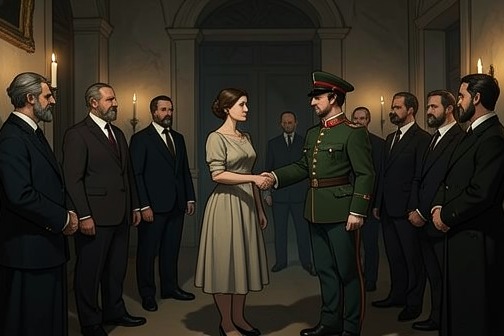
[Radha Pentland’s marriage to Sir David Pentland](entity:event-recall-event-radha-pentland-s-marria-d82335186cab) is the decisive act by which a life shaped by captivity and imposed identities becomes a chosen household partnership. It joins an Indian survivor of enslavement, piracy, and religious coercion to a British naval hero who responds to her injuries not with disgust or social calculation but with sustained care. The marriage also becomes the foundation of their long life together in Britain, their purchase of [Grenadine Reef](entity:location-recall-location-grenadine-reef-ad0be7a0e4a4), and the moral example through which [Elizabeth Bennet](entity:character-recall-character-elizabeth-bennet-f97b53a479cc) later understands love, responsibility, and what it means to be a gentle-born lady.
## Origins and Forced Displacement
Radha’s marriage cannot be separated from the chain of movements that preceded it. Born Radha Bhimani in [Kutch](entity:location-recall-location-kutch-9cd484dc0f71) in western India, she lost her mother in childbirth and was raised by her paternal grandmother and aunts. Her childhood was repeatedly disrupted by fighting among the Mughals, the Marathas, and the British. Because her Hindu family lived in a district conquered by Muslim Mughal forces, they fled and later returned; further political change brought the British into the same unstable landscape. Radha’s memories of the sequence had become fragmented, but the pattern was clear: war and imperial rule repeatedly made home precarious.
Her father remarried, yet Radha never lived with him, his new wife, or the siblings born from that union. When she was only a year older than Elizabeth Bennet at the time of their conversation, she was kidnapped for sale into slavery. Rescue came before the sale could be completed, but it did not restore her to India. A Spanish ship carrying several priests took her aboard off the coast of the [Arabian Peninsula](entity:location-recall-location-arabian-peninsula-f00d52e55f25), taught her rudimentary Spanish, and carried her to [Spain](entity:location-recall-location-spain-336a02c89dc7). The safety of that rescue had a coercive price: once she reached Spain, she was forced into a nunnery and remained cloistered outside [Cadiz](entity:location-recall-location-cadiz-6779628989a5) for six years.
At twenty-one, Radha was selected for a mission to South America and was given no say in the decision. In the spring of [1772](entity:time-recall-time-1772-7fea1bc90391), she and twenty-nine other members of her order sailed from Cadiz toward [Cartagena](entity:location-recall-location-cartagena-a586cc897c9b) on the Spanish Main. Her life before meeting Sir David therefore consisted not of one settled migration but of repeated compulsory relocations: flight from war, kidnapping, transport across the sea, confinement in a religious institution, and another assigned voyage. The marriage later matters because it is the first major change in this sequence that Radha can accept as her own decision.
## Rescue, Injury, and Courtship
The ship carrying Radha and the religious order was captured by pirates during the voyage. The captivity lasted four days, and the conditions were grim. During the battle in which Sir David and the crew of HMS Glory engaged the pirates, the pirate captain dragged Radha onto the deck and stabbed her with a sword. The wound passed through her womb. As she collapsed in agony, her last apparent sight was Sir David cutting the pirate captain through the neck. The violence that had defined her earlier life thus reached its most intimate form at the very moment when rescue arrived.
Radha survived wounds that were considered nearly uniformly fatal. She received the last rites and continued to linger while fighting the infection. The rest of the surviving order was landed under a white flag of neutrality and continued onward, but Radha was too ill to be moved and was left behind. Sir David brought her to his large house in Bridgetown on [Barbados](entity:location-recall-location-barbados-a285bae3d98a), where his housekeeper and a nurse helped him care for her. Even with that personal attention, she nearly died twice before finally overcoming the last infection. By the time she recovered, she was an Indian woman who spoke Spanish, a forced nun separated from her order, a survivor of four days of pirate depredations, and a patient living in the home of a British naval hero.
Sir David’s care becomes the practical beginning of their relationship. After eleven weeks had passed since the original capture of her ship, Radha understood that she was alive in substantial part because of him. She regarded him as an exceptionally decent and kind man, but she did not allow gratitude to erase the need for honesty. For propriety, she moved into the home of a widow known to him, and Sir David began to court her. During one difficult afternoon, she alluded to what had happened during the four days before her rescue. He took her hand and told her that it did not matter.
That response is presented as extraordinary rather than socially ordinary. Elizabeth understands that Sir David’s reaction was not guaranteed and that Radha’s account makes it unusual. Radha had been subjected to innumerable crimes for nearly ten years, yet the surrounding society treated her survival as an embarrassment. She heard more than once that it would have been better if she had died from her wounds. Her supposed original fault was merely having lived too near the coast in India, where slavers could capture her. Barbados shunned her despite the fact that she had been the victim, not the author, of the crimes committed against her.
## Marriage and Resettlement
The treatment of Radha became the final reason Sir David abandoned his naval career. He had already been knighted for his actions, but his uncertainty about continuing in the service hardened into resignation after witnessing the contempt directed toward the woman he had rescued and loved. The marriage therefore joins private affection to a public refusal: Sir David would not preserve his career at the cost of accepting the social punishment imposed on Radha.
Radha willingly converted, though she admitted that the conversion was superficial, to the [Church of Scotland](entity:organization-recall-organization-church-of-scotla-c72c453213dc). She and Sir David married in his home town outside Edinburgh, then travelled to [London](entity:location-recall-location-london-420923d4a60a) after their wedding. There they learned of an estate available for purchase and acquired it. The couple subsequently lived there for thirty-two years, establishing the household later known as Grenadine Reef. Their movement from Barbados to Britain was not simply a return to Sir David’s professional world; it was a relocation into a shared domestic and landed life in which Radha was no longer a rescued dependent or a cloistered religious subject.
The marriage also carried physical consequences that shaped their household. Radha’s injuries meant that she could not bear children. Elizabeth later describes her as a shy woman born in India, kidnapped three times, horribly treated by pirates, and ultimately settled in [Hertfordshire](entity:location-recall-location-hertfordshire-3be0dd22bb53), while noting that she and Sir David were rarely visible in society. Their childlessness and limited social appearance did not diminish the marriage’s durability. Instead, the relationship is measured through care, loyalty, and daily responsibility rather than through heirs, display, or conventional social approval.
## Example and Afterlife
For Elizabeth, Radha and Sir David’s marriage becomes a living alternative to the marriage market’s logic. Elizabeth had learned from Radha’s experience that a woman could be blamed for the violence done to her and judged by the social meanings attached to her body, birthplace, religion, and survival. Sir David’s conduct rejects that logic: he nurses Radha, hears what she can disclose, accepts her without demanding a spotless history, and changes the course of his own life in response to the injustice surrounding her.
Radha’s influence on Elizabeth is not merely emotional. Over eight years, Elizabeth learns what it means to be a lady chiefly through the examples of her aunt [Madeline Gardiner](entity:character-recall-character-madeline-gardiner-932ce19b654c) and Lady Radha. The two women differ sharply in background and social activity, but both teach lessons connected with love and the practical realities of daily life. Radha’s visits to tenants at Grenadine Reef help Elizabeth and [Jane Bennet](entity:character-recall-character-jane-bennet-1913002c8ec6) conduct their own tenant visits at [Longbourn](entity:location-recall-location-longbourn-09a641b38d11) more effectively. Through the marriage’s household, estate, and charitable consequences, Radha’s experience is converted into an ethic of active responsibility.
The union’s later significance is intensified by Radha’s sudden death from apoplexy in her sleep. More than a month after her death, Elizabeth visits the small chapel at Grenadine Reef and sees the devastation of Sir David’s bereavement: the light has gone from his life. Their marriage is thus shown not as a convenient arrangement that ends when its practical purposes are fulfilled, but as a bond whose loss leaves Sir David visibly altered. Its endurance is finally registered through grief, memory, and the obligations that Radha’s example continues to impose on Elizabeth and on the estate.
## Legal and Moral Tensions
The marriage also exposes the conflict between formal institutions and lived justice. Radha’s passage through several systems of authority was repeatedly marked by the absence of meaningful consent: war displaced her family, slavers kidnapped her, Spanish clergy confined her in a nunnery, and the mission to Cartagena assigned her a new destination without consultation. Against that history, Sir David’s courtship begins only after she has been moved to a widow’s home for propriety and has been given the opportunity to disclose what she could about her captivity. His acceptance does not erase the violence, but it refuses to convert that violence into a reason to deny her the possibility of marriage.
The contrast becomes especially sharp when placed beside Elizabeth Bennet’s later refusal of [William Collins](entity:character-recall-character-william-collins-a95fe9afaea4). Elizabeth insists that a bride cannot be forced to marry and rejects the notion that she can be sold for the sake of Longbourn. Radha’s story gives that principle an earlier, harsher historical depth: Radha had literally been targeted for sale, while respectable society continued to judge her as though her victimhood were a stain. Sir David’s marriage to her therefore stands against both the commodification of women and the social double standard that excuses harm to women while condemning their survival.
## Household, Estate, and Responsibility
Once settled in Britain, the marriage expanded beyond private protection into an organized household and estate community. Radha’s inability to bear children, caused by the pirate captain’s wound through her womb, meant that the couple could not build their future through descendants. Their life at Grenadine Reef instead acquired continuity through stewardship, tenant visits, and the humane administration of property. Elizabeth later identifies this practical attention to tenants as one of the lessons Radha taught her, even when the lesson was conveyed through ordinary activity rather than formal instruction.
Sir David’s later concern for the estate shows how closely the marriage’s emotional history is tied to succession and responsibility. After Radha’s death, his mortality became more pressing, and he began seeking a way to protect both Elizabeth and the future of Grenadine Reef. He had already recognized that Elizabeth’s difficulty at Longbourn was connected to his own lack of a clear solution. As he became slower, frailer, and more susceptible to cold, the question of what would happen to the estate could no longer be postponed. The household Radha and Sir David created thus survives them only through deliberate planning rather than through an uncomplicated hereditary line.
Sir David eventually explains that he had begun thinking about Elizabeth within a year of meeting her, although his original will left everything to his twin brother. After Radha’s death, and especially after the events of the previous autumn made Elizabeth’s reaching her majority essential to her escape from Mrs. Bennet, he considered how to assist her. The discovery of his cancer then compressed a long-term plan into weeks. He arranged for [James Pentland](entity:character-recall-character-james-pentland-f74c1d84a81a) to witness a new will, the marriage settlement, and the wedding, while a doctor and the local magistrate attested that he remained of sound mind. The proposal required Elizabeth and [Fitzwilliam Darcy](entity:character-recall-character-fitzwilliam-darcy-ad3b1ecc1d50) to place their personal happiness on hold for a year, making the estate’s continuity inseparable from an emotional sacrifice.
## Lasting Significance
The union’s legacy reaches beyond Radha and Sir David because it supplies the standard against which later relationships are judged. Elizabeth sees that love is not a decorative sentiment or a financial transaction: it is care enacted under pressure, honesty offered despite shame, and responsibility accepted when society would prefer abandonment. Sir David’s conduct toward Radha becomes the model that allows Elizabeth to distinguish a partnership grounded in respect from an arrangement designed merely to preserve property or reputation.
Radha’s marriage also gives the novel a cross-imperial history that unsettles the apparent quiet of British landed life. Kutch, the Arabian Peninsula, Spain, Cadiz, Cartagena, Barbados, Edinburgh, London, and Hertfordshire are linked through one woman’s forced movements and one man’s decision to care for her. The connection reveals how slavery, piracy, religious authority, naval power, colonial conflict, and English estate society belong to the same historical world. Grenadine Reef is therefore not an isolated country house: it is the final form of a life assembled from displacement, rescue, illness, resistance, and chosen belonging.
The marriage ends biologically with Radha’s death, but not morally or narratively. Her absence leaves Sir David bereft, while her example remains active in Elizabeth’s education, her treatment of tenants, and her understanding of female dignity. The couple’s thirty-two years together provide the emotional foundation for that inheritance. What began with an injured survivor being carried into a naval hero’s house becomes a durable household ethic: women are not commodities, suffering is not culpability, and a marriage proves its worth through the freedom, protection, and responsibility it makes possible.
Event 5
Sir David Pentland’s salvage of the Spanish treasure galleon

[Sir David Pentland’s salvage of the Spanish treasure galleon](entity:event-recall-event-sir-david-pentland-s-sa-0ebf2a3c8b81) is the founding event of the Pentland fortune and the material origin of [Grenadine Reef](entity:location-recall-location-grenadine-reef-ad0be7a0e4a4). The episode turns a dangerous naval assignment into a prize whose consequences reach far beyond the wreck itself: it establishes Sir David’s public reputation, finances the purchase of the estate, and later supports a disciplined investment network and an enduring family legacy.
## The Hurricane and the Wreck
In [1770](entity:time-recall-time-1770-48b20ad9bba3), Sir David was the newly appointed captain of HMS Glory, sent to the West Indies after the ship’s refit in Plymouth. The [Admiralty](entity:organization-recall-organization-admiralty-f42cc9488820) ordered the vessel onto station immediately, even though the hurricane season had begun. HMS Glory encountered the edge of the first hurricane of the season. The ship was battered and lost some spars, but survived with relatively limited injuries: the crew suffered bumps and bruises, and only one man sustained a broken leg.
The storm proved fatal to a Spanish treasure galleon attempting to reach Havana before the weather worsened. The galleon ran aground on a reef off one of the [Grenadine Islands](entity:location-recall-location-grenadine-islands-7ca836dbcab2) and broke apart. Nearly all of its crew died in the wrecking conditions created by the hurricane. Two days later, HMS Glory reached the site and found what remained of the hull wedged on the reef, already close to complete destruction.
## Salvage and Knighthood
Sir David and his crew recovered a significant portion of the treasure before the wreck’s remaining structure was smashed apart and sank. The action is presented as a salvage operation performed under extreme natural and maritime pressure rather than as the culmination of a long series of celebrated campaigns. Sir David later describes his reputation as resting chiefly on this single exploit, which gives the event an unusual double character: it is both a practical rescue of valuable cargo and the condensed origin of his public identity as a naval hero.
The salvage earned Sir David a knighthood. His share of the captured treasure supplied the funds with which he and [Lady Radha Pentland](entity:character-recall-character-lady-radha-pentland-8550d21cca9a) purchased their estate. The wealth therefore moved directly from a wreck in the Caribbean into British landed society, transforming maritime danger and imperial commerce into property, title, and security. The estate’s name, Grenadine Reef, preserves the geographical memory of the reef where the galleon was lost and the treasure was recovered.
## Wealth, Property, and Investment
The salvage remained economically important long after the original purchase. Sir David’s fortune was described as coming from one of the richest prizes ever taken by the [Royal Navy](entity:organization-recall-organization-royal-navy-31f3701ac194). He used the proceeds to acquire a substantial estate and placed the remainder in Consols. Sir David and Lady Radha then lived quietly and with near-frugality: they did not entertain extensively, spend [London](entity:location-recall-location-london-420923d4a60a) seasons, or maintain the costly household and social display expected of wealthy families, and they had no children whose education, travel, horses, or dowries would consume the surplus.
Their excess annual income was invested rather than spent. The returns increased the surplus, which in turn enlarged the investment base. Over time, the Pentlands transferred funds and cashed out investments to double the size of Grenadine Reef and acquire smaller estates. The original salvage thus became more than a windfall. Through restrained expenditure and repeated reinvestment, it developed into a self-expanding financial structure that later helped support [Elizabeth Bennet](entity:character-recall-character-elizabeth-bennet-f97b53a479cc) and many of her projects.
## Connections to the Wider Story
The treasure’s consequences are inseparable from the Pentlands’ global history. Grenadine Reef’s wealth is connected to a Spanish vessel, a British naval expedition, the Caribbean, and the imperial maritime routes that also shaped Lady Radha’s life. Lady Radha was born Radha Bhimani in [Kutch](entity:location-recall-location-kutch-9cd484dc0f71), was displaced by conflicts involving the Mughals, the Marathas, and the British, and was kidnapped for sale into slavery when she was about a year older than Elizabeth Bennet. After being rescued off the coast of the [Arabian Peninsula](entity:location-recall-location-arabian-peninsula-f00d52e55f25) by a Spanish ship carrying priests, she was taken to [Spain](entity:location-recall-location-spain-336a02c89dc7), forced into a nunnery outside [Cadiz](entity:location-recall-location-cadiz-6779628989a5), and later sent toward [Cartagena](entity:location-recall-location-cartagena-a586cc897c9b). Her eventual survival and life with Sir David therefore bring together the same transcontinental systems of war, shipping, religion, coercion, and rescue that surround the galleon’s story.
Sir David’s wealth also made possible the care that saved Lady Radha after pirates attacked the ship carrying her religious order. When she was taken to [Barbados](entity:location-recall-location-barbados-a285bae3d98a), gravely wounded and left behind because she was too sick to be moved, Sir David brought her into his house in Bridgetown and paid for her care with the assistance of his housekeeper and a nurse. The salvage did not merely establish his estate; indirectly, it helped create the material conditions for the relationship and household that became the Pentland legacy.
## Long-Term Legacy
The fortune continued to shape the family after Sir David’s death. His will left £50,000 in Consols to his brother, together with an additional £25,000, while Elizabeth Bennet inherited £400,000 in assets producing nearly £20,000 a year after tax. The scale of those resources is traced back to the Spanish treasure and to the quiet investment policy begun with the salvage proceeds.
The estate’s later division preserves the event’s influence across generations. Elizabeth Bennet and [Fitzwilliam Darcy](entity:character-recall-character-fitzwilliam-darcy-ad3b1ecc1d50) divided the original Grenadine Reef lands among their children, retaining 1,000 acres around the dower house. They built St. Vincent Lodge there after consulting an atlas and nautical charts, naming it for the nearest large island to the place where Sir David discovered the wrecked treasure ship. In this way, the salvage survives not only in the estate’s name and wealth but also in the map-like arrangement of the family’s memory: a Caribbean wreck becomes a British estate, then a network of inheritances, investments, and homes whose geography continues to point back toward the sea.
Event 6
Elizabeth Bennet’s coming out

[Elizabeth Bennet’s coming out](entity:event-recall-event-elizabeth-bennet-s-comi-5ec3878d6218) is both a social milestone and a test of self-definition. Her first Assembly in the autumn of [1806](entity:time-recall-time-1806-e529a3cf22f3), when she was still only fifteen, proceeds without public disaster because [Longbourn](entity:location-recall-location-longbourn-09a641b38d11), the local church, and regular visits to [Meryton](entity:location-recall-location-meryton-84bf7e41468e) have already made her familiar to the community. Yet the event is not socially neutral: it places her body, clothing, conduct, and marriageability under scrutiny, while Elizabeth attempts to enter society without surrendering the intellectual and moral independence that distinguish her from her mother.
## Preparation and Family Conflict
Elizabeth’s entry into society grows out of a household already strained by competing ideas of femininity. Mrs. Bennet is consumed by preparations for [Jane Bennet](entity:character-recall-character-jane-bennet-1913002c8ec6)’s first Assembly and treats the occasion as urgent, even though Jane is not yet fifteen. Elizabeth regards the excitement as excessive and premature, but the disagreement is part of a much older antagonism. Mrs. Bennet’s voice has become shrill as she repeatedly presses her views, and Elizabeth escapes Longbourn through the kitchen rather than risk being stopped on the visible eastern path toward [Oakham Mount](entity:location-recall-location-oakham-mount-db91bc9c688c).
Elizabeth’s private route through the estate reveals how closely her freedom is tied to space. She slips out through the kitchen, circles the west side of the house, and walks north toward the brook marking Longbourn’s northern boundary. The tenants know her because she began accompanying Jane on estate visits at the age of ten, and the fields offer a sense of safety and belonging that the family parlour does not. Her coming out therefore begins in contrast with an established private self: she is already intellectually curious, familiar with estate responsibilities, and at ease among tenants before she is displayed as a young woman in society.
## Dress, Visibility, and Female Respectability
The sharpest immediate conflict concerns Elizabeth’s first social dress. By the autumn of 1806 her figure has developed, and Mrs. Bennet insists on clothing her in a way that accentuates it through fabric, lace, and a revealing cut. Elizabeth does not object to every decorative detail, but she refuses outright to appear in society with her décolletage exposed. The issue is not simple modesty. She rejects the idea that her public identity should be constructed primarily through the sexualized display of her body.
Mrs. Bennet makes the conflict more humiliating by loudly reminding Elizabeth that similar physical attraction supposedly helped secure Mr. Bennet’s attention during their courtship. Elizabeth’s resistance is so firm that she threatens to ruin the dress before leaving Longbourn. Mrs. Bennet finally backs down, but the victory carries a domestic cost: the relative improvement in their relationship over the preceding two years collapses, and the atmosphere at Longbourn becomes tense and antagonistic again.
The episode makes coming out a negotiation over who has the authority to define a young woman. Mrs. Bennet sees clothing as a practical instrument in the marriage market; Elizabeth insists that participation in society need not mean accepting another person’s representation of her. Her refusal is therefore a small but consequential assertion of agency within a culture that expects young women to become publicly legible through dress, manners, and presumed readiness for marriage.
## From Local Assembly to Wider Social Movement
The first Assembly itself is not presented as an expedition into the unknown. Elizabeth has lived at Longbourn all her life, attends the local church, shops in Meryton almost weekly, and is already known by the surrounding community. Her formal debut confirms an existing local identity rather than creating one from nothing. That familiarity gives her a measure of security, even as the ceremony places her within the expectations of the social world she has previously observed from its margins.
Her later movements show how the meaning of coming out expands beyond the initial Assembly. During the period surrounding her social debut, Elizabeth’s life is shaped not only by local dances but also by visits to [Grenadine Reef](entity:location-recall-location-grenadine-reef-ad0be7a0e4a4), correspondence mediated by [Vivian Harkness](entity:character-recall-character-vivian-harkness-4b541bfd881c) and [Violet Harkness](entity:character-recall-character-violet-harkness-9bcb3ea8feb1), and conversations with [Sir David Pentland](entity:character-recall-character-sir-david-pentland-9d7df8c780b8). Because a young gentlewoman cannot be alone with an unrelated man or correspond with him openly, Vivian acts as chaperone and intermediary. Elizabeth sends her questions for Sir David; Vivian carries them to him, and the sisters return his answers and questions in writing. The arrangement creates a narrow but usable channel for intellectual exchange within the rules of respectability.
This parallel social education complicates the conventional meaning of a debut. Elizabeth is learning how society works in public, but she is also learning business, estate management, and moral responsibility through the Pentlands. Her favourite word becomes “why?”, and Sir David encourages her to make suggestions, explaining rather than mocking the ones he rejects. The Assembly introduces her to public society, while these relationships teach her to question the assumptions governing it.
## Expanding the Meaning of Being a Lady
Elizabeth’s understanding of womanhood is formed by examples that do not fit a single social model. She later identifies [Madeline Gardiner](entity:character-recall-character-madeline-gardiner-932ce19b654c) and [Lady Radha Pentland](entity:character-recall-character-lady-radha-pentland-8550d21cca9a) as her principal teachers. Madeline is the wife of a [London](entity:location-recall-location-london-420923d4a60a) tradesman, the mother of four children, and a frequent hostess whose social work supports [Edward Gardiner](entity:character-recall-character-edward-gardiner-ff481a4f187c)’s business. Lady Radha is a shy woman born in India who was kidnapped three times, suffered terribly at the hands of pirates, and became unable to bear children because of her injuries. The two women occupy radically different positions, yet Elizabeth finds their lessons about love and the practical conduct of life remarkably close.
Lady Radha’s history widens Elizabeth’s social education beyond the narrow concerns of Meryton. Born Radha Bhimani in [Kutch](entity:location-recall-location-kutch-9cd484dc0f71), she grew up amid repeated conflict involving the Mughals, the Marathas, and the British. She was kidnapped when she was only a year older than Elizabeth and intended for sale into slavery, rescued off the [Arabian Peninsula](entity:location-recall-location-arabian-peninsula-f00d52e55f25), carried to [Spain](entity:location-recall-location-spain-336a02c89dc7) aboard a ship transporting priests, and forced into a nunnery outside [Cadiz](entity:location-recall-location-cadiz-6779628989a5) for six years. Later, after pirates captured the vessel taking her toward [Cartagena](entity:location-recall-location-cartagena-a586cc897c9b), she was wounded and left behind before Sir David cared for her in [Barbados](entity:location-recall-location-barbados-a285bae3d98a). He accepted what had happened to her, resigned his naval commission after the social cruelty surrounding her survival, married her in Scotland, and eventually settled with her in [Hertfordshire](entity:location-recall-location-hertfordshire-3be0dd22bb53).
Elizabeth’s coming out thus occurs against an ethical education in which gentility is measured less by display than by care, courage, and responsibility. Her experience with tenants at Longbourn and Grenadine Reef teaches her that the welfare of those living on an estate belongs to its master. Her later view of the [Asylum for Female Orphans](entity:location-recall-location-asylum-for-female-or-4f260edd15a7) extends this concern into London: the institution houses two hundred girls, feeds and cleans them on admission, educates them mainly for domestic employment, and depends on female volunteers despite being governed by a committee of nineteen gentlemen.
## Narrative Significance
The event establishes a recurring contrast between public performance and private substance. Elizabeth can enter the Assembly successfully because she already possesses local familiarity, cultural knowledge, and a disciplined sense of self; she does not become a person merely by being presented to society. At the same time, the struggle over her dress demonstrates that social recognition is controlled by others, especially by those who treat a young woman’s body as a form of marital capital.
Her later appearance at the theatre makes this tension more visible. When [Fitzwilliam Darcy](entity:character-recall-character-fitzwilliam-darcy-ad3b1ecc1d50) escorts her into the Earl’s box on his arm, Elizabeth is publicly displayed in a far more prominent setting than any she has previously experienced. She maintains an iron grip on herself as patrons watch her, then sits in the centre of the front row with Darcy and [Georgiana Darcy](entity:character-recall-character-georgiana-darcy-1674b422333a) on either side while the Colonel sits behind her with Edward Gardiner and Madeline Gardiner. The movement from a familiar local Assembly to a highly visible London theatre shows that coming out is not a single night but an expanding condition of exposure, negotiation, and choice.
The event also foreshadows Elizabeth’s eventual transformation of social participation into active responsibility. Her route out of Longbourn, her refusal of the revealing dress, her questioning of Sir David, her work with the Asylum for Female Orphans, and her attention to women whose lives have been constrained or damaged by violence all point toward the same principle: entering society should not require passive submission to its definitions. Elizabeth’s debut matters because it places her before that society while preserving the questions, loyalties, and moral independence with which she will challenge it.
Event 7
Lady Radha Pentland’s death

[Lady Radha Pentland’s death](entity:event-recall-event-lady-radha-pentland-s-d-7d3a68210142) is the decisive bereavement that changes the balance of life at [Grenadine Reef](entity:location-recall-location-grenadine-reef-ad0be7a0e4a4). Her sudden apoplexy, which carries her off in her sleep, ends the constant companionship she shared with [Sir David Pentland](entity:character-recall-character-sir-david-pentland-9d7df8c780b8) and leaves [Elizabeth Bennet](entity:character-recall-character-elizabeth-bennet-f97b53a479cc) confronting both personal grief and the responsibilities that death will eventually force upon the household.
## The Sudden Death and Elizabeth’s Delayed Visit
More than a month passes before Elizabeth visits Grenadine Reef, and the delay gives the event a particular emotional shape. She does not arrive merely to pay conventional respects; she comes because she understands that Sir David needs someone to talk to, just as she herself had needed him earlier in the year. At Lady Radha’s grave in the tiny chapel, Elizabeth stands with tears streaming down her face, recognizing how frighteningly sudden the death has been. Lady Radha had gone to bed one night and never awakened.
The chapel also establishes the physical setting in which grief is processed. Elizabeth returns there repeatedly, first after Sir David’s conversation and later after Sir David himself is buried beside Lady Radha. The space becomes a place of reflection rather than formal religious consolation: Elizabeth thinks about the tumultuous changes in her life and gives thanks for the lives of both Pentlands. Lady Radha’s death is therefore narrated not only as a medical fact but as an absence that reorganizes memory, domestic space, and Elizabeth’s sense of belonging.
## Sir David’s [Bereavement](entity:state-recall-state-bereavement-51c17827b4e5)
The death affects Sir David more severely than Elizabeth. He tells her that, while he had been driven to distraction by his brother and nephew during their stay, the house has become lifeless now that they have returned to [East Linton](entity:location-recall-location-east-linton-993f9e158331). The silence he once craved has become something different: an emptiness that seems to echo more loudly than a cannon blast. His distinction between silence and emptiness gives the loss its central image. The house is not peaceful; it has been stripped of the person around whom its life was organized.
Sir David had been ten years older than Lady Radha and had always assumed that he would die first. He is relieved that she has been spared the pain of being left alone, yet that consolation cannot diminish his own isolation. The two had been constant companions, with their lives focused on the estate, its dower house and occupants, and each other. Their marriage was not simply a private attachment: it was also the emotional center of the estate’s work of refuge and care. Once Lady Radha is gone, Sir David loses both his companion and the person who shared the meaning of that work.
## Death, Mortality, and Estate Governance
Lady Radha’s death makes Sir David’s own mortality newly pressing. Before her death, he had expected his existing will to leave everything to his twin brother. Afterward, he begins to consider how to protect Elizabeth, especially after the events of the previous autumn and the importance of her reaching legal adulthood so that she can escape Mrs. Bennet. The death thus becomes the background to an elaborate attempt to secure Elizabeth’s future before Sir David’s own illness removes the remaining time.
Sir David later tells Darcy that his cancer is terminal: a doctor doubts that he will last the year, and a growing lump in his stomach causes a constant ache with occasional spikes of pain. He takes a diluted solution of laudanum before retiring to help him sleep. The medical reality converts grief into urgent administration. His plans for Elizabeth cannot remain long-term intentions; they must be completed while he is still considered of sound mind and before his condition deteriorates further.
The resulting will and marriage settlement place nearly the whole estate in the hands of the widow, after specific bequests to [James Pentland](entity:character-recall-character-james-pentland-f74c1d84a81a) and his named children, Sir David’s valet, and other long-serving servants. Arrangements normally made for a widow and unmarried children are unnecessary in this unusual settlement. Lady Radha’s death has therefore altered not only the emotional life of Grenadine Reef but also the legal and financial structure through which its future will be managed.
## Consequences for Elizabeth and the Pentland Legacy
Elizabeth’s relationship with Lady Radha gives the bereavement a second dimension. Elizabeth has learned from Lady Radha’s history of displacement, captivity, survival, and enforced religious confinement, and she has visited the Pentlands for nearly three years. Lady Radha’s death leaves Elizabeth grieving a mentor while also drawing her closer to Sir David, who now speaks to her with an intimacy made possible by shared loss. Her presence at the chapel and in the drawing room marks the beginning of a more consequential responsibility within the Pentland world.
That responsibility eventually leads to Sir David’s proposal of a marriage of convenience. He believes Lady Radha had begun thinking about such an arrangement within a year of meeting Elizabeth, and he has come to see it as the last available means of protecting her. Because his cancer advances from a prognosis of less than a year to a matter of weeks, the legal arrangements are executed with extreme haste. Six days after proposing, Sir David marries Elizabeth Bennet by common licence.
The wedding is conducted under the rites of the Church of England, a choice made possible because Sir David had converted after Lady Radha’s death following counsel with a local vicar. He is carried into the church in a chair, Elizabeth is escorted down the aisle by her uncle, and the congregation includes the Gardiner family, [Fitzwilliam Darcy](entity:character-recall-character-fitzwilliam-darcy-ad3b1ecc1d50), servants, tenants, and other members of the estate community. The crowded church becomes a public acknowledgment that Elizabeth is being accepted as the new mistress of Grenadine Reef, even though the marriage originates in the crisis created by Lady Radha’s death.
## Narrative Significance
Lady Radha’s death is a hinge between one generation of protection and the next. It exposes how fully the Pentland marriage has sustained the estate, while revealing the fragility of a refuge dependent on the health and presence of particular people. It also turns bereavement into an ethical demand: Sir David must decide what he owes Elizabeth, the estate’s dependants, his brother’s family, and the memory of Lady Radha.
For Elizabeth, the event deepens a pattern already established by Lady Radha’s life. Violence, forced movement, illness, and death do not remain private misfortunes; they shape property, law, marriage, and women’s capacity to act. Lady Radha’s sudden passing first empties Grenadine Reef, then indirectly produces the arrangements that make Elizabeth its successor. When Sir David dies soon after the wedding, Elizabeth wakes as a widow and later returns to the chapel to reflect on both Pentlands. Lady Radha’s death thus remains the first loss in a chain that transforms Elizabeth from visitor and confidante into guardian of the Pentland legacy.
Event 8
Elizabeth Bennet’s commitment to help Sir David after Radha’s death

[Elizabeth Bennet](entity:character-recall-character-elizabeth-bennet-f97b53a479cc)’s commitment to help [Sir David Pentland](entity:character-recall-character-sir-david-pentland-9d7df8c780b8) after Radha’s death is the turning point that converts a relationship of gratitude into an active alliance. In the tiny chapel at [Grenadine Reef](entity:location-recall-location-grenadine-reef-ad0be7a0e4a4), Elizabeth mourns [Lady Radha Pentland](entity:character-recall-character-lady-radha-pentland-8550d21cca9a), who had died suddenly in her sleep from apoplexy, while recognizing that Sir David’s bereavement is even more devastating. After nearly three years of visiting the Pentlands, Elizabeth understands that the retired naval hero needs someone with whom he can speak. Her promise is therefore not a gesture of polite sympathy but the beginning of a demanding form of companionship, education, and estate-level responsibility.
## Grief and the Promise to Continue
Elizabeth first encounters Sir David in the immediate aftermath of Lady Radha’s death, when the house has become a place of shock rather than ordinary hospitality. Lady Radha had died more than a month earlier, yet this is Elizabeth’s first visit to Grenadine Reef since the event. She comes specifically because she realizes that Sir David needs to talk. [Mrs. Perkins](entity:character-recall-character-mrs-perkins-3c113395699b) remains in the drawing room far enough away to observe without overhearing, preserving the propriety required when a young gentlewoman speaks privately with an unrelated older man.
Sir David is unable at first to sustain the conversation. He has just seen his twin brother [James Pentland](entity:character-recall-character-james-pentland-f74c1d84a81a) and James’s family for the first time in more than twenty years, and the encounter has reopened the history of his own family. Elizabeth gently asks him to tell her about them, giving him a subject through which grief can move into speech. When he finally admits that he does not know what he will do now, Elizabeth immediately decides that she wants to help him, just as he and Lady Radha had helped her. The fifty-one-year difference between them does not deter her; in that moment, the moral fact of mutual assistance outweighs the conventions that separate a sixteen-year-old neighbour’s daughter from a retired Captain in the [Royal Navy](entity:organization-recall-organization-royal-navy-31f3701ac194).
Elizabeth asks what Lady Radha would have wanted him to do. Sir David answers that Lady Radha would have wanted him to carry on and not give up. The answer joins his future to the memory of his wife: continuing is not presented as forgetting her, but as fulfilling the endurance that defined their shared life. Elizabeth then makes the commitment explicit: she will help him however she can. The pledge gives form to grief while also placing Elizabeth inside the Pentland family’s unfinished obligations.
## A Carefully Managed Partnership
The practical relationship develops slowly. Even arranging transport and agreeing on suitable days proves difficult, because Elizabeth cannot be alone with an unrelated man or correspond with him directly. The solution depends on [Vivian Harkness](entity:character-recall-character-vivian-harkness-4b541bfd881c) and [Violet Harkness](entity:character-recall-character-violet-harkness-9bcb3ea8feb1), two long-term helpers at the dower house. Vivian had once accompanied Violet when Violet needed to escape an employer; instead of returning to service, the sisters remained under Mrs. Perkins and helped run the house. Vivian now waits for Elizabeth with the phaeton and acts as her chaperone when Elizabeth visits Sir David.
The sisters also create a deliberately thin but usable veneer of respectability for written communication. Elizabeth writes to Vivian about the questions she intends to ask on her next visit, and Vivian repeats those questions to Sir David. He gives his answers, along with questions of his own, which Vivian or Violet writes out and sends to Elizabeth. This arrangement allows the two principal participants to continue their intellectual and practical exchange when bad weather prevents travel. The correspondence is therefore not merely a convenience: it is the mechanism that makes an otherwise socially forbidden partnership possible.
Elizabeth’s favourite word becomes “why?” She asks Sir David why he is invested in particular businesses and industries, compelling him to explain assumptions he had taken for granted for decades. Between Sir David and her uncle, [Edward Gardiner](entity:character-recall-character-edward-gardiner-ff481a4f187c), Elizabeth develops a substantial understanding of business. More importantly, Sir David encourages her to offer suggestions. Some are rejected immediately because she lacks relevant facts; others fail because of an opposing party or the changing state of the war. Yet between a fifth and a quarter of her original proposals receive serious consideration, and many are implemented. His method treats her questions as the beginning of education rather than as evidence of female presumption. Her promise to help consequently becomes a training in judgment, administration, and independent thought.
## From [Bereavement](entity:state-recall-state-bereavement-51c17827b4e5) to Medical Crisis
The commitment acquires greater urgency when Sir David’s own mortality becomes undeniable. He tells Elizabeth that he is dying: a doctor has diagnosed cancer and doubts that he will live through the year. A growing lump can be felt in his stomach, producing a general constant ache with occasional spikes of pain. He takes a very diluted solution of laudanum before retiring to help him sleep. The conversation places bodily suffering beside the institutional questions that his illness creates: who will inherit, who will be protected, and how can Grenadine Reef continue after his death?
Sir David explains that Lady Radha had likely begun thinking about Elizabeth’s future within a year of meeting her. He had already been in his sixties when Elizabeth entered their lives, and his earlier will left everything to his twin brother. After Lady Radha’s death, his own mortality became more pressing; after the previous autumn’s events and Elizabeth’s need to reach the age of majority so that she could escape Mrs. Bennet, he began considering how to assist her. The discovery of cancer destroys the possibility of long-term planning. What might once have been arranged over years must be completed in months, then weeks.
The commitment thus works in both directions. Elizabeth had promised to help a grieving man, but Sir David has also been preparing to protect a young woman whose domestic circumstances leave her vulnerable. Their relationship is founded on reciprocal care rather than simple patronage. Her assistance gives him conversation, analysis, and companionship; his final plans seek to give her legal and domestic independence.
## The Marriage and Its Immediate Consequences
Sir David proposes that Elizabeth and [Fitzwilliam Darcy](entity:character-recall-character-fitzwilliam-darcy-ad3b1ecc1d50) place their personal happiness on hold for a year so that Elizabeth can enter a marriage of convenience with him. The arrangement is presented as a way to protect her and secure his estate before his death. James Pentland is to witness the new will, the marriage settlement, and the wedding; he and his descendants receive significant bequests, while the main estate passes to Sir David’s widow. The proposal places Darcy in an impossible emotional position, because he wants to support Elizabeth and also resents Sir David’s interference in their lives.
The legal and financial arrangements are completed in a rush as Sir David visibly fades. The will and marriage settlement largely coincide. Provisions normally made for a widow or unmarried children are unnecessary; after specific bequests to James Pentland, his named children, Sir David’s valet, and other long-term servants, everything else goes to Elizabeth. The settlement makes her promise materially consequential: helping Sir David means accepting responsibility for the people and property entrusted to her.
Six days after the proposal, Sir David marries Elizabeth by common licence. He must be carried into the church in a chair because he can no longer walk. His brother serves as groomsman; Edward Gardiner escorts Elizabeth down the aisle; her young cousin [Lily](entity:character-recall-character-lily-96089ba009e2) is maid of honour; the Gardiner family and Darcy attend, along with servants and tenants whose presence fills the small church and signals their approval of the new mistress of the estate. Sir David had converted to the Church of England three years earlier after seeking counsel from a local vicar, enabling the wedding to take place under the rites of that church despite Lady Radha’s earlier conversion to the [Church of Scotland](entity:organization-recall-organization-church-of-scotla-c72c453213dc).
The ceremony is brief and functional. Afterward, Sir David gently kisses Lady Pentland on the forehead, and the congregation returns to Grenadine Reef for a wedding breakfast that feels more like a tenant celebration than a conventional social occasion. Pain quickly forces the bridegroom to retire, with a large dose of laudanum serving as the cost of enduring the short public appearance. Elizabeth holds his hand as she escorts him to his bedroom.
## Promise, Care, and Narrative Significance
Sir David never leaves that bedroom alive. Elizabeth spends long stretches of the Friday and Saturday sitting beside him and reading aloud quietly, uncertain whether he remains lucid enough to know that she is there but determined to offer the kindness he deserves. She goes to bed late on Saturday in her cottage and wakes the following morning a widow. The commitment made beside Lady Radha’s grave has therefore led not to a long period of shared management but to an intense final act of care.
After Sir David’s death, Elizabeth sits in the chapel containing Lady Radha’s grave while the vicar, the local magistrate, James Pentland, Darcy, and Edward Gardiner confirm the body’s identity. Sir David is buried beside Lady Radha, and Elizabeth reflects on the tumultuous changes that have overtaken her life. The next days take a severe emotional toll, yet the reading of the will confirms the scale of what her promise has brought upon her: she is now responsible for many people, not merely for her own future.
The event also gathers the novel’s moral tensions into one trajectory. Elizabeth has learned from Lady Radha’s history that survival can be treated as an embarrassment, and she has wrestled with the competing biblical claims about vengeance and repayment. Her response to Sir David is neither passive submission nor abstract moralizing. She asks questions, listens to testimony, helps organize action, and accepts the burdens that follow from being trusted. The commitment’s significance lies in this movement from sympathy to agency: a young woman constrained by rules of propriety uses those rules through Vivian and Violet Harkness, turns conversation into governance, and finally accepts a public responsibility created by another person’s approaching death.
Event 9
The Meryton Assembly of 1811
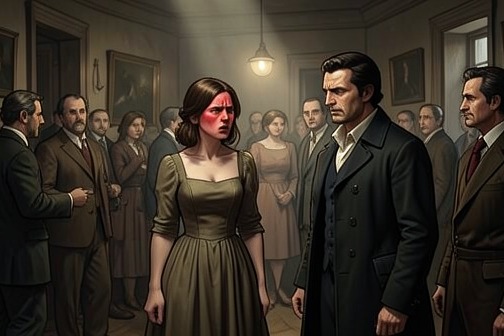
[The Meryton Assembly of 1811](entity:event-recall-event-the-meryton-assembly-of-28b5f0ac7ba6) is the decisive first public encounter between [Elizabeth Bennet](entity:character-recall-character-elizabeth-bennet-f97b53a479cc) and [Fitzwilliam Darcy](entity:character-recall-character-fitzwilliam-darcy-ad3b1ecc1d50), as well as the occasion on which the social world of [Meryton](entity:location-recall-location-meryton-84bf7e41468e) turns observation into conflict. In an overheated Assembly Rooms, Elizabeth Bennet meets the newly arrived Netherfield party, sees Fitzwilliam Darcy as exceptionally handsome, overhears his dismissal of her, and converts wounded attraction into anger. The event establishes the central contrast between appearance and character: Darcy’s beauty attracts Elizabeth before his pride repels her, while the public nature of his insult makes it socially memorable and personally consequential.
## Setting and Social Function
The assembly takes place at the [Meryton Assembly Rooms](entity:location-recall-location-meryton-assembly-roo-ddb016033054) at the beginning of autumn, but the weather remains unseasonably warm. The room is made more oppressive by the mass of bodies, producing a stifling, sweaty atmosphere in which dancing and watching are inseparable. After the first dance, Elizabeth Bennet and [Charlotte Lucas](entity:character-recall-character-charlotte-lucas-5bc2f625c79b) retreat toward the refreshment table for tepid punch whose chill has long since disappeared. The physical discomfort of the room gives the polished rituals of the evening a material edge: the assembly is not an abstract scene of elegance but a crowded, overheated public test.
Charlotte Lucas explains that an assembly is a chance to see and be seen. Dancing is among the few respectable ways for an unrelated man and woman to spend time together, and several dances can become the unofficial beginning of courtship. In a countryside where people believe they already know one another, the event permits unmarried men and women to present themselves differently from their ordinary daily selves. The scarcity of eligible gentlemen makes the ritual more intense. Meryton lies close enough to [London](entity:location-recall-location-london-420923d4a60a) to be convenient, yet not close enough to attract travelers who would rather reach the capital or escape farther from it; the continuing continental war further reduces the supply of eligible men.
## Arrival of the Netherfield Party
The arrival of the Netherfield party interrupts the limited social routine Elizabeth Bennet and Charlotte Lucas know so well. They identify [Charles Bingley](entity:character-recall-character-charles-bingley-d470295e8e11) by his sandy hair and broad smile, while the married couple and the rest of the group become visible among the crowd and refreshments. Elizabeth Bennet, [Jane Bennet](entity:character-recall-character-jane-bennet-1913002c8ec6), and [Mary Bennet](entity:character-recall-character-mary-bennet-3ad0e066a036) are formally presented to Charles Bingley by [Sir William Lucas](entity:character-recall-character-sir-william-lucas-d96a797b4b8a). Charles Bingley then introduces [Caroline Bingley](entity:character-recall-character-caroline-bingley-9475b9ccc779), [Louisa Hurst](entity:character-recall-character-louisa-hurst-38bbbcc04279), [Mr. Hurst](entity:character-recall-character-mr-hurst-6f5f871144ef), and his close friend Fitzwilliam Darcy.
Elizabeth Bennet’s first sight of Fitzwilliam Darcy is momentarily overwhelming. She is transfixed by his handsomeness, flushes while looking at him, and briefly loses track of her mother’s rambling conversation. The attraction is immediate but not yet informed by knowledge of his conduct. This first impression therefore places Elizabeth Bennet in a vulnerable position: before she can judge Darcy’s character, his appearance has already made an impression upon her.
## Darcy’s Insult and Elizabeth’s Response
The encounter changes when Elizabeth Bennet overhears Charles Bingley encouraging Fitzwilliam Darcy to dance. Darcy objects that there is no other woman in the room with whom it would not be a punishment for him to stand. Charles Bingley defends the evening’s company, insisting that several women are unusually pretty. Darcy then acknowledges that Charles Bingley is dancing with the only handsome girl in the room, looking toward Jane Bennet as he says so.
Charles Bingley attempts to draw Darcy’s attention to Elizabeth Bennet, describing her as very pretty and likely agreeable. Darcy is aware that Elizabeth Bennet is being discussed and scrutinizes her before answering. His refusal is not private or tactful. He tells Charles Bingley, "She is tolerable, but not handsome enough to tempt me; I am in no humour at present to give consequence to young ladies who are slighted by other men. You had better return to your partner and enjoy her smiles, for you are wasting your time with me."
The words produce a sharp emotional reversal. Elizabeth Bennet experiences the shock of public dismissal, then recognizes that the insult is worse than a mere failure to receive a dance. She had considered Darcy the most handsome man she had ever met; within less than an hour, he has reduced her in public to being merely tolerable. Her composure, learned partly through dealing with Mrs. Bennet, conceals sadness and anger rather than eliminating either feeling. The insult’s social setting ensures that it can be remembered, repeated, and transformed into a basis for judgment.
Elizabeth Bennet’s anger finally displaces her attraction. She privately brands Darcy an arrogant and pompous man, reasoning that handsome exterior cannot conceal an unpleasant interior. Her decisive inward word is "[Vengeance](entity:concept-recall-concept-vengeance-c2a58c5cf2e0)." It is not spoken aloud, but it becomes the emotional emblem of the assembly: a wounded response to humiliation and the first sign that Elizabeth Bennet will meet Darcy’s hauteur with wit, resistance, and independent judgment.
## Consequences and Narrative Significance
The assembly establishes the initial pattern of Elizabeth Bennet and Fitzwilliam Darcy’s relationship: attraction is immediately entangled with offense, and social performance becomes evidence of moral character. Darcy’s refusal is presented through the ordinary courtship machinery of the dance, yet it exposes his contempt for the local society and his readiness to make a young woman’s inferiority publicly legible. Elizabeth Bennet, in turn, mistakes a single arrogant performance for a complete account of Darcy’s nature, but the mistake is understandable because the assembly makes conduct visible before motives are known.
The event also introduces the broader social network that will shape the plot. Jane Bennet’s beauty attracts Charles Bingley’s notice, while the presence of Caroline Bingley, Louisa Hurst, and Mr. Hurst establishes the relationships and judgments surrounding the Netherfield household. Elizabeth Bennet’s encounter with Fitzwilliam Darcy is therefore not isolated from the marriage market; it is produced by that market’s rituals, scarcity, spectatorship, and pressure to interpret every glance or dance as social evidence.
In the larger structure of the story, the assembly is later recalled alongside the history of [Lady Radha Pentland](entity:character-recall-character-lady-radha-pentland-8550d21cca9a). Lady Radha describes a life that began as Radha Bhimani in [Kutch](entity:location-recall-location-kutch-9cd484dc0f71), was marked by forced migration, kidnapping, attempted enslavement, a pirate attack, confinement in a nunnery outside [Cadiz](entity:location-recall-location-cadiz-6779628989a5), rescue and recovery in [Barbados](entity:location-recall-location-barbados-a285bae3d98a), and eventual marriage to [Sir David Pentland](entity:character-recall-character-sir-david-pentland-9d7df8c780b8). Her history, as Elizabeth Bennet later explains to the Gardiners, gives the assembly’s seemingly narrow concerns a larger counterpoint. The Meryton room is governed by judgments about beauty, eligibility, and reputation, while Lady Radha’s life reveals how women can be judged, displaced, and punished for circumstances imposed upon them. Elizabeth Bennet’s first experience of Darcy’s public dismissal thus becomes part of a wider narrative about social power, female vulnerability, survival, and the need to distinguish a person’s worth from the judgments imposed upon her.
The assembly’s decisive legacy is not the dance that does not occur but the interpretation that follows. Elizabeth Bennet leaves the evening with a grievance and a sharpened view of Darcy; Darcy leaves it having created the very hostility that will later challenge his assumptions. A crowded room, a few overheard exchanges, and one public refusal become the first durable structure of their conflict, making the [Meryton Assembly](entity:action-recall-action-a094673fbf1a) the point at which their eventual relationship begins in antagonism rather than indifference.
Event 10
Jane Bennet’s illness and stay at Netherfield Park
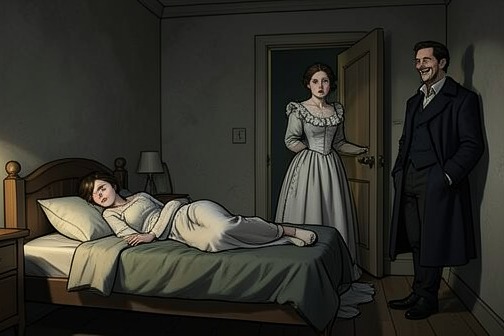
[Jane Bennet’s illness and stay at Netherfield Park](entity:event-recall-event-jane-bennet-s-illness-a-b62a3f80f7a7) is not merely a short domestic interruption: it exposes the Bennet family’s failures of care, places [Elizabeth Bennet](entity:character-recall-character-elizabeth-bennet-f97b53a479cc) in the role of practical protector, and brings the social tensions surrounding [Charles Bingley](entity:character-recall-character-charles-bingley-d470295e8e11)’s household into sustained contact. Jane’s slow recovery changes the immediate movement of the plot, while Elizabeth’s conduct during the illness establishes a contrast between genuine familial responsibility and the calculated politeness of the Netherfield party.
## Causes and Background
[Jane Bennet](entity:character-recall-character-jane-bennet-1913002c8ec6) is twenty-two, and her family already knows that a cold usually develops into a long, slow recovery. Mrs. Bennet nevertheless treats her illness as an opportunity. Because Charles Bingley has been visiting [Longbourn](entity:location-recall-location-longbourn-09a641b38d11) regularly to see Jane, Mrs. Bennet sends Jane to [Netherfield Park](entity:location-recall-location-netherfield-park-5ab7b1301fde) in circumstances designed to prolong contact with him, even though she has little real concern for the danger or discomfort involved. Elizabeth Bennet is particularly angered by this manipulation, since her mother has effectively made Jane’s health serve a matrimonial strategy.
[Thomas Bennet](entity:character-recall-character-thomas-bennet-fdb1df6a4cdd) offers no meaningful corrective. Instead, he jokes that Jane’s possible death would have been for a good cause, a remark that deepens Elizabeth’s sense that both parents have failed their eldest daughter. The illness therefore begins within a household where Jane’s supposed status as her mother’s favorite does not guarantee protection. Affection is expressed as matchmaking pressure, while paternal humor substitutes for responsibility.
## Elizabeth’s Journey and Arrival
Elizabeth Bennet walks from Longbourn to Netherfield Park to see Jane. The path is muddy, and she slips repeatedly, splashing mud over the bottom of her dress and muttering in frustration. Her anger is directed less at the physical hardship than at the indifference that made the journey necessary. Once she reaches Netherfield, however, her annoyance recedes because Jane’s condition matters more than her own appearance or resentment.
Elizabeth initially hopes that Mr. Bingley can be called to the entrance hall so that she may reach Jane without becoming a spectacle. Instead, she is led into the breakfast room, where the assembled members of the Netherfield household turn to look at her. Charles Bingley immediately instructs the housekeeper to take her to Jane, recognizing the seriousness of the situation. Elizabeth spends the day with her sister, apart from a brief visit by [Louisa Hurst](entity:character-recall-character-louisa-hurst-38bbbcc04279) and [Caroline Bingley](entity:character-recall-character-caroline-bingley-9475b9ccc779), and Jane asks her to remain. Charles Bingley agrees, although Caroline’s consent is markedly less generous, and a message is sent to Longbourn for Elizabeth’s trunk.
## The Stay at Netherfield
Elizabeth’s presence at Netherfield is defined by nursing rather than sociability. She spends the day alone with Jane, returns to her repeatedly, and leaves the drawing room to check on her after dinner. The household’s social arrangements make this care more difficult: [Mr. Hurst](entity:character-recall-character-mr-hurst-6f5f871144ef) is absorbed in eating, while Caroline Bingley and Louisa Hurst lavish attention on [Fitzwilliam Darcy](entity:character-recall-character-fitzwilliam-darcy-ad3b1ecc1d50). Elizabeth is largely ignored except by Charles Bingley, yet she refuses to let the atmosphere intimidate her or drive her away from Jane.
Caroline’s hostility centers on Elizabeth’s muddy dress and the family’s social inferiority. Elizabeth hears Caroline criticizing her and later responds by asking Charles Bingley whether he has a Bible she may read. The request is an oblique but deliberate answer to the ridicule: rather than defend her appearance or seek Caroline’s approval, Elizabeth asserts her composure and makes the household’s petty judgments look spiritually and intellectually small.
Jane’s illness also brings the Bennet family’s public behavior under scrutiny. Mrs. Bennet arrives at Netherfield with [Kitty Bennet](entity:character-recall-character-kitty-bennet-e68b587aa3bf) and [Lydia Bennet](entity:character-recall-character-lydia-bennet-0020f0bd0490), while Jane is still recovering. Lydia Bennet presses Charles Bingley about the ball he has promised to hold, declaring that it would be shameful if he failed to keep his engagement. Charles Bingley agrees to hold the ball once Jane has recovered, but Elizabeth slips back into Netherfield by the rear stairs while her relatives depart, leaving the rest of the household to judge their conduct. Her embarrassment is directed not at Jane’s illness but at the spectacle created around it.
## Recovery and the Problem of Departure
After more than two days, Jane’s fever subsides enough to show that she has passed the danger period. Liquids, soup, hot tea, and small meals of solid food help restore her strength, and the sisters hope that Jane may come down to the drawing room after dinner. Elizabeth begins to imagine that the household may soon return to normal and that the sisters can go back to Longbourn the following afternoon.
The practical question of departure remains difficult because Mrs. Bennet will not send the carriage. Elizabeth proposes asking Charles Bingley to lend them his carriage, but Jane hesitates. Since Mrs. Bennet had told him that Jane was still ill, Jane fears that leaving too soon would make her mother appear a liar. Her response reveals how thoroughly the daughters must accommodate their mother’s social designs, even while Jane is recovering from the illness those designs helped produce. Jane chooses instead to rest before coming down to dinner, while Elizabeth goes to look for something to read in the library.
## Consequences and Significance
The stay at Netherfield gives Elizabeth sustained exposure to Caroline Bingley’s contempt and to Fitzwilliam Darcy’s presence. It also intensifies the contrast between the sisters’ conduct: Jane remains gentle and protective of her mother despite the manipulation, while Elizabeth becomes increasingly alert to the cruelty concealed by polished manners. Her nursing is active, stubborn, and materially grounded; she walks through bad weather, stays when Jane needs her, manages the question of transport, and refuses to abandon her sister to the household’s social pressures.
The episode also establishes a broader pattern in which women’s bodies are made to carry the consequences of family ambition and social judgment. Jane’s health is treated as a means of securing Charles Bingley’s attention, Caroline condemns Elizabeth for the mud produced by her act of care, and the arrival of Kitty and Lydia turns illness into an occasion for social performance. Against these distortions, Elizabeth’s behavior presents care as an ethical practice rather than a decorative sentiment. Years later, Elizabeth’s account of the lessons learned from Jane’s tenant visits and from [Lady Radha Pentland](entity:character-recall-character-lady-radha-pentland-8550d21cca9a) confirms the importance of practical responsibility: health, welfare, and daily assistance matter more than the appearance of gentility. Jane’s illness at Netherfield is therefore an early, concrete instance of the principle that Elizabeth later makes explicit—that a household’s true character is shown by how it cares for those who depend on it.
Event 11
Elizabeth Bennet’s confrontation with Caroline Bingley at Netherfield
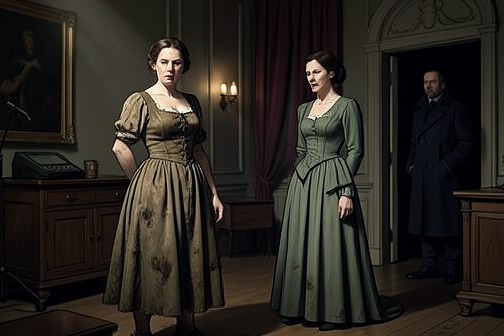
[Elizabeth Bennet’s confrontation with Caroline Bingley at Netherfield](entity:event-recall-event-elizabeth-bennet-s-conf-f55ecf9621ea) is a decisive scene in which a dispute over dress, address, and social rank becomes a contest over who may define acceptable womanhood. Elizabeth refuses to be intimidated, uses the authority of Scripture against Caroline’s religious and social pretensions, and leaves [Fitzwilliam Darcy](entity:character-recall-character-fitzwilliam-darcy-ad3b1ecc1d50) both amused and unsettled by the force of her independence. The encounter gives [Caroline Bingley](entity:character-recall-character-caroline-bingley-9475b9ccc779) a humiliation she cannot forgive and gives Darcy an early, complicated view of the woman who fascinates him precisely because she will not submit to his world’s hierarchies.
## Causes and Setting
Elizabeth arrives at [Netherfield Park](entity:location-recall-location-netherfield-park-5ab7b1301fde) after walking there to attend [Jane Bennet](entity:character-recall-character-jane-bennet-1913002c8ec6), who is seriously ill. Her annoyance at her parents has subsided because Jane’s needs take precedence, and she spends the day nursing her sister, remaining largely separate from the household’s social life. When she returns to the drawing room, she has already heard Caroline’s comments from the other side of a closed door. Caroline has been discussing Elizabeth in a dismissive manner, including a complaint about the mud on her dress and the condition of her appearance after the walk.
Elizabeth’s decision to re-enter the room is therefore deliberate. She considers retiring for the night but rejects the idea of being driven away by Caroline Bingley. The issue is not merely that Caroline is unkind. Her criticism reduces Elizabeth to a country visitor whose clothing and manner may be inspected, mocked, and ranked before an audience that includes [Charles Bingley](entity:character-recall-character-charles-bingley-d470295e8e11), [Louisa Hurst](entity:character-recall-character-louisa-hurst-38bbbcc04279), [Mr. Hurst](entity:character-recall-character-mr-hurst-6f5f871144ef), and Fitzwilliam Darcy. Elizabeth answers that social aggression by refusing its terms: rather than defend the hem of her dress, she redirects attention toward Caroline’s conduct.
## The Biblical Counterattack
Elizabeth begins with an apparently courteous request to Charles Bingley: “Good evening again. Mr. Bingley do you happen to have a Bible I may read?” When he asks whether she has a particular passage in mind, she answers, “Yes, I am going to read the Gospel of Luke, Chapter 10.” The reference is pointed because the chapter contains the Parable of the Good Samaritan, a story about compassion toward a suffering stranger and the failure of respectable observers to act with mercy.
The request immediately silences the room. Fitzwilliam Darcy alone understands the reference and nearly laughs into his brandy, coughing instead. Elizabeth’s apparent Bible study thus works on two levels: it distracts the company while also placing Caroline’s behavior under a moral judgment that Caroline cannot easily challenge without exposing herself. Elizabeth quietly reads, allowing Caroline’s discomfort to grow.
Caroline then asks, “Miss Eliza, why are you reading the Bible?” Elizabeth closes the book carefully and first addresses the form of Caroline’s insult. She reminds Caroline that she had already explained that only her closest neighbors and long-standing friends were entitled to call her by that name. Elizabeth insists that “My name is Miss Elizabeth,” and adds that remembering this is “the most basic requirement of an acceptable hostess.” The correction is not trivial. Caroline’s shortened form of Elizabeth’s name is treated as a claim of intimacy and superiority, while Elizabeth reasserts the boundary between genuine familiarity and deliberate condescension.
Elizabeth then explains her reading: “I had thought you a good Christian. I am reading the Parable of the Good Samaritan. Shall I have the vicar at St. Alfred’s visit for some Bible study?” The line converts Caroline’s public performance of refinement and Christianity into evidence against her. Caroline’s face reddens as though she had been struck, and Elizabeth returns to the Bible, refusing to continue the exchange on Caroline’s preferred ground. Her silence afterward is part of the victory: Caroline is left to rage while Elizabeth declines to provide further material for attack.
## Immediate Reactions and Moral Tension
The confrontation produces a rare silence in the drawing room. Elizabeth feels both smug satisfaction and mortification. She is pleased to have chastised Caroline, yet she knows the scene has not represented the conduct of a perfectly composed lady. Her self-assessment is exacting: if she expects other people to meet high standards, she cannot simply excuse herself when anger makes her cross the line.
Elizabeth decides that correcting “Miss Eliza” was justified because Caroline had been told privately and discreetly not to use it. The sharper accusation, that Caroline might need instruction in being a good Christian, troubles Elizabeth more. That distinction reveals the ethical structure of the scene. Elizabeth’s objection to Caroline’s address concerns dignity and consent; her religious taunt is an act of retaliation. She can defend the first as a necessary boundary, but she recognizes the second as excessive even while enjoying its effect.
Fitzwilliam Darcy’s reaction contains the same tension. He is delighted by Caroline’s spectacular humiliation and wishes, despite his own inability to say such things, that he had delivered the retort himself. At the same time, he understands that Elizabeth has gone too far. Caroline’s earlier description of Elizabeth as possessing a “conceited independence” returns to his mind. He sees that the phrase is imperfect but suggestive: Elizabeth is burning a bridge and does not care whether Caroline approves of her.
Caroline Bingley interprets the event in the opposite way. She ignores the fact that her own mockery provoked the response and imagines Elizabeth as an insolent country girl who has insulted her in her own house and humiliated her before Darcy. Her anger becomes a project of correction. She intends to force Elizabeth back into the position Caroline believes she occupies, revealing how social manners can serve not mutual respect but the enforcement of rank.
## Consequences and Narrative Significance
The encounter deepens the hostility between Elizabeth and Caroline Bingley. Elizabeth’s success is immediate but not uncomplicated: she protects her name and dignity, yet the public nature of the rebuke makes reconciliation less likely. Caroline’s resentment is intensified because her brother does not come to her defense and because the humiliation occurs before Fitzwilliam Darcy, whose opinion she wants to control.
For Darcy, the scene is an early demonstration that Elizabeth’s independence is not passive self-possession. It is active, verbal, and willing to incur social cost. He is attracted by the very quality that makes her difficult to manage, while also recognizing that her wit can become a weapon. The confrontation therefore anticipates the larger movement of their relationship: admiration must be accompanied by moral reconsideration, and attraction cannot survive unless both characters learn to distinguish genuine principle from wounded pride.
The episode also exposes the instability of Caroline’s social authority. She possesses the setting, the family connection, and the confidence of someone accustomed to judging others, but Elizabeth briefly reverses the arrangement by making Caroline answerable to the standard she claims to represent. The Bible becomes more than a prop. In Elizabeth’s hands it is a social instrument, a moral mirror, and a means of refusing the idea that gentility belongs automatically to the wealthier or more polished party. The scene’s lasting significance lies in that reversal: Elizabeth does not win by becoming socially powerful, but by making Caroline’s conduct visible.
Event 12
The Netherfield Ball
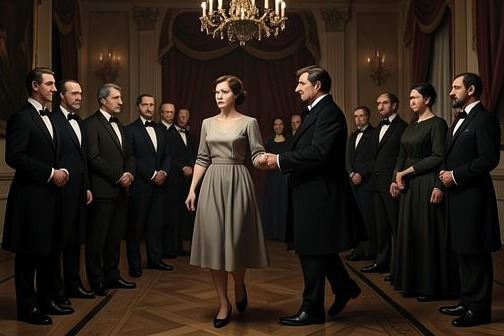
[The Netherfield Ball](entity:event-recall-event-the-netherfield-ball-e886326faf28) transforms an ostensibly elegant country entertainment into a public trial of manners, loyalties, and social power. [Elizabeth Bennet](entity:character-recall-character-elizabeth-bennet-f97b53a479cc) refuses both [William Collins](entity:character-recall-character-william-collins-a95fe9afaea4)’s and [Fitzwilliam Darcy](entity:character-recall-character-fitzwilliam-darcy-ad3b1ecc1d50)’s invitations, witnesses the Bennet family’s humiliations and the Netherfield party’s indifference, then openly rebukes [Caroline Bingley](entity:character-recall-character-caroline-bingley-9475b9ccc779) and the gentlemen who allow the evening to deteriorate. Her decision to leave [Netherfield Park](entity:location-recall-location-netherfield-park-5ab7b1301fde) with [Jane Bennet](entity:character-recall-character-jane-bennet-1913002c8ec6) at first light gives the event its decisive consequence: a ball that should have consolidated connections instead hardens resentments, exposes concealed judgments, and becomes one of the principal causes of Elizabeth and Darcy’s continuing misunderstanding.
## Setting and Social Performance
The ball is staged as a performance before an audience already familiar with the roles its participants are expected to play. The arrival of the Netherfield party resembles a troupe of players coming to perform a known drama. [Mr. Hurst](entity:character-recall-character-mr-hurst-6f5f871144ef) immediately makes for the refreshment table, while Caroline Bingley and [Louisa Hurst](entity:character-recall-character-louisa-hurst-38bbbcc04279) move through the room with frozen, sneering expressions, converting their smugness into active social offence. Darcy extracts his arm from Caroline’s grasp and retreats to the edge of the room, physically present but socially detached. [Charles Bingley](entity:character-recall-character-charles-bingley-d470295e8e11), by contrast, heads directly toward Jane with boyish excitement, almost oblivious to the conduct of the rest of his party. The spatial arrangement makes the evening’s hierarchy visible: Caroline seeks possession of Darcy’s attention, Darcy refuses ordinary sociability, Bingley pursues Jane, and Elizabeth watches the entire system with increasingly disbelieving attention.
Elizabeth is asked to perform at the piano and plays a short piece followed by an aria. Her performance is warmly received, even though it is technically less accomplished than Caroline’s. The contrast is not merely musical. Elizabeth’s playing is warm and inclusive, whereas Caroline’s later performance is cold, exact, and designed to display superior training. Caroline glares at Elizabeth throughout her own performance and responds to the applause with a false smile, turning artistic accomplishment into another contest for rank. [Mary Bennet](entity:character-recall-character-mary-bennet-3ad0e066a036) then follows Caroline and is placed at an immediate disadvantage: she and Elizabeth are largely self-taught, while Caroline has benefited from a master’s instruction. [Lydia Bennet](entity:character-recall-character-lydia-bennet-0020f0bd0490) and Mrs. Bennet compound Mary’s embarrassment by demanding music for dancing and treating her concertos as an obstacle to amusement. The piano therefore becomes a miniature version of the ball itself, where every act of participation is judged according to class, polish, and the ability to command attention.
## Elizabeth’s Refusal of Darcy
Elizabeth’s central action occurs when she moves near [Sir William Lucas](entity:character-recall-character-sir-william-lucas-d96a797b4b8a), who is speaking at Darcy rather than engaging him in a genuine exchange. Sir William reaches for Elizabeth’s hand and tries to present her to Darcy as a desirable partner, assuming that neither party can properly refuse the social arrangement he is creating. Elizabeth immediately withdraws and states, "Indeed, sir, I have not the least intention of dancing. I entreat you not to suppose that I moved this way in order to beg for a partner." Her words reject not only the dance but also the presumption that a woman’s movement through a room can be interpreted as a request for male attention.
Darcy makes a grave and formally proper request for the honour of her hand, with Sir William pressing the invitation on his behalf. Elizabeth answers, "Mr. Darcy is all politeness. But I would not want him to have to tolerate my company for so long." She then gives a curtsey and walks away without waiting for a response. The refusal reverses the expected social value of the scene. Darcy’s rank, wealth, and reputation should make his invitation a privilege; Elizabeth treats it as an obligation she has no desire to accept. Her refusal is controlled rather than openly insulting, but its effect is severe because it denies Darcy the automatic authority he assumes his status gives him.
Darcy is left genuinely confounded. He has been refused by a young woman and cannot initially understand how she could dismiss a man who is the grandson and nephew of an earl. He retreats to the wall, criticizes Elizabeth’s manners, and then recognizes that he himself has refused to dance at the Assembly. The recognition does not yet produce humility; instead, he concludes that Elizabeth is beneath him and that her rejection was a fortunate escape. His judgment is immediately complicated by jealousy when he sees Bingley dancing with Jane. The ball thus gives Darcy two contradictory impressions of Elizabeth: she appears socially improper because she will not submit to his invitation, yet her independence also becomes inseparable from his attention and resentment.
## The Ball’s Accumulating Fiasco
The evening’s damage is cumulative. Elizabeth later recounts that she had refused Collins’s request for the first dance and then sat out the entire night. Jane also refuses Bingley’s request for the first dance and sits beside Elizabeth, leaving Mrs. Bennet furious and treating Elizabeth as responsible for the social disappointment. Elizabeth is then able to refuse Darcy as well, making the sequence a striking pattern of women declining dances that men and families regard as socially valuable. The refusals interrupt the expected progression from public dance to courtship and expose the difference between a woman’s consent and the marriage-market ambitions imposed upon her.
Other incidents turn the ball into a farce of collapsing propriety. Collins addresses Darcy without an introduction and drones on about Darcy’s aunt, [Catherine de Bourgh](entity:character-recall-character-catherine-de-bourgh-b7f4e7ab5e16), who is his patron. Mary’s nervous performance suffers before the assembled guests, and [Thomas Bennet](entity:character-recall-character-thomas-bennet-fdb1df6a4cdd) embarrasses her while attempting to make her stop. [Kitty Bennet](entity:character-recall-character-kitty-bennet-e68b587aa3bf) and Lydia flirt with men in red coats after drinking too much, and Lydia eventually waves a sword apparently belonging to one of the officers. Mrs. Bennet has a loud argument with Lady Lucas about the supposedly imminent betrothal of Jane and Bingley, despite Jane’s refusal to dance with him. These episodes make the family’s private disorder publicly legible and place Elizabeth in the painful position of being judged through conduct she cannot control.
Darcy’s own conduct is no refuge. [George Wickham](entity:character-recall-character-george-wickham-93fa026a5574), then Lieutenant Wickham, confronts him with wild allegations. Darcy refutes the lies, but in doing so admits that he knows Wickham to be a liar, a cheat who has defrauded honest shopkeepers, and a serial seducer with several natural children. He nevertheless has not discreetly warned the local tradesmen. Elizabeth interprets this omission as selfish pride: Darcy possesses knowledge that might protect vulnerable people but considers the shopkeepers beneath his notice. The confrontation therefore damages Darcy in Elizabeth’s eyes even while he is defending himself. His truthfulness about Wickham cannot overcome the moral failure of refusing to act on what he knows.
## Caroline Bingley and the Final Confrontation
The evening continues after the dancing with the Netherfield party’s failure to recognize its own obligations as hosts. Caroline repeatedly redirects her attention from Jane to Darcy and interrupts him while he attempts to write to [Georgiana Darcy](entity:character-recall-character-georgiana-darcy-1674b422333a). When Mr. Hurst wakes and demands a card game, Darcy declines because his letter remains unfinished, and Bingley refuses because he is talking with Jane. The remaining players turn to Elizabeth as though she should accept their convenience after enduring the evening’s insults. She declines politely, but Hurst remarks, "You prefer reading to cards? That is singular." Caroline then characterizes her in a deliberately reductive manner: "Miss Eliza Bennet despises cards. She is a great reader and has no pleasure in anything else."
Caroline’s statement provokes Elizabeth into the most direct speech of the night. Elizabeth calls her either "unpardonably rude" or "an imbecile," demands that she address her correctly, and rejects Caroline’s claim to know what she despises or enjoys. She asks whether Caroline is a prophet or the False Prophet, a comparison Caroline experiences as an accusation that she is devilish. Elizabeth then announces, "I will retire now. It has been a very enlightening evening." The phrase is formally restrained but unmistakably condemning: the ball has taught her not about elegance but about the character of the people who have hosted it.
Before leaving, Elizabeth addresses the three gentlemen and condemns their silence. She says that it has been instructive to watch the behaviour of so-called gentlemen and adds, "your fathers would be so proud." The rebuke identifies the evening’s deepest failure as collective rather than individual. Caroline’s malice, Hurst’s obtuseness, Bingley’s passivity, and Darcy’s self-absorption have been enabled by men who allow women and guests to be mistreated while preserving the appearance of civility. Elizabeth’s speech breaks the etiquette that has concealed the abuse, making the performance of gentility answerable to the conduct beneath it.
## Departure and Narrative Consequences
Elizabeth and Jane leave the drawing room together. At the top of the stairs, Elizabeth tells Jane that she will pack her trunk, keep only an outfit for the morning, sleep in Jane’s room, and leave at first light. They pack within minutes, lock the door, and escape Netherfield Park before sunrise. Jane is inelegantly bundled up, but the early departure is preferable to remaining in a house where hospitality has become humiliation. Their flight gives physical form to Elizabeth’s judgment: rather than continue performing gratitude toward people who have failed them, the sisters remove themselves from the scene.
The ball becomes a major source of Elizabeth’s later understanding of Darcy and the Bingley circle. She remembers it as an evening of refusals, family embarrassment, Wickham’s accusations, and Darcy’s exposed pride. When she later recounts it to [Edward Gardiner](entity:character-recall-character-edward-gardiner-ff481a4f187c) and [Madeline Gardiner](entity:character-recall-character-madeline-gardiner-932ce19b654c), she presents the event as a disastrous social spectacle whose high point was being able to turn down Collins and Darcy before everything collapsed. Darcy’s own recollection is equally formative. He remembers that Elizabeth and Jane both refused the first dances, that Elizabeth had deliberately sat out the night, and that he himself approached her afterward to ask about Wickham. He recognizes that he was drawn toward the very person whose opinion he feared, comparing himself to a moth unable to resist a flame.
The event’s narrative significance lies in its reversals. A ball intended to display refinement exposes cruelty; Darcy’s invitation, meant to express formal politeness, becomes a test Elizabeth refuses; Wickham’s attack, meant to control the story of their conflict, reveals Darcy’s failure to protect others; and the Netherfield party’s effort to preserve social ease ends with Elizabeth and Jane abandoning the house. The Netherfield Ball therefore does not advance courtship through harmonious dancing. It establishes the conditions under which later courtship must become more honest: Elizabeth must distinguish independence from impropriety, while Darcy must learn that rank without responsibility is only another form of bad manners.
Event 13
The departure of the Netherfield party
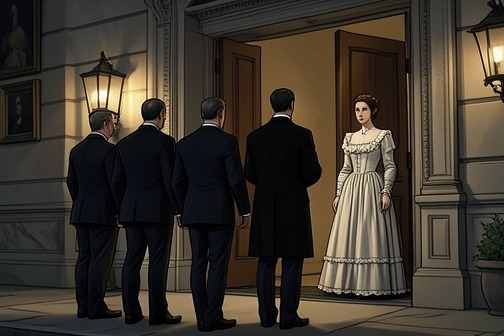
[The departure of the Netherfield party](entity:event-recall-event-the-departure-of-the-ne-8404d5e02ea5) is not merely a change of residence. After the [1811](entity:time-recall-time-1811-7a471bcec2f1) [Meryton Assembly](entity:action-recall-action-a094673fbf1a), [Charles Bingley](entity:character-recall-character-charles-bingley-d470295e8e11), [Caroline Bingley](entity:character-recall-character-caroline-bingley-9475b9ccc779), [Louisa Hurst](entity:character-recall-character-louisa-hurst-38bbbcc04279), and [Mr. Hurst](entity:character-recall-character-mr-hurst-6f5f871144ef) leave [Netherfield Park](entity:location-recall-location-netherfield-park-5ab7b1301fde) with remarkable speed and little regard for the people or estate they leave behind. Their withdrawal removes the immediate social excitement from [Hertfordshire](entity:location-recall-location-hertfordshire-3be0dd22bb53), but it also reveals a deeper failure of responsibility: the newly acquired house is treated as a convenience to be closed, its servants dismissed, and its tenants left without guidance. The event becomes a turning point in [Jane Bennet](entity:character-recall-character-jane-bennet-1913002c8ec6)’s understanding of Charles Bingley and in [Elizabeth Bennet](entity:character-recall-character-elizabeth-bennet-f97b53a479cc)’s determination to leave [Longbourn](entity:location-recall-location-longbourn-09a641b38d11), while [Fitzwilliam Darcy](entity:character-recall-character-fitzwilliam-darcy-ad3b1ecc1d50) is left to reconsider both his friend and his own conduct in Hertfordshire.
## The Sudden Withdrawal
The departure follows a disastrous week in which [William Collins](entity:character-recall-character-william-collins-a95fe9afaea4) has been irritating, self-important, petulant, and petty, while the tensions surrounding the Netherfield household have steadily intensified. Rather than Charles Bingley returning alone to [London](entity:location-recall-location-london-420923d4a60a), the entire Netherfield party abandons the house within two days of the ball. There are no courtesy calls, no adequate explanation, and no proper instructions for the steward. Caroline Bingley closes Netherfield Park, dismisses all but the core servants, and leaves for London with the Hursts. The action is therefore both social and administrative: the household vanishes from the neighborhood, and the estate is placed into a state of suspended, uncertain management.
The party’s stated intention makes the withdrawal more deceptive. Charles Bingley had suggested that he would be in London for only three or four days before returning to spend the [Christmas](entity:time-recall-time-christmas-a573265d0167) period at Netherfield Park. Instead, Caroline Bingley orders the house closed less than a day after Charles Bingley and Fitzwilliam Darcy depart. More than a month later, Charles Bingley has still not returned, and the residents of [Meryton](entity:location-recall-location-meryton-84bf7e41468e) begin to question who, if anyone, has truly been acting as master of Netherfield. The gap between the promise of a brief absence and the reality of abandonment turns an apparently temporary departure into a public embarrassment.
## Neglected Estate and Social Disorder
The consequences are most visible among Netherfield’s tenants. When Elizabeth Bennet, Jane Bennet, and [Mary Bennet](entity:character-recall-character-mary-bennet-3ad0e066a036) continue their visits to tenants in preparation for winter, they also check on those nearest Netherfield Park because the two estates border one another. The tenants report that Charles Bingley left no instructions for dealing with them. The sisters write notes to the steward about the problems they find, and the steward thanks them for their Christian neighbourliness. Their intervention is practical rather than ceremonial: they respond to needs that the estate’s owner has failed to anticipate.
This neglect gives the departure a significance beyond local gossip. Charles Bingley possesses the social title and economic position associated with landed responsibility, but his conduct suggests that he has not understood the obligations attached to them. Fitzwilliam Darcy reaches the same conclusion while reflecting in London. He sees that Charles Bingley was enthusiastic when he first arrived at Netherfield, yet seemed unable to manage even a modest estate, much less a substantial one. Caroline Bingley wants the privileges of belonging to the landed gentry without accepting its responsibilities, and Fitzwilliam Darcy suspects that Charles Bingley is not wholly different. The closed house becomes a visible emblem of that contradiction.
## Jane Bennet’s Changed Judgment
The departure also transforms the effect of [Caroline Bingley’s letter to Jane Bennet](entity:object-recall-object-caroline-bingley-s-let-3d6f36ebcf1d). The letter arrives on the day Caroline Bingley leaves Netherfield Park and is presented as an explanation, but it does not explain the departure. Instead, it sets out what Caroline Bingley wants to happen rather than what has actually happened, and it is described as insincere and filled with lies. Jane Bennet, Mary Bennet, and Elizabeth Bennet examine it together and count more than ten falsehoods in a single letter.
Two months earlier, Elizabeth Bennet would have expected such a letter to devastate Jane Bennet. By the time Jane reads it, however, her understanding has changed enough for her to struggle not with grief but with amusement. Mary Bennet’s dismissal, "Good riddance to bad rubbish," captures the new atmosphere. The sisters’ counting of the letter’s lies converts Caroline Bingley’s attempt at social manipulation into an object of collective scrutiny. The departure thus marks a movement in Jane Bennet from trusting disappointment toward clearer judgment, even though the emotional history surrounding Charles Bingley remains important.
## Elizabeth Bennet and Fitzwilliam Darcy After Netherfield
For Elizabeth Bennet, the Netherfield party’s departure removes one set of external distractions but leaves the pressures at Longbourn intact. With Charles Bingley, Caroline Bingley, Louisa Hurst, and Mr. Hurst gone, and William Collins also absent, Elizabeth feels that she must escape Longbourn itself. She walks out in darkness and rain, half-willing to catch a cold simply to gain relief from the house, although she recognizes that confinement would soon make her restless. The departure therefore produces no peace at home; it clears the neighborhood while intensifying the domestic strain.
In London, Fitzwilliam Darcy reviews the preceding months, including the damage caused by his poorly researched decision to hire Mrs. Younge, the severe effect of [Georgiana Darcy](entity:character-recall-character-georgiana-darcy-1674b422333a)’s crisis, and the problem created by [George Wickham](entity:character-recall-character-george-wickham-93fa026a5574)’s presence in the Militia near Meryton. Charles Bingley’s sudden departure adds another unresolved responsibility. Fitzwilliam Darcy encounters Charles Bingley briefly at their club and learns that Caroline Bingley has closed Netherfield Park and that the party will remain in London until at least the [New Year](entity:time-recall-time-new-year-3081c4d3858f). Charles Bingley hurries away to another appointment, leaving Fitzwilliam Darcy with questions about the estate’s arrangements.
The event also feeds Fitzwilliam Darcy’s troubled reflection on Elizabeth Bennet. He remembers her confrontation with Caroline Bingley, judging it fierce and even vicious while recognizing that she should not have been forced to respond alone when three gentlemen failed to stop Caroline Bingley’s conduct. The departure leaves him with no easy resolution: Charles Bingley has failed as an estate manager, Caroline Bingley has acted deceptively, and Elizabeth Bennet’s aggression has exposed the passivity of the men around her. The withdrawal from Netherfield consequently becomes part of Fitzwilliam Darcy’s moral reappraisal rather than a self-contained social episode.
## Broader Significance
The Netherfield departure exposes the difference between social display and durable stewardship. Netherfield Park represents newly acquired gentility, but the closed house, discharged servants, and absent instructions reveal how fragile that performance is when separated from daily work. Elizabeth Bennet’s later account of estate management makes the contrast explicit: the welfare of tenants is the responsibility of the master of the estate, and Charles Bingley was told this but never grasped it. Her own experience of tenant visits at Longbourn, strengthened by lessons learned from [Lady Radha Pentland](entity:character-recall-character-lady-radha-pentland-8550d21cca9a) and from visits to tenants at [Grenadine Reef](entity:location-recall-location-grenadine-reef-ad0be7a0e4a4), gives the criticism practical force.
The event also reveals how women preserve social and material continuity when men retreat. Elizabeth Bennet, Jane Bennet, and Mary Bennet inspect the tenants and communicate with the steward; Caroline Bingley, by contrast, uses a letter to control appearances while abandoning the estate. The departure therefore reverses the expected hierarchy of competence. The nominal master and his household withdraw, while the Bennet sisters perform the obligations that should have belonged to the owner.
Finally, the departure operates as a narrative hinge. It closes the first intense period of contact between Hertfordshire and Netherfield Park, but it does not settle the relationships formed there. Charles Bingley’s absence sharpens Jane Bennet’s disillusionment, Caroline Bingley’s evasions become easier to identify, and Fitzwilliam Darcy’s uncertainty about both Charles Bingley and Elizabeth Bennet deepens. What leaves Hertfordshire is a fashionable party; what remains is a set of unresolved moral, emotional, and practical consequences.
Event 14
Elizabeth Bennet’s rejection of Mr. Collins
[Elizabeth Bennet’s rejection of Mr. Collins](entity:event-recall-event-elizabeth-bennet-s-reje-50558e0dfd93) is one of the clearest early tests of her independence. Faced with the man who will inherit [Longbourn](entity:location-recall-location-longbourn-09a641b38d11), whose position as a clergyman is reinforced by [Lady Catherine de Bourgh](entity:character-recall-character-lady-catherine-de-b-81c73654629a)’s patronage, and whose proposal is urged by Mrs. Bennet as a practical necessity, Elizabeth refuses to let property, family anxiety, or male insistence define her future. The refusal is not merely a failed courtship: it establishes that her spoken consent has authority even when the surrounding household treats it as an obstacle.
## The Arrival of an Unwelcome Heir
Mr. Collins enters Elizabeth’s life with almost no warning. [Thomas Bennet](entity:character-recall-character-thomas-bennet-fdb1df6a4cdd) tells Mrs. Bennet, only four hours before the visit, that the heir to Longbourn has invited himself to stay, although Thomas Bennet has known about the visit for weeks. His timing briefly diverts Mrs. Bennet’s anger away from Elizabeth, but the respite does not last. Thomas Bennet reads aloud Mr. Collins’s letter, whose elaborate language combines servility toward his patroness with inflated self-importance. Mr. Collins presents himself as bringing an olive branch to the Bennet family, yet Elizabeth hears the phrase as ominous rather than conciliatory, while [Mary Bennet](entity:character-recall-character-mary-bennet-3ad0e066a036) finds it promising.
The man himself proves worse than the letter. Mr. Collins uses ten words where one would suffice and becomes especially verbose whenever he discusses Lady Catherine de Bourgh and the “benevolent condescension of Lady Catherine de Bourgh.” His inheritance, clerical office, and aristocratic connection combine into what Elizabeth experiences as oily self-importance. He is excessively familiar with her and leaves her no real peace except in her bedroom, while Mrs. Bennet repeatedly demands that Elizabeth stop retreating there. The situation reverses the familiar pattern of [Caroline Bingley](entity:character-recall-character-caroline-bingley-9475b9ccc779)’s fawning attention toward [Fitzwilliam Darcy](entity:character-recall-character-fitzwilliam-darcy-ad3b1ecc1d50): here, a man imposes himself upon a woman, and the household treats her discomfort as less important than the advantages he represents.
## The Proposal and the Refusal
Elizabeth’s unease grows as Mr. Collins’s attentions continue. On the morning after the Netherfield Ball, three weeks after the event itself, he chooses what he considers the perfect moment to propose. His proposal is described as nearly the most appalling in the history of marriage, surpassed only by the comparison’s exaggerated reference to the Trojan War. The comic scale of the description does not lessen the pressure placed upon Elizabeth. Mr. Collins’s long-winded speeches make the proposal an ordeal rather than an exchange between two consenting people.
Elizabeth refuses him, but Mr. Collins refuses to believe the refusal. He interprets her clear rejection as a conventional feminine performance intended to increase his ardour and claims that she cannot truly mean what she says. His response exposes the central conflict: Elizabeth speaks as an autonomous woman, while Mr. Collins translates her words into a script in which a woman’s “no” is merely an invitation to persist. His dismissal of her stated wishes makes her first nauseous, because she imagines the prospect of his fervour, and then intensely angry. The anger is specifically directed at being overruled by a man who assumes that his interpretation of her desire is more authoritative than her own.
Mrs. Bennet intensifies the confrontation. She is vehemently in favour of the marriage because she wants Elizabeth to remain at Longbourn, and Elizabeth’s happiness is treated as irrelevant beside the practical security of the estate. Mrs. Bennet nearly drags Elizabeth before Thomas Bennet, forcing the matter into the family’s centre. Thomas Bennet supports Elizabeth’s refusal, though he also toys with both Mrs. Bennet and Mr. Collins before the dispute ends. Elizabeth eventually escapes to her bedroom and weeps from frustration, not because she regrets refusing, but because her plainly expressed decision has required such a struggle to defend.
## Consent Against Inheritance and Maternal Pressure
The proposal makes visible the legal and economic structure behind Elizabeth’s predicament. Mr. Collins is not simply an unsuitable suitor; he is the man positioned to inherit Longbourn. His claim gives him unusual authority within the Bennet household and makes Mrs. Bennet regard marriage to him as a solution to the family’s vulnerability. The inheritance system therefore turns Elizabeth’s body and future into instruments of estate management. A marriage that might preserve her residence is presented as more important than whether she can respect or love the man who proposes it.
Elizabeth’s refusal rejects that calculation. She does not accept that the prospective heir’s status, his association with Lady Catherine de Bourgh, or the danger facing the Bennet family can purchase her consent. The conflict also exposes a gendered asymmetry: Mr. Collins can speak at length, press his suit, and redefine Elizabeth’s answer, while Elizabeth must repeatedly defend the legitimacy of her own words. Her rejection restores the meaning of consent by insisting that a woman’s decision remains a decision even when it frustrates family strategy.
The episode’s irony lies in Mrs. Bennet’s claim to defend the family while treating one daughter’s happiness as expendable. Her repeated declaration that she will “never speak to Lizzy again” is undermined by the fact that she says it at least five times a day. The threat is thus both coercive and ineffective: Mrs. Bennet attempts to punish Elizabeth through emotional withdrawal, yet her inability to maintain silence reveals how completely the household remains entangled in the conflict.
## [Charlotte Lucas](entity:character-recall-character-charlotte-lucas-5bc2f625c79b) and the Immediate Consequence
Elizabeth’s refusal is followed only three days later by Charlotte Lucas’s acceptance of Mr. Collins’s proposal. Charlotte Lucas’s decision gives Elizabeth’s rejection an immediate social and personal contrast. Elizabeth tries to conceal her opinion from her friend, though even suppressing the question of whether Charlotte Lucas is acting irrationally is difficult. The friendship is strained because the same proposal that Elizabeth experiences as intolerable offers Charlotte Lucas a form of security that she is willing to accept.
Mrs. Bennet interprets the outcome as further proof that Elizabeth has acted disastrously. In her imagination, Charlotte Lucas will become the next mistress of Longbourn, and Mrs. Bennet will eventually be driven into the hedgerows by the Collins household before Thomas Bennet’s body is cold in the grave. Elizabeth is blamed for this anticipated displacement because she refused the man who might have kept her at home. The consequence reveals the social cost of female refusal: even when a woman preserves her freedom, relatives may define the resulting loss of comfort or status as her fault.
The rejection also contributes to Elizabeth’s sense that the autumn of [1811](entity:time-recall-time-1811-7a471bcec2f1) has become increasingly oppressive. The [Netherfield Park](entity:location-recall-location-netherfield-park-5ab7b1301fde) party arrives and departs, the Militia comes to the neighbourhood, Mr. Collins arrives, and Charlotte Lucas is positioned to become the next mistress of Longbourn. Against this accumulation of external noise, Elizabeth experiences the mornings at [Grenadine Reef](entity:location-recall-location-grenadine-reef-ad0be7a0e4a4) as oases of calm and intelligent conversation. Her need for that refuge clarifies the emotional significance of the rejection: refusing Mr. Collins is one act within a larger effort to preserve a life in which her judgment, peace, and inward freedom are not continually invaded.
## Narrative Significance
Elizabeth Bennet’s rejection of Mr. Collins establishes a governing contrast between marriage as transaction and marriage as chosen partnership. Mr. Collins offers social and material convenience while displaying no capacity to hear Elizabeth accurately; Mrs. Bennet supports the match because it appears to protect the estate; Elizabeth alone insists that the arrangement cannot be justified without her willing participation. The scene therefore makes her independence costly, immediate, and practical rather than merely rhetorical.
The event also prepares the larger pattern of Elizabeth’s development. She can be polite to new acquaintances, pleasant in company, and outwardly composed, but propriety does not require her to accept over-familiarity or surrender her wishes. Her refusal, the tears that follow the family confrontation, and the later pressure produced by Charlotte Lucas’s acceptance together show that autonomy is not effortless. It is a position Elizabeth must actively defend against male persistence, maternal manipulation, inheritance law, and the fear of losing her place in her own home. In that sense, the rejection is both a personal boundary and an argument: a woman’s future cannot become just simply because it is convenient for everyone else.
Event 15
The death of George Wickham

[The death of George Wickham](entity:event-recall-event-the-death-of-george-wic-97965d0ef46b) is a decisive punitive turn in the story: a man who has endangered women, accumulated debts, and moved through society by charm and deception is found dead in the [River Lea](entity:location-recall-location-river-lea-67a35fdb05b8). Although the immediate evidence points to an accidental drowning after theft and drunkenness, the event carries the force of an unofficial reckoning. It removes a continuing threat from the local community, confirms the dangers attached to Wickham’s habits, and exposes the unstable boundary between justice, vengeance, and chance.
## Causes and Background
The news arrives at [Longbourn](entity:location-recall-location-longbourn-09a641b38d11) through [Lydia Bennet](entity:character-recall-character-lydia-bennet-0020f0bd0490), who runs from [Meryton](entity:location-recall-location-meryton-84bf7e41468e) breathless and announces that Lieutenant Wickham has been found dead. The household initially receives the report as shocking but not wholly unexpected. [Elizabeth Bennet](entity:character-recall-character-elizabeth-bennet-f97b53a479cc) and her sisters already know enough about Wickham’s conduct to understand why fathers and brothers in the district might have wished to avenge injuries done to their families. His death therefore enters the narrative under a cloud of suspected violence, even before the physical circumstances are known.
Wickham’s immediate difficulties were financial as well as moral. He had been hounded for money by people in Meryton and by fellow officers, and he had surrendered his lodgings in the town, retreating to a tent at the militia camp. The change stripped away what little social stability his position as an officer had provided. He remained visible as a gentleman in uniform, but he was living under pressure from creditors, local hostility, and the consequences of his treatment of women. His last known evening was spent at an inn in Meryton, after which he set out toward the camp and never arrived.
## Discovery and Reconstruction
Wickham’s body is found in the River Lea, caught by the weir beside the Smith farm on the road to Wheathampstead. The location gives the death a concrete, physical finality: the man who had passed through drawing rooms, military company, and village gossip is reduced to a body trapped in the river’s machinery. A search party of soldiers encounters [Sir William Lucas](entity:character-recall-character-sir-william-lucas-d96a797b4b8a) escorting the cart containing the remains, linking the discovery to both the militia and the local civilian community.
The later account supplies evidence for an accident rather than a planned killing. Investigators find the place where Wickham slipped and fell down the riverbank. Fabric from his uniform coat is snagged on a branch, and it matches the torn sleeve on the recovered body. They also find a half-drunk bottle of brandy on the riverbank, stolen from the inn. The reconstruction is therefore starkly simple: Wickham left the inn after drinking, carried stolen spirits with him, lost his footing, and drowned. The story does not establish that anyone killed him, despite the understandable suspicion that his enemies may have done so.
## Immediate Reactions and Moral Charge
The family’s first response moves between alarm, curiosity, and gossip. Lydia and [Kitty Bennet](entity:character-recall-character-kitty-bennet-e68b587aa3bf) compete to tell the story, while Mrs. Bennet performs the role of an eager audience, ready with her handkerchief for the dreadful news. Their speculation concerns not only how Wickham died but whether foul play might be detected. [Mary Bennet](entity:character-recall-character-mary-bennet-3ad0e066a036) offers the practical prediction that Mrs. Philips will soon bring the latest report, and that expectation is fulfilled within four hours.
When the evidence of drunkenness is reported, the event changes emotional character. Wickham’s death is no longer an open mystery but the apparent consequence of his own appetite and recklessness. Elizabeth has to school her features to conceal a smile. To her, the drowning is a fitting end for a debauched and dissolute man whose presence had been a blight on local women. Her satisfaction is not the satisfaction of formal law; it is the private recognition that a danger has been removed and that Wickham’s habits have finally turned against him.
Yet the narrative refuses to make that satisfaction entirely comfortable. The possibility of fathers and brothers seeking revenge remains in the background, and Elizabeth’s relief is initially stronger than her certainty. The accidental explanation closes the question of direct culpability, but it does not erase the wider moral atmosphere surrounding Wickham. He may not have been murdered, but his death still feels socially produced: debt, disgrace, predation, and fear have narrowed his choices until one drunken fall becomes fatal.
## Consequences and Aftermath
The immediate practical consequence is that the young women of Meryton are safer from Wickham. Elizabeth’s earlier efforts to alert shopkeepers and make his financial behavior known have apparently worked at least partially, and she takes comfort in the thought that his outstanding debts and wandering presence can no longer expose local women to him. His death thus completes, in an indirect way, a protective campaign that had begun before the drowning.
The emotional consequence is less settled. A week later, Elizabeth’s silent satisfaction begins to fray while she is driven by [Vivian Harkness](entity:character-recall-character-vivian-harkness-4b541bfd881c) toward [Grenadine Reef](entity:location-recall-location-grenadine-reef-ad0be7a0e4a4). The initial comic or grimly satisfying shape of the event gives way to a more persistent awareness that Wickham’s death cannot be absorbed as a simple joke or a clean act of vengeance. The delayed weakening of her certainty makes the event more than a piece of punishment: it becomes a test of how far she can accept retribution when it arrives through an apparently accidental death.
The event also contrasts with the earlier history of [Sir David Pentland](entity:character-recall-character-sir-david-pentland-9d7df8c780b8). Sir David’s reputation rests on a single naval exploit in [1770](entity:time-recall-time-1770-48b20ad9bba3), when HMS Glory encountered the edge of a hurricane, survived severe damage, and salvaged treasure from a Spanish galleon wrecked on a reef in the [Grenadine Islands](entity:location-recall-location-grenadine-islands-7ca836dbcab2). That rescue made him wealthy and earned him a knighthood; the resulting fortune later supported Grenadine Reef, investment, and long-term estate planning. Wickham’s story moves in the opposite direction. Where Sir David converts danger at sea into disciplined wealth and lasting institutions, Wickham converts opportunity into debt, stolen brandy, and death in a local river.
## Narrative Significance
Wickham’s drowning functions as an instance of justice without a courtroom. No public trial establishes his crimes, and no named avenger is shown delivering punishment. Instead, the narrative allows the consequences of his own conduct to appear as an accident, leaving readers to decide whether the result is providential justice, social retribution, or merely the predictable end of reckless behavior. The event’s power lies in that uncertainty: it fulfills the emotional promise of vengeance while withholding the certainty that would make vengeance legally or morally straightforward.
Its placement also exposes the novel’s recurring concern with how women’s safety depends on action outside official structures. Elizabeth works through warnings, reputation, and community knowledge rather than relying on institutions to protect the women Wickham threatens. After his death, she can recognize a concrete benefit, but her unease suggests that protection achieved through another person’s destruction remains ethically complicated. Wickham disappears from the plot, yet the questions raised by his disappearance endure: whether a harmful man’s self-destruction counts as punishment, whether relief compromises compassion, and whether a society that fails to restrain predation can claim innocence when the river finally does so.
Event 16
Charlotte Lucas’s marriage to Mr. Collins
[Charlotte Lucas](entity:character-recall-character-charlotte-lucas-5bc2f625c79b)’s marriage to [William Collins](entity:character-recall-character-william-collins-a95fe9afaea4) is a decisive domestic and social reversal in [Elizabeth Bennet](entity:character-recall-character-elizabeth-bennet-f97b53a479cc)’s life. Coming only three days after William Collins’s rejected proposal to Elizabeth, the marriage joins Elizabeth’s friend to the man she considers absurd and intolerable, while making Charlotte the future mistress of [Longbourn](entity:location-recall-location-longbourn-09a641b38d11) and deepening the hostility already directed at Elizabeth by [Fanny Bennet](entity:character-recall-character-fanny-bennet-32517e125a1f). What might appear to be a prudent marriage therefore becomes, for Elizabeth, evidence of altered loyalties and a threat to the home associated with her childhood.
## Immediate Background
The marriage follows William Collins’s extraordinary proposal to Elizabeth. When Elizabeth refused him, he declined to believe that her refusal was genuine, treating it instead as an encouragement to pursue her more fervently. [Thomas Bennet](entity:character-recall-character-thomas-bennet-fdb1df6a4cdd) supported Elizabeth’s decision, though he amused himself at the expense of both his wife and William Collins before Elizabeth escaped to her room in frustration. Fanny Bennet reacted with far greater seriousness: she considered Elizabeth’s refusal a betrayal of the family’s security and repeatedly declared that she would never speak to her again.
Charlotte Lucas’s acceptance arrived almost immediately. She agreed to marry William Collins only three days after he had proposed to Elizabeth, a speed that Elizabeth regarded as morally and emotionally revealing even though she did not care that William Collins had first approached her. Elizabeth was less disturbed by Charlotte’s future possession of Longbourn in itself than by the fact that Charlotte accepted the very man whose proposal had just been rejected by her friend. The decision forced Elizabeth to reconsider what their friendship had meant.
## The Wedding and Its Domestic Stakes
The wedding took place on Wednesday, 16 January, four days before Elizabeth’s twenty-first birthday. Its timing intensified the strain at Longbourn. Lady Lucas repeatedly reminded Fanny Bennet that her daughter would one day become mistress of the estate, and each such reminder provoked Fanny Bennet to lash out at Elizabeth rather than at the circumstances that had produced the danger. Elizabeth consequently became the target of resentment from both the family she was expected to protect and the friend whose marriage would eventually displace that family.
The prospect of Charlotte Lucas becoming mistress of Longbourn is inseparable from the estate’s male inheritance arrangements. Elizabeth understands that Charlotte’s future position threatens the Bennet family’s continued possession of its home, but she does not blame Charlotte merely for accepting that eventual role. Her injury comes from the combination of circumstances: Charlotte accepted William Collins almost at once, knew that the marriage would place her in the line of succession to Longbourn, and nevertheless proceeded without appearing to acknowledge how the arrangement would look to Elizabeth. The wedding thus converts an abstract inheritance problem into a visible social fact.
## Elizabeth’s Rupture with Charlotte
Elizabeth tries to conceal her judgment, but even maintaining silence requires effort. The thought of Charlotte married to William Collins produces such visceral discomfort that Elizabeth must be careful not to dwell on it. Her difficulty is not simply disapproval of Charlotte’s prudence; she cannot understand how Charlotte could accept William Collins as a husband at all. The marriage makes the difference between their values impossible to ignore.
Elizabeth concludes that the friendship has a shallowness she had not previously recognized. She does not announce a dramatic quarrel, and Charlotte’s outward relationship with her does not immediately collapse. Instead, Elizabeth foresees a quieter and more final reduction: the friendship will fade into acquaintance at best. That restrained judgment is significant because Elizabeth has long treated [Jane Bennet](entity:character-recall-character-jane-bennet-1913002c8ec6) as her closest sister and Charlotte Lucas as an important friend; Charlotte’s marriage changes the emotional geography of her life without requiring an open confrontation.
Charlotte nevertheless invites Elizabeth to travel to [Hunsford Parsonage](entity:location-recall-location-hunsford-parsonage-e5aadf3398ab) at [Easter](entity:time-recall-time-easter-4ee721615d13). Elizabeth declines politely but firmly. She is willing to remain a faithful correspondent, yet she has no desire to live under the same roof as Charlotte and William Collins. The refusal preserves civility while acknowledging that ordinary intimacy has become impossible. Elizabeth’s comment that William Collins requires extensive training also confirms that she sees the marriage as a practical arrangement in which Charlotte will have to manage, rather than cherish, her husband.
## Consequences for Elizabeth and Longbourn
The wedding contributes to Elizabeth’s decision to leave Longbourn. By the autumn of [1811](entity:time-recall-time-1811-7a471bcec2f1), the household has become increasingly oppressive: the [Netherfield Park](entity:location-recall-location-netherfield-park-5ab7b1301fde) party has arrived and departed, the militia has entered the local social world, William Collins has married Charlotte, and the future displacement of the Bennets has become a constant reminder of their precarious position. Fanny Bennet’s repeated accusations make Elizabeth’s remaining at home emotionally exhausting, while the wedding gives those accusations a permanent object.
Against this noise, Elizabeth experiences the mornings at [Grenadine Reef](entity:location-recall-location-grenadine-reef-ad0be7a0e4a4) as oases of calm and intelligent conversation. Her attachment to that estate is not merely recreational. The quiet there gives her the strength to endure Longbourn, and the example of [Lady Radha Pentland](entity:character-recall-character-lady-radha-pentland-8550d21cca9a) helps her imagine a wider model of female dignity and useful domestic responsibility. Lady Radha Pentland, born in India, kidnapped three times, subjected to pirate violence, and left unable to bear children because of her injuries, represents a life shaped by coercion yet not reduced to it. Elizabeth later places Lady Radha Pentland beside [Madeline Gardiner](entity:character-recall-character-madeline-gardiner-932ce19b654c) as one of the two women from whom she learned what it means to be a lady.
The contrast also clarifies what Charlotte’s marriage does and does not signify. Charlotte seeks security through a socially available husband, while Elizabeth refuses to treat marriage as an obligation to accept the first tolerable settlement. Elizabeth’s own experiences with the Gardiners and with Lady Radha Pentland have taught her that a woman’s life can be organized around judgment, responsibility, care for tenants, and moral independence as well as marriage. Charlotte’s wedding therefore marks not only the loss of a friendship but a divergence between two strategies for surviving a society that gives women limited control over property and domestic stability.
## Narrative Significance
Charlotte Lucas’s marriage functions as an early test of Elizabeth’s principles. It places affection beside security and asks whether friendship can survive a decision that is rational for one woman but deeply wounding to another. The event also brings the legal vulnerability of Longbourn into the emotional foreground: the estate’s future is no longer a distant technicality but a consequence embodied by Charlotte’s new status.
The marriage is presented through Elizabeth’s judgment rather than through Charlotte’s own explanation, so its significance lies partly in the limits of Elizabeth’s understanding. Elizabeth recognizes the social and financial logic of the decision, yet she cannot reconcile that logic with her idea of marriage as something requiring genuine esteem. Her response is neither public vengeance nor sentimental forgiveness. She withdraws, preserves correspondence, and accepts that a friendship can survive formally while ending in substance. In that quiet separation, the wedding becomes one of the events that prepares Elizabeth to leave Longbourn and seek a life governed less by inherited constraint than by deliberate choice.
Event 17
Elizabeth Bennet’s decision to leave Longbourn
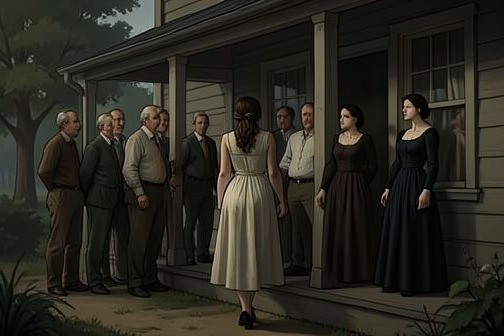
[Elizabeth Bennet’s decision to leave Longbourn](entity:event-recall-event-elizabeth-bennet-s-deci-1103fc82eb06) is the decisive break between her birth family and the household that has failed to protect her. What begins as a winter visit to the Gardiners becomes a permanent departure when Elizabeth recognizes that the house offers her neither parental love nor security. Her choice is not an impulsive escape but a carefully considered act of self-preservation, supported by relatives who give her a real alternative to dependence within [Longbourn](entity:location-recall-location-longbourn-09a641b38d11).
## Causes and Family Pressure
The immediate background is the collapse of domestic peace after Elizabeth rejects [William Collins](entity:character-recall-character-william-collins-a95fe9afaea4) and the Netherfield party leaves [Hertfordshire](entity:location-recall-location-hertfordshire-3be0dd22bb53). Mrs. Bennet treats both events as Elizabeth’s personal crimes. She tells [Edward Gardiner](entity:character-recall-character-edward-gardiner-ff481a4f187c) that Elizabeth could have saved the family from being “[Thrown into the hedgerows](entity:expression-recall-expression-thrown-into-the-he-02737f8a94bc)” by accepting William Collins, and blames her “blue-stocking opinions” for driving away [Charles Bingley](entity:character-recall-character-charles-bingley-d470295e8e11), despite his interest in [Jane Bennet](entity:character-recall-character-jane-bennet-1913002c8ec6). The complaints are not new, since Mrs. Bennet has repeated them in letters and conversation, but the Gardiners’ [Christmas](entity:time-recall-time-christmas-a573265d0167) arrival exposes the depth of the resentment behind them.
The household’s atmosphere has also changed in kind, not merely in degree. Mrs. Bennet is no longer presented as a woman fluttering over her nerves and requesting salts; she has become bitter and angry. [Thomas Bennet](entity:character-recall-character-thomas-bennet-fdb1df6a4cdd) does not meaningfully intervene. He looks annoyed, sighs, rolls his eyes, and returns to his book, leaving Elizabeth without effective paternal protection while [Lydia Bennet](entity:character-recall-character-lydia-bennet-0020f0bd0490) openly laughs at her. The other sisters are horrified, but their sympathy cannot alter the structure of the house or restrain their mother’s attacks.
## The Decision to Depart
Elizabeth asks Edward and [Madeline Gardiner](entity:character-recall-character-madeline-gardiner-932ce19b654c) to speak with her privately after the family confrontation. She explains that a month earlier she had hoped to return to [London](entity:location-recall-location-london-420923d4a60a) only for the winter, but now she must accept that she will not return to Longbourn after leaving. Her wording carries the force of a decision already made, although tears rise as she says it. She offers to avoid becoming a burden by seeking work as a companion or governess, revealing both her anxiety about dependence and her willingness to earn an independent place.
The Gardiners refuse to let her imagine herself unwanted or precarious. Edward tells her that she may stay with them, that his business is prospering, and that their house can accommodate another person. He also points to the practical reciprocity of the arrangement: Elizabeth can help with the children, while the children will be delighted to have their favorite cousin with them. The offer transforms departure from a lonely rejection of Longbourn into a supported relocation. Elizabeth leaves the private conversation feeling as though Atlas’s boulder has been lifted from her shoulders.
## Recognition of Failed Parental Love
The emotional importance of the decision lies in Elizabeth’s discovery that affection and parental love are not interchangeable. In Madeline Gardiner’s arms she feels gentle, familial support rather than romantic attachment, and this experience allows her to compare the Gardiners’ conduct with that of Thomas Bennet and [Fanny Bennet](entity:character-recall-character-fanny-bennet-32517e125a1f). She knows that Jane Bennet and [Mary Bennet](entity:character-recall-character-mary-bennet-3ad0e066a036) love her, and she knows that [Sir David Pentland](entity:character-recall-character-sir-david-pentland-9d7df8c780b8) has loved her as though she were his granddaughter, although neither has openly defined the relationship in those terms. Yet she cannot honestly claim the same confidence in her parents.
Elizabeth realizes that her former declaration of love for her parents would now require qualifications. She does not respect or trust them, because daily provocations have been met with no protection. The departure therefore answers an emotional fact that has become impossible to ignore: Longbourn is her family home by birth, but not a reliable home in the deeper sense of care, loyalty, and safety. Her tears are not simply grief at leaving. They register the painful clarity of discovering what has been absent.
## Timing, Secrecy, and Preparation
Although Elizabeth has reached her conclusion, she and the Gardiners agree not to announce it immediately. They will say nothing until after [New Year](entity:time-recall-time-new-year-3081c4d3858f), perhaps waiting until only two or three days before the planned departure. The delay shows that Elizabeth’s independence is being pursued with caution rather than theatrical defiance. She must manage the practical and emotional consequences of leaving while avoiding an earlier confrontation that would give Mrs. Bennet more opportunity to obstruct or weaponize the decision.
The timing also places the decision close to Elizabeth’s legal adulthood. Edward reminds her that her birthday is on the twentieth and that she will come of age in little more than three weeks. This detail changes the meaning of the move: Elizabeth is not merely being rescued as a distressed daughter; she is approaching the legal status of an adult woman able to shape her own domestic life. The Gardiners’ household offers protection without demanding that she surrender judgment or dignity.
## Wider Meaning and Consequences
Elizabeth’s departure is connected to the wider history of women whose lives have been determined by forced movement, social judgment, and the absence of safe homes. The story Elizabeth has heard from [Lady Radha Pentland](entity:character-recall-character-lady-radha-pentland-8550d21cca9a) gives that decision a broader context. Radha Bhimani was born in [Kutch](entity:location-recall-location-kutch-9cd484dc0f71), displaced during fighting among the Mughals, the Marathas, and the British, kidnapped for sale into slavery when she was only a year older than Elizabeth, rescued off the coast of the [Arabian Peninsula](entity:location-recall-location-arabian-peninsula-f00d52e55f25), forced into a nunnery outside [Cadiz](entity:location-recall-location-cadiz-6779628989a5), and later abandoned after pirates captured her ship. Sir David Pentland’s care in [Barbados](entity:location-recall-location-barbados-a285bae3d98a), their return to Britain, and their eventual marriage show a contrasting form of relocation: movement imposed by violence can be followed by chosen shelter and a new household.
Elizabeth has learned from Lady Radha and Madeline Gardiner that a lady’s life is defined less by rank than by love and the practical work of living responsibly. Their circumstances differ sharply—Madeline is the wife of a London tradesman and mother of four, while Lady Radha was born in India, suffered repeated kidnapping and pirate violence, and could not bear children because of her injuries—but Elizabeth sees common lessons in both women’s examples. The visits to tenants at [Grenadine Reef](entity:location-recall-location-grenadine-reef-ad0be7a0e4a4) have also taught her that household and estate responsibility consists of innumerable practical acts. Leaving Longbourn consequently does not mean abandoning domestic duty; it means rejecting a household in which duty is demanded from Elizabeth while protection and affection are withheld.
The decision initiates Elizabeth’s relocation to London and her incorporation into the Gardiners’ household. It separates her from the immediate authority of Fanny Bennet and from Thomas Bennet’s passivity, while bringing her closer to a family structure in which care is active, reciprocal, and dependable. In narrative terms, the move turns injury into agency. Elizabeth does not wait for Longbourn to become kinder, for her mother to repent, or for her father to assume the protection he has neglected. She recognizes the house’s failure, accepts the support offered by Edward and Madeline Gardiner, and begins the adult life that the Bennet household could neither secure nor imagine for her.
Event 18
Elizabeth Bennet’s departure from Longbourn for London

[Elizabeth Bennet’s departure from Longbourn for London](entity:event-recall-event-elizabeth-bennet-f6d3cbcbb449) is the decisive break between her coming of age and her family’s continued control over her life. Though she plans to join the Gardiners in [London](entity:location-recall-location-london-420923d4a60a), the journey first takes her to [Grenadine Reef](entity:location-recall-location-grenadine-reef-ad0be7a0e4a4), where [Sir David Pentland](entity:character-recall-character-sir-david-pentland-9d7df8c780b8) receives her. She leaves not in a burst of anger but with a settled purpose: the home she is leaving has become a place of daily emotional injury, and she no longer expects to return to it.
## Causes and Decision
The immediate background is Elizabeth’s twenty-first birthday and her uncertain position at [Longbourn](entity:location-recall-location-longbourn-09a641b38d11). She has reached adulthood, but still lives under her father’s authority and knows that asking [Thomas Bennet](entity:character-recall-character-thomas-bennet-fdb1df6a4cdd) for permission to visit the Gardiners may result in another refusal. Three weeks earlier, he had denied her return to London after [Twelfth Night](entity:time-recall-time-twelfth-night-deeef3fa9741), requiring her to remain at home for fifteen additional days. To Elizabeth, that decision seemed less like protection than an arbitrary use of authority. Meanwhile, [Fanny Bennet](entity:character-recall-character-fanny-bennet-32517e125a1f)’s repeated verbal attacks continued without effective intervention from her husband.
Elizabeth understands the harm as more than ordinary family friction. Remembering a conversation with Sir David, she thinks of the bruises left by Fanny Bennet’s words as injuries to the psyche rather than to the skin. That understanding gives her decision its gravity: staying would mean accepting an environment that was actively wearing her down, while leaving would mean acting without her father’s approval. As the fog lifts on the morning after her birthday, she resolves to walk out the next day if the weather permits.
## Preparation and Farewell
On her final morning at Longbourn, Elizabeth writes notes to Jane and Mary. They explain her decision and express affection, while also seeking to ease the guilt she feels about not having disclosed her plan to them beforehand. Her letter to Thomas Bennet takes five attempts. She eventually produces a short, factual note whose closing words express love without conveying any actual warmth. The difficulty of writing it makes plain how distant their relationship has become.
The afternoon offers a quieter, more intimate farewell. Elizabeth spends time with Jane and Mary and accompanies them on a visit to a tenant family. The visit is not necessary, but it gives the three sisters a reason to be away from the house together. Elizabeth values their company and the calm of the outing, especially after time spent around Fanny Bennet and [Lydia Bennet](entity:character-recall-character-lydia-bennet-0020f0bd0490). Although she considers claiming a chill to avoid the final meal, she joins her parents and all four of her sisters for dinner. What surprises her is her own composure: she does not reconsider, and she remains certain that leaving is right.
## Departure and Immediate Reception
The next morning is bright and clear, with the ground hardened by overnight frost. Thomas Bennet is at breakfast when Elizabeth comes downstairs, but she does not enter the dining room. Instead, she leaves by the kitchen, taking the route she normally uses. Her pace is brisk, neither a run nor a leisurely stroll. She looks back only once, from the last point at which the house remains visible. At that distance, Longbourn is reduced to a small building marked by smoke rising from its chimneys; she gives it one rueful glance, rounds the hedge, and loses sight of it.
The departure is followed almost immediately by a practical contrast to the neglect she has experienced at home. Less than thirty minutes later, Elizabeth is having a light breakfast with Sir David at Grenadine Reef. He has arranged a carriage whose cushions have been reupholstered and whose springs have been renewed, with hot tea, food, warmed bricks, rugs, and blankets ready for the journey. His attentiveness treats her comfort as a matter worth planning for. The welcome also establishes that the departure is not simply an escape into uncertainty: Elizabeth has reached a household where she is received with care, and preparations have been made for her onward travel toward London.
## Consequences and Significance
Elizabeth’s departure is a separation from Longbourn as a home, not merely a short visit undertaken without permission. In a later conversation, Mary asks whether Elizabeth is ever coming back, and Jane answers that she does not believe so. Jane reports that Elizabeth writes of becoming a governess or companion, though she imagines Edward and [Madeline Gardiner](entity:character-recall-character-madeline-gardiner-932ce19b654c) may try to dissuade her from that drastic course. The sisters’ discussion confirms that Elizabeth’s departure has changed how they understand her future: she is prepared to make a life outside her parents’ household rather than return to it by default.
The episode also places Elizabeth’s independence against two contrasting models of care. At Longbourn, her father’s authority has prevented her from leaving earlier, while his failure to restrain his wife has allowed the daily verbal attacks to continue. At Grenadine Reef, Sir David’s carefully provided carriage and breakfast show a different use of responsibility: attention to another person’s needs expressed through concrete preparation. The contrast gives the departure more than geographical force. Elizabeth leaves a household in which her distress has gone unaddressed and moves toward people who take her welfare seriously.
The narrative’s emphasis on ordinary actions—the unsentimental letter, the visit to tenants, the final dinner, the familiar route through the kitchen, and the single backward glance—makes the break both deliberate and restrained. Elizabeth does not stage a confrontation or seek a dramatic last word. The decisive act is that she walks away, reaches Grenadine Reef, and continues toward a future not governed by Longbourn.
Event 19
伊丽莎白抵达格雷彻奇街

[Elizabeth Bennet](entity:character-recall-character-elizabeth-bennet-f97b53a479cc)’s arrival at [Gracechurch Street](entity:location-recall-location-gracechurch-street-4070ca0d2619) is the decisive transition between her life at [Longbourn](entity:location-recall-location-longbourn-09a641b38d11) and her new residence with [Edward Gardiner](entity:character-recall-character-edward-gardiner-ff481a4f187c) and [Madeline Gardiner](entity:character-recall-character-madeline-gardiner-932ce19b654c) in [London](entity:location-recall-location-london-420923d4a60a). It is not merely a change of address: after years of moving secretly between the Bennet world and [Grenadine Reef](entity:location-recall-location-grenadine-reef-ad0be7a0e4a4), Elizabeth leaves her family home by choice, travels under the protection of [Sir David Pentland](entity:character-recall-character-sir-david-pentland-9d7df8c780b8)’s household, and begins the period in which the hidden Pentland history can be brought into the open.
## Departure from Longbourn
Elizabeth’s departure is prepared against the persistent strain of Longbourn. Earlier, when Mrs. Bennet’s voice became shrill during preparations for [Jane Bennet](entity:character-recall-character-jane-bennet-1913002c8ec6)’s social debut, Elizabeth escaped through the kitchen rather than risk being stopped. Her habitual route took her northward from the house, away from the visible path to [Oakham Mount](entity:location-recall-location-oakham-mount-db91bc9c688c), along the brook marking the estate’s northern boundary. The landscape offered both physical refuge and emotional distance: among the trees and tenant farms, Elizabeth felt known, safe, and at peace, unlike the domestic atmosphere she shared with her mother.
By the time she finally leaves Longbourn, the action has become purposeful rather than impulsive. She spends the previous afternoon with Jane Bennet and [Mary Bennet](entity:character-recall-character-mary-bennet-3ad0e066a036) visiting a tenant family, then takes her last family dinner without the second thoughts that had troubled her earlier. The following morning she walks away at her usual brisk pace, glancing back only once, from the last point at which the house remains visible. The house then disappears behind the hedge, making the departure a controlled severing from the place that had been both her home and the source of her confinement.
## The Journey to London
Elizabeth reaches Grenadine Reef less than half an hour after leaving Longbourn and has a light breakfast with Sir David Pentland before beginning the journey south. Sir David has prepared the old carriage carefully: its cushions have been re-upholstered, new springs have been fitted, and the cabin contains hot tea, food, heated bricks, rugs, and blankets. The precautions show the protective relationship he has established with Elizabeth, whom he presents publicly as an unrelated granddaughter while arranging the practical means for her safety and comfort.
The journey to London is less than thirty miles and takes about four hours. [Vivian Harkness](entity:character-recall-character-vivian-harkness-4b541bfd881c) and [Violet Harkness](entity:character-recall-character-violet-harkness-9bcb3ea8feb1) accompany Elizabeth inside the carriage, and Elizabeth refuses to treat them as socially invisible simply because they are servants. To occupy the time, she asks them for detailed news from the dower house, including the circumstances in which its residents arrived and their hopes when they departed. Their account is simultaneously depressing and uplifting, reflecting the refuge’s mixture of abuse, recovery, and renewed possibility. At the end of the journey, the sisters remain part of the transition: Elizabeth arrives not alone, but accompanied by women connected to the protected community she has come to understand and support.
## Arrival at Gracechurch Street
At Gracechurch Street Elizabeth enters the Gardiners’ household, where Edward Gardiner and Madeline Gardiner become the first people to hear the complete account of her relationship with the Pentlands. Her story begins with her accidental meeting with [Lady Radha Pentland](entity:character-recall-character-lady-radha-pentland-8550d21cca9a) in the summer of [1804](entity:time-recall-time-1804-f49df1bd40ab), when Elizabeth was thirteen, and extends across more than seven and a half years of acquaintance, instruction, friendship, and concealed movement between Longbourn and Grenadine Reef.
The history Elizabeth recounts reaches far beyond the immediate geography of [Hertfordshire](entity:location-recall-location-hertfordshire-3be0dd22bb53) and London. Lady Radha explains that she was born Radha Bhimani in [Kutch](entity:location-recall-location-kutch-9cd484dc0f71), lost her mother at birth, and grew up among her paternal grandmother and aunts during repeated upheavals involving the Mughals, the Marathas, and the British. She was kidnapped when only slightly older than Elizabeth and intended for sale into slavery. Rescued off the [Arabian Peninsula](entity:location-recall-location-arabian-peninsula-f00d52e55f25) by a Spanish ship carrying priests, she learned rudimentary Spanish, was forced into a nunnery outside [Cadiz](entity:location-recall-location-cadiz-6779628989a5) for six years, and was later sent without meaningful choice on a mission from Cadiz to [Cartagena](entity:location-recall-location-cartagena-a586cc897c9b).
That voyage ended in piracy and severe injury. After being stabbed and left behind because she was too ill to move, Radha survived a stomach wound and infection. Sir David took her into his house in Bridgetown, [Barbados](entity:location-recall-location-barbados-a285bae3d98a), where a housekeeper and nurse helped care for her through repeated crises. Although she had endured captivity and violence, she was subjected to hostile judgments once her survival became certain. Sir David ultimately resigned his naval commission, returned with her to Britain, converted her to the [Church of Scotland](entity:organization-recall-organization-church-of-scotla-c72c453213dc), married her near Edinburgh, and settled with her in London before purchasing the estate later known as Grenadine Reef. The estate’s name derives from Sir David’s rescue of treasure from a Spanish galleon wrecked on a reef in the [Grenadine Islands](entity:location-recall-location-grenadine-islands-7ca836dbcab2), the fortune that enabled the purchase.
## Disclosure and New Independence
The Gardiners’ reception gives Elizabeth a form of family confidence unavailable at Longbourn. Her account takes until close to midnight, and Edward Gardiner does not go to his office the next morning because he and Madeline have so many questions. Their later interrogation begins uneasily, including the fear that Sir David might have taken advantage of Elizabeth, but the very fact that Elizabeth can tell the story in full establishes the seriousness of the new household’s role. Gracechurch Street becomes a place where secrecy can be examined rather than merely maintained.
Elizabeth’s arrival also confirms the unusual system that had enabled her earlier relationship with Sir David. As a young gentlewoman, she could neither be alone with an unrelated man nor correspond with him directly. Vivian and Violet therefore acted as chaperones and intermediaries: Elizabeth sent Vivian the questions she wished to ask, Vivian repeated them to Sir David, and the sisters transmitted his answers and further questions back to Elizabeth. This thin structure of respectability allowed their intellectual and practical education to continue despite gendered restrictions on movement and correspondence.
In London, Elizabeth’s understanding of what it means to be a lady is placed beside the examples of Madeline and Lady Radha. Madeline is the wife of a London tradesman, the mother of four children, and a frequent hostess for both social and business purposes. Lady Radha is a shy woman born in India, kidnapped three times, horribly abused by pirates, and left unable to bear children because of her injuries. Elizabeth sees their circumstances as radically different but their lessons as closely aligned: love must be expressed through the practical conduct of daily life, and the welfare of dependants is a responsibility rather than a decorative ideal.
The new London life soon widens Elizabeth’s social and civic experience. Her first visit with Madeline to the [Asylum for Female Orphans](entity:location-recall-location-asylum-for-female-or-4f260edd15a7) takes her south of the River Thames for the first time. They cross at [Blackfriars Bridge](entity:location-recall-location-blackfriars-bridge-26da472f42d8) and continue to [St. George’s](entity:location-recall-location-st-george-s-b4bca741221c) Fields, where the large institution houses about 200 girls between nine and fourteen. Governed by a committee of nineteen gentlemen, though supported by royal patronage, the Asylum cleans, feeds, educates, and prepares the girls for employment, most often in domestic service. Elizabeth’s entry into London thus joins personal refuge to public observation: she is not simply sheltered in a new household, but increasingly involved with the structures that determine women’s safety, labor, and prospects.
## Narrative Significance
The event’s importance lies in the contrast between Elizabeth’s two departures. Her earlier walks from Longbourn are evasions, carefully routed around the parlour window so that Mrs. Bennet cannot intercept her. The journey to Gracechurch Street uses the same impulse toward escape but gives it an acknowledged destination, a prepared carriage, trusted companions, and a household capable of hearing the truth. What begins as flight from domestic uproar becomes a movement toward agency.
Gracechurch Street also functions as a threshold between concealed and public identities. Elizabeth has not yet abandoned every secret, and Vivian confirms that her visits to the dower house remain unknown to her older sisters. Yet the complete disclosure to the Gardiners makes the hidden past materially present within a new family structure. The arrival therefore changes not only where Elizabeth lives but also who can understand her, question her, and help determine what she will do next.
The event’s wider significance is transnational. Through Lady Radha’s remembered life, Elizabeth’s move to London carries histories of Kutch, the Arabian Peninsula, [Spain](entity:location-recall-location-spain-336a02c89dc7), Cadiz, Cartagena, Barbados, the British Navy, and the Grenadine Islands into a London domestic setting. Wealth obtained through naval action and a wrecked Spanish treasure galleon has become an estate, a household, an education, and a refuge for vulnerable women. Elizabeth’s arrival is the point at which these distant histories begin to shape her visible adult life in London.
Event 20
Elizabeth reveals the Pentland family history to the Gardiners

[Elizabeth reveals the Pentland family history to the Gardiners](entity:event-recall-event-294c7329d4fa) in a long, emotionally difficult disclosure that turns an apparently unusual friendship into the hidden framework of her intellectual and moral development. The account joins Elizabeth’s childhood meetings with Lady Radha to a much older history of forced migration, slavery, piracy, religious conversion, naval violence, marriage, and estate-building. It also shows why Elizabeth’s understanding of love and the social position of women cannot be separated from the example of the Pentlands.
## Circumstances of the Revelation
Elizabeth tells the Gardiners the complete story after arriving at [Gracechurch Street](entity:location-recall-location-gracechurch-street-4070ca0d2619) in [Sir David Pentland](entity:character-recall-character-sir-david-pentland-9d7df8c780b8)’s carriage. She first reassures Aunt Madeline that she is well but insists that the tale should wait until Sir David has returned, then sends word to Uncle Edward not to delay that evening. The disclosure is so extensive that [Edward Gardiner](entity:character-recall-character-edward-gardiner-ff481a4f187c) does not attend his office the next morning. Elizabeth begins after an early dinner in the drawing room, and the Gardiners listen through a succession of emotions until she reaches the point at which she has arrived in [London](entity:location-recall-location-london-420923d4a60a). She finishes close to midnight; Edward and Madeline continue discussing the account until nearly three in the morning before sleep overtakes them.
The conversation immediately exposes the social danger surrounding Elizabeth’s history. Madeline’s first question is whether Sir David took advantage of her, a possibility Elizabeth finds so offensive that she rises from her seat in anger. She distinguishes the adult woman speaking to her aunt and uncle from the thirteen-year-old child whose story began in [1804](entity:time-recall-time-1804-f49df1bd40ab). Her objection is not merely personal: she invokes the principle that a person is [innocent until proven guilty](entity:expression-recall-expression-innocent-until-pro-9ba4b97af76a), while recognizing that society treats a young woman’s association with an older man as suspect regardless of the actual history.
At Madeline’s request, Elizabeth then agrees to supply not only facts and dates but also the feelings, intentions, and meanings that had been unavailable to her younger self. The resulting narrative is retrospective in both senses. Elizabeth remembers what she saw as a child, but interprets it with the knowledge acquired during the intervening years. She warns that the account may not remain fully linear, because her three central subjects—love, the conduct of a lady, and society’s unfairness toward women—are intertwined in memory.
## Elizabeth’s First Meeting with Lady Radha
The story begins in the summer of 1804, when Elizabeth was thirteen. Mrs. Bennet was preoccupied with [Jane Bennet](entity:character-recall-character-jane-bennet-1913002c8ec6)’s social debut, and Elizabeth used the distraction to escape [Longbourn](entity:location-recall-location-longbourn-09a641b38d11). Her preferred route toward [Oakham Mount](entity:location-recall-location-oakham-mount-db91bc9c688c) could be seen from the parlour, so she deliberately went north instead of east to avoid being noticed and dragged back into the house. That small act of evasion led to her first meeting with Lady Radha.
Elizabeth is careful about the names used in recalling the relationship. For the first two and a half years she addressed Lady Radha as Lady Pentland; on Elizabeth’s sixteenth birthday, Lady Radha asked her to use the latter’s given name, and Elizabeth has thought of her as Lady Radha ever since. Sir David, by contrast, remained Sir David Pentland throughout Elizabeth’s acquaintance with him. She notices that social rank determines forms of address: knights may not easily be called by their given names, while unknighted men are addressed as Mr. Goulding or Mr. Long, even when their given names are unknown. The observation becomes an early example of the class conventions Elizabeth learned to perceive rather than simply obey.
From 1804 onward, whenever the weather allowed, Elizabeth visited Lady Radha once or twice a week for two or four hours. She describes the visits as gradual education rather than a single formal instruction. Lady Radha taught her about love, about how to be a lady, and about the unfairness society directed toward women. Elizabeth emphasizes that she did not understand the full subtext of Lady Radha’s explanations at thirteen. At the time she recognized that certain treatment had been unkind or wrong; only later did she grasp how deeply social judgments were shaped by gender, reputation, foreignness, and the assumption that a woman’s suffering was somehow her fault.
## Lady Radha’s Transnational History
Lady Radha’s history gives Elizabeth’s private education a global and violent background. Born Radha Bhimani in [Kutch](entity:location-recall-location-kutch-9cd484dc0f71) in western India, she lost her mother in childbirth and was raised by her paternal grandmother and aunts. Her father was a minor district official, and the family moved repeatedly as power shifted among the Mughals, the Marathas, and the British. Because the family was Hindu and the district was conquered by Muslim rulers, they fled and later returned when those rulers were defeated; the subsequent arrival of the British created another period of instability. Lady Radha describes her childhood memories as fragmented, with the sequence of events difficult to reconstruct.
When she was only a year older than Elizabeth was at their first meeting, Lady Radha was kidnapped for sale into slavery. She was rescued before the sale took place, but the rescue removed her permanently from her birthplace. A Spanish ship carrying several priests found her off the coast of the [Arabian Peninsula](entity:location-recall-location-arabian-peninsula-f00d52e55f25). The priests kept her safe during the remainder of the voyage and taught her rudimentary Spanish, but that safety came at the cost of another forced relocation: on reaching [Spain](entity:location-recall-location-spain-336a02c89dc7), she was compelled to enter a nunnery outside [Cadiz](entity:location-recall-location-cadiz-6779628989a5), where she remained cloistered for six years.
At twenty-one, Lady Radha was selected, without any say in the decision, to join a mission to South America. In the spring of [1772](entity:time-recall-time-1772-7fea1bc90391) she and twenty-nine other members of her order sailed from Cadiz toward [Cartagena](entity:location-recall-location-cartagena-a586cc897c9b) on the Spanish Main. The ship was captured by pirates during the voyage. Lady Radha alludes to what happened during four days in pirate hands rather than describe it fully, telling Elizabeth that some parts are too dark for a young listener and that she will not shatter Elizabeth’s innocence by narrating them directly.
Her account nevertheless establishes the scale of what she survived. She was not merely displaced once but carried across several imperial and religious worlds: Kutch, the Arabian Peninsula, Spain, the Spanish Main, [Barbados](entity:location-recall-location-barbados-a285bae3d98a), and Britain. She was an Indian woman who spoke Spanish, a forced nun left behind after a pirate attack, and a survivor of violence whose identity could not be contained by the categories available in British society. The disclosure therefore makes her life more than a piece of family background; it reveals the human cost concealed beneath imperial travel, religious institutions, naval power, and colonial wealth.
## Rescue, Marriage, and [Grenadine Reef](entity:location-recall-location-grenadine-reef-ad0be7a0e4a4)
Lady Radha’s survival depended first on endurance and then on deliberate care. After being stabbed in the stomach during the pirate ordeal, she was given the last rites, yet continued to resist the infection that should have killed her. The surviving members of her order were put ashore under a white flag and continued their journey, while she was too ill to be moved and was left behind. When the survivors reached Barbados, Sir David Pentland took her into his large house in Bridgetown, where his housekeeper and a nurse helped care for her. She nearly died twice even under that personal attention, but eventually recovered from the wound and its final infection.
Lady Radha’s position remained precarious after her physical recovery. She moved into the home of a widow known to Sir David in order to preserve propriety, and Sir David began to court her. Before accepting his attentions, she disclosed what she could about the four days before her rescue. His response was that the past did not alter his regard for her. The marriage joined two people whose lives had been shaped by different imperial worlds, while refusing to treat Lady Radha’s victimization as a stain upon her. Sir David’s decision to leave the navy was prompted in part by the barbed comments directed at her on Barbados, including suggestions that it would have been better if she had died. They returned to Britain, married near Edinburgh after her willing but superficial conversion to the [Church of Scotland](entity:organization-recall-organization-church-of-scotla-c72c453213dc), and moved to London after their wedding journey.
The estate they later purchased took its name from the event that made their wealth possible. In [1770](entity:time-recall-time-1770-48b20ad9bba3), Sir David had commanded HMS Glory, newly appointed to the West Indies station after a refit in Plymouth. The [Admiralty](entity:organization-recall-organization-admiralty-f42cc9488820) ordered the ship to sail despite the beginning of hurricane season. HMS Glory survived the storm with damaged spars, bruises, and one broken leg among the crew, but a Spanish treasure galleon attempting to reach Havana was wrecked on a reef near the [Grenadine Islands](entity:location-recall-location-grenadine-islands-7ca836dbcab2). Two days later, Sir David’s ship found what remained of the hull and salvaged a substantial portion of its treasure before the wreck was destroyed and sank. The exploit brought him a knighthood and supplied his share of the prize money for the purchase of Grenadine Reef, an estate situated more than fifty miles from the sea.
## Love and the Education of a Lady
Elizabeth’s disclosure is also an argument about what love looks like when sustained beyond the first years of marriage. In 1804 she viewed the Bennet household as a place where love had disappeared, while the Gardiners offered the example of a marriage still in its first and second decades. The Pentlands provided a longer test: they had already been married for thirty-two years, yet their affection remained visible, consistent, and more demonstrative than polite society usually permitted without becoming improper. Elizabeth’s childhood visits allowed her to observe not a performance for guests but a settled habit of mutual attachment.
That contrast gave substance to a phrase Elizabeth and Jane Bennet had repeated without understanding it. The Pentlands showed her what enduring love meant in practice, while the unhappy atmosphere at Longbourn showed her what marriage became when that bond was absent. Her later account therefore treats love not as an ornamental ideal but as a standard by which domestic life, future choices, and the conduct of husbands and wives could be judged. Lady Radha’s marriage was especially powerful as an example because it had survived displacement, bodily injury, public cruelty, and more than three decades of shared life.
Lady Radha’s instruction extended beyond romance. Elizabeth says that she learned how to be a lady through the examples of Lady Radha and [Madeline Gardiner](entity:character-recall-character-madeline-gardiner-932ce19b654c), despite their very different circumstances. Madeline was the wife of a London tradesman, the mother of four young children, and a frequent hostess who supported Edward Gardiner’s business as well as his social life. Lady Radha was a shy woman born in India, kidnapped three times, gravely injured by pirates, unable to bear children because of those injuries, and rarely present in society. Their similarity, in Elizabeth’s account, lay in the practical work of living: hospitality, judgment, responsibility, care for others, and the ability to act with dignity without allowing social approval to define one’s worth.
The lessons were reinforced by Elizabeth’s visits to the tenants of Grenadine Reef. Jane Bennet had begun accompanying tenant visits at twelve, and Elizabeth had joined her even earlier. Lady Radha’s example made those visits more efficient and humane, because Elizabeth learned to understand the estate’s tenants not as an abstract obligation but as people whose welfare belonged to its management. The education was cumulative and often indirect. Elizabeth absorbed innumerable small practices without recognizing each one as a lesson, then carried them back into Longbourn’s poorer and less effectively managed world.
## Wealth, Management, and Continuing Influence
The Pentland history also explains why Grenadine Reef could support the expansive responsibilities later associated with it. Sir David’s salvaged Spanish treasure was described as one of the richest prizes ever taken by the [Royal Navy](entity:organization-recall-organization-royal-navy-31f3701ac194). He used part of it to buy a substantial estate and placed the remainder in the Consols. The Pentlands then lived quietly and almost frugally: they entertained little, did not spend the London seasons in an expensive townhouse, had no children, and avoided the accumulated costs of additional horses, education, university, Grand Tours, and daughters’ dowries. Their surplus income was invested year after year, and the returns enlarged the capital available for further investment.
This financial discipline made the estate more than a monument to a naval exploit. Money was transferred from the original investments to double the size of Grenadine Reef and to purchase smaller estates. Elizabeth also learned to extend the same practical intelligence into new ventures. When servants and workers were asked what beer they preferred, the inquiry identified breweries in [Alton](entity:location-recall-location-alton-b149e804c75f) and [Lewes](entity:location-recall-location-lewes-e76396e796f2); she proposed acquiring acreage for hops and barley near those locations and investigating breweries in Southampton and Portsmouth, where merchant sailors and the Royal Navy created substantial demand. Sir David admired the way one question expanded into several connected investment opportunities, showing that Elizabeth’s education had prepared her to reason about labor, consumption, land, and commerce together.
Sir David’s later illness gives the family history a final, painful dimension. He tells Elizabeth that he is dying of cancer and that the doctor doubts he will survive the year. A growing lump in his stomach causes a general constant ache with occasional spikes of pain; he takes a diluted solution of laudanum before retiring to help him sleep. Elizabeth asks directly whether he is in pain and whether he is receiving laudanum, treating his condition as a reality to be discussed rather than concealed behind ceremony. His illness transforms the Pentland legacy from a story of survival and marriage into a question of care, succession, and what can be preserved after the founding generation is gone.
After Sir David’s death, the scale of the fortune becomes clear. He left £50,000 in the Consols and a further £25,000 to his brother, while Elizabeth received £400,000 in assets producing nearly £20,000 a year after tax. The inheritance reflected not only the original treasure but decades of restrained expenditure and reinvestment. In the next generation, Elizabeth and [Fitzwilliam Darcy](entity:character-recall-character-fitzwilliam-darcy-ad3b1ecc1d50) divided the estate into planned portions for their children: [Helena Darcy](entity:character-recall-character-helena-darcy-dc76883425b1) was to receive 3,000 acres of Grenadine Reef, David 2,000 acres, Richard the former Longbourn lands, and the remaining children inheritances in Scotland, Dorset, and Kent. The final 1,000 acres around the dower house were retained as a distinct portion.
That last portion became St. Vincent Lodge, named after the nearest large island to the place where Sir David discovered the wrecked treasure ship. Elizabeth, Darcy, and their children used the lodge when visiting the estate, while Edward and Madeline Gardiner were intended to move there when Helena entered her inheritance. Annabel, Helena’s older cousin, had long helped run the dower house and showed no immediate wish to marry; the St. Vincent estate was eventually intended for her, with a niece or cousin of the next generation as heiress. The future arrangement extends the original revelation beyond private memory: Lady Radha’s and Sir David’s lives continue to shape property, refuge, family responsibility, and female inheritance long after their deaths.
## Narrative and Thematic Significance
The revelation is structured as a remembered story rather than a simple chronological report. Elizabeth first gives the Gardiners the factual outline, ending with her arrival at Gracechurch Street, and only afterward returns to add feeling, intention, and retrospective interpretation. She openly acknowledges that later knowledge has altered the way she understands her childhood encounters. The account consequently moves between the thirteen-year-old who listened without grasping the social subtext and the adult woman who can identify the injustice directed at Lady Radha and at women more generally.
Its fragmented movement is appropriate to the history being recovered. Lady Radha’s own memories of Kutch are uncertain because war repeatedly displaced her family, while the most violent part of her pirate captivity remains deliberately unspoken. Elizabeth preserves that silence rather than converting suffering into spectacle. Yet the omission does not erase the event; it makes the limits of testimony part of the disclosure. The Gardiners are asked to become witnesses to a history whose full details cannot be safely or ethically narrated to the younger Elizabeth who first heard it.
The conversation therefore changes the meaning of Elizabeth’s relationship with the Pentlands. What might have looked like an eccentric friendship between a young country girl and an older couple becomes the foundation of Elizabeth’s education in love, social rank, estate management, global violence, and women’s restricted agency. It also explains why she resists the insinuation that Sir David exploited her: the revelation is not a secret romance but an account of long-term mentorship, friendship, care, and moral formation. By telling the Gardiners, Elizabeth converts a hidden life into shared family knowledge, while preserving the Pentlands’ history as an active inheritance rather than a closed chapter.
Event 21
Lady Radha’s pirate captivity and rescue

[Lady Radha’s pirate captivity and rescue](entity:event-recall-event-615a040597af) is the formative catastrophe and turning point of her life. Born Radha Bhimani in [Kutch](entity:location-recall-location-kutch-9cd484dc0f71) in western India, she was kidnapped as a child to be sold into slavery, rescued from a Spanish ship near the [Arabian Peninsula](entity:location-recall-location-arabian-peninsula-f00d52e55f25), and then carried through a sequence of forced displacements that ended in her marriage to [Sir David Pentland](entity:character-recall-character-sir-david-pentland-9d7df8c780b8) and her life in Britain. The event does not end with physical rescue: its consequences include serious wounds, infection, exile, public shaming, and a lasting determination to make [Grenadine Reef](entity:location-recall-location-grenadine-reef-ad0be7a0e4a4) a place where other abused women could recover in safety.
## Origins and Forced Displacement
Radha’s ordeal began within an already unstable childhood. Her mother died in childbirth, and Radha was raised by her paternal grandmother and aunts while her father served as a minor district official. Her family was Hindu, but Kutch was repeatedly affected by conflict among the Mughals, the Marathas, and the British. The family fled when Mughal power reached the district and returned after that authority was defeated, only to face another imperial presence when the British arrived. Radha later described her childhood memories as fragmented, with the order of events difficult to recover, because movement and danger had made continuity impossible.
At an age only slightly older than [Elizabeth Bennet](entity:character-recall-character-elizabeth-bennet-f97b53a479cc) was when she first heard the story, Radha was kidnapped for sale into slavery. The attempted enslavement severed her from her birthplace permanently. She was rescued before the sale could take place, but the rescue itself carried her farther from India: the vessel was Spanish and transported several priests, who protected her during the remainder of the voyage while teaching her rudimentary Spanish. Safety therefore arrived inseparably from displacement, language change, and dependence on strangers.
## Captivity, Wounding, and Rescue
After landing in [Spain](entity:location-recall-location-spain-336a02c89dc7), Radha was forced into a nunnery outside [Cadiz](entity:location-recall-location-cadiz-6779628989a5). She remained cloistered there for six years, with no meaningful control over the course of her life. At twenty-one she was selected, again without being given a choice, to join a mission to [Cartagena](entity:location-recall-location-cartagena-a586cc897c9b) on the Spanish Main. In the spring of [1772](entity:time-recall-time-1772-7fea1bc90391) she sailed from Cadiz with twenty-nine other members of the order. The journey transformed one form of confinement into another when pirates captured the ship.
Radha later told Elizabeth only that the four days under the pirates had been a “very grim time.” Elizabeth initially lacked the knowledge to understand the phrase fully, but in later years came to recognise that it concealed an experience of extreme violence. Radha had been subjected to innumerable crimes over nearly a decade by the time she reached safety, and the later account records that she was stabbed in the womb. The wound was ordinarily fatal; she received the last rites and fought an infection for more than two months. Her survival was not presented as a simple reversal of danger but as a prolonged physical struggle in which death remained a continuing possibility.
The Spanish vessel and the surviving members of the order eventually proceeded under a white flag of neutrality, but Radha was too ill to be moved and was left behind. Her rescue therefore depended on a second act of intervention. Sir David Pentland brought her to his large house in Bridgetown, [Barbados](entity:location-recall-location-barbados-a285bae3d98a), where his housekeeper and a nurse helped care for her. Even with that personal attention, she nearly died twice before overcoming the final infection. She arrived in his household as an Indian woman who spoke Spanish, a forced nun abandoned by her order, and a survivor of four days of pirate violence.
## Sir David Pentland and the Cost of Survival
Sir David’s response changed the meaning of rescue. Radha moved into the home of a widow known to him in order to preserve propriety, and he began to court her. Before the relationship could proceed, she alluded to what had happened during the days before her rescue. Sir David took her hand and told her that it did not matter. His acceptance allowed the survivor to be treated as a person rather than as a scandal attached to an injury.
Barbadian society offered a harsher judgment. Once it was clear that Radha would survive, she heard repeated comments that it would have been better if she had died. The hostility made her survival itself appear embarrassing, as though the crime belonged to the victim rather than to those who had harmed her. Elizabeth later understood that Radha’s supposed “original sin” was merely living too close to the coast in India, where slavers could capture her. The public response thus extended the captivity beyond the pirate ship: physical confinement ended, but social condemnation attempted to impose another form of punishment.
The treatment of Radha became the last reason Sir David abandoned his naval career. He had been a naval hero and had been knighted two years earlier, yet he resigned his commission rather than continue within a world that tolerated such cruelty toward the woman he loved. The couple returned to Britain, where Radha willingly, though superficially, converted to the [Church of Scotland](entity:organization-recall-organization-church-of-scotla-c72c453213dc) before they married near Edinburgh. After their wedding trip they moved to [London](entity:location-recall-location-london-420923d4a60a) and acquired the estate that became Grenadine Reef. Their marriage converted rescue into shared life, while their departure from Barbados rejected the society that had treated Radha’s survival as a disgrace.
## From Survival to Purpose
The meaning of Radha’s rescue widened after the marriage. She and Sir David did not attempt merely to bury the past or treat her ordeal as an isolated misfortune. At Grenadine Reef, they established a refuge for servant women and tradesmen’s daughters who had suffered comparable abuse. The women were given time to recover in peace and safety before deciding how to rebuild their lives. Some emigrated to [Canada](entity:location-recall-location-dc0088f9b440) to place as much distance as possible between themselves and their former circumstances; others changed their names. No two stories were identical, but the refuge recognised a shared need for protection, privacy, and recovery rather than public punishment.
The Harkness sisters became part of this continuing work. [Vivian Harkness](entity:character-recall-character-vivian-harkness-4b541bfd881c) came to Grenadine Reef to support her younger sister [Violet Harkness](entity:character-recall-character-violet-harkness-9bcb3ea8feb1), who needed refuge and recovery. Both joined the small permanent staff, later serving as Elizabeth Bennet’s drivers and chaperones on the estate. Their presence shows that Radha’s response to violence was not sentimental charity but an organised domestic institution, sustained through trusted women and practical labour.
## The Pentland Household and Its Wider Consequences
Radha’s history shaped the character of Grenadine Reef as decisively as the estate’s finances did. She and Sir David lived quietly and with considerable comfort, but they rarely entered society and did not spend heavily on fashionable London seasons, elaborate entertainments, or ostentatious display. Their childlessness and restrained way of life left surplus income available for investment, while Sir David’s fortune had begun with the treasure recovered from a Spanish galleon wrecked on a reef in the [Grenadine Islands](entity:location-recall-location-grenadine-islands-7ca836dbcab2). The resulting wealth funded the estate, its later expansion, and the practical independence that made the refuge possible.
Sir David’s earlier naval career supplied the material foundation for this transformation. In [1770](entity:time-recall-time-1770-48b20ad9bba3), as the newly appointed captain of HMS Glory, he was sent to the West Indies after the ship’s refit in Plymouth. The [Admiralty](entity:organization-recall-organization-admiralty-f42cc9488820) required an immediate departure despite the beginning of hurricane season. After surviving the edge of the first hurricane, his ship found the remains of a Spanish treasure galleon that had run onto a reef while attempting to reach Havana. Sir David and his crew salvaged a substantial portion of the treasure before the wreck was completely destroyed, an action for which he was knighted. The prize money enabled the purchase of Grenadine Reef, so the estate’s later role as a haven for abused women was materially connected to a dangerous imperial and maritime economy.
Radha’s influence also extended into the estate’s economic decisions. When Elizabeth Bennet later surveyed the drinking preferences of grooms, male servants, warehouse employees, other servants, tradesmen, workers, merchant sailors, and members of the [Royal Navy](entity:organization-recall-organization-royal-navy-31f3701ac194), she identified breweries in [Alton](entity:location-recall-location-alton-b149e804c75f) and [Lewes](entity:location-recall-location-lewes-e76396e796f2) as promising investments and proposed acquiring acreage suitable for hops and barley near those centres. Sir David treated the proposal as a chain of further opportunities, including investigations into breweries in Southampton and Portsmouth. The episode reflects the household’s characteristic combination of practical observation, commercial reinvestment, and attention to working people—values associated with the life Radha and Sir David had built together.
## Elizabeth Bennet as Witness and Successor
Elizabeth’s understanding of Radha’s captivity developed slowly. When Radha first gave her an edited account, Elizabeth was thirteen and heard the description of the pirate days only as a warning that some matters were too dark for a child. In adulthood she recognised the full implication of the phrase “very grim time,” including the violence, the stabbing in the womb, the prolonged infection, and the social cruelty that followed. The delayed understanding became part of Elizabeth’s moral education: what had once seemed simply unkind was later revealed as a system of blame directed at a woman for the crimes committed against her.
Elizabeth also learned from the contrast between Radha and [Madeline Gardiner](entity:character-recall-character-madeline-gardiner-932ce19b654c). Madeline was the wife of a tradesman, the mother of four young children, and an active hostess supporting [Edward Gardiner](entity:character-recall-character-edward-gardiner-ff481a4f187c)’s business; Radha was an Indian woman who had been kidnapped three times, endured pirate violence, could not bear children because of her injuries, and lived largely outside society. Elizabeth regarded both women as models of what it meant to be a gentle-born lady, not because either conformed to a single social pattern, but because both combined love with the daily practical work of caring for others. Radha’s example taught Elizabeth that responsibility could be exercised through estate management, tenant visits, discretion, and direct assistance rather than through fashionable display.
Elizabeth’s later explanation of the refuge makes Radha’s legacy explicit. Sir David had rescued and married her instead of yielding to gossip; together they had created a place where women marked by violence could recover without being forced to relive their histories before hostile observers. Radha therefore became, in Elizabeth’s memory, not only a survivor but the moral purpose of Grenadine Reef. Her life converted a private wound into an institution capable of protecting strangers.
## Legacy After Radha’s Death
Although Radha’s death ended her direct stewardship, the refuge and the estate continued to embody her decisions. Elizabeth’s regular involvement at Grenadine Reef, the Harkness sisters’ work there, and the household’s commitment to women seeking safety all preserve the structure Radha and Sir David established. The estate’s apparent distance from the sea could obscure its origins, yet its name recalled the reef where Sir David found the wreck, while its social function recalled the woman whose rescue gave the wealth a humane direction.
Later generations were incorporated into that design rather than being allowed to erase it. Elizabeth Bennet and [Fitzwilliam Darcy](entity:character-recall-character-fitzwilliam-darcy-ad3b1ecc1d50) divided the enlarged estates among their children and retained the final thousand acres of the original Grenadine Reef around the dower house. On that land they built St. Vincent Lodge, named after the nearest large island to the place where Sir David had discovered the wreck. The family stayed there during visits, while the dower house remained connected to the refuge. When [Helena Darcy](entity:character-recall-character-helena-darcy-dc76883425b1) inherited the main Grenadine Reef estate, Edward Gardiner and Madeline Gardiner were expected to move to the Lodge, and Helena’s older cousin Annabel had already become deeply involved in running the dower house. The future arrangement thus kept women’s protection and practical stewardship at the centre of the property’s succession.
Radha’s captivity and rescue consequently function as a long causal arc rather than a concluded episode. Kutch, the Arabian Peninsula, Spain, Cadiz, Cartagena, Barbados, Edinburgh, London, and Grenadine Reef mark successive stages in a life shaped by forced movement, survival, and chosen belonging. The event begins with a child deprived of home and agency, passes through slavery, religious confinement, pirate violence, abandonment, and public condemnation, and ends in a form of collective protection. Its decisive reversal is not only that Radha lives; it is that the life others tried to reduce to shame becomes the foundation for safety, dignity, and future independence for other women.
Event 22
The establishment of the Grenadine Reef refuge for women
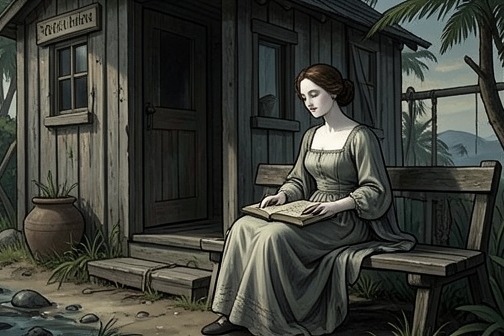
[The establishment of the Grenadine Reef refuge for women](entity:event-recall-event-e05a7bcfd29a) is the practical expression of [Lady Radha Pentland](entity:character-recall-character-lady-radha-pentland-8550d21cca9a)’s response to violence: with [Sir David Pentland](entity:character-recall-character-sir-david-pentland-9d7df8c780b8), she turned the estate’s dower house into a secluded place where women assaulted by men could recover in safety and prepare to rebuild their lives. The refuge makes private suffering the basis of an enduring form of care, rather than something to be hidden and forgotten.
## Origins in Lady Radha’s Experience
Lady Radha’s history crossed several countries and forms of coercion before she became mistress of [Grenadine Reef](entity:location-recall-location-grenadine-reef-ad0be7a0e4a4). Born Radha Bhimani in [Kutch](entity:location-recall-location-kutch-9cd484dc0f71), in western India, she grew up amid shifting conflict and repeated displacement. She was kidnapped as a child to be sold into slavery, rescued from a ship off the [Arabian Peninsula](entity:location-recall-location-arabian-peninsula-f00d52e55f25), and taken to [Spain](entity:location-recall-location-spain-336a02c89dc7). There, she was compelled to enter a convent; at twenty-one she was selected, without being given a choice, to join a mission sailing from [Cadiz](entity:location-recall-location-cadiz-6779628989a5) to [Cartagena](entity:location-recall-location-cartagena-a586cc897c9b).
Pirates captured the mission’s ship. Lady Radha endured four days of violence before being rescued, but she had been stabbed in the womb and remained dangerously ill. Sir David took her into his home in Bridgetown, [Barbados](entity:location-recall-location-barbados-a285bae3d98a), where his housekeeper and a nurse helped care for her through a prolonged recovery. After their marriage, the couple left Barbados for Britain, in part because Lady Radha had faced gossip and hostile comments about what had happened to her. The refuge’s later purpose is inseparable from this history: its founders knew how violence could be followed by social judgment, and how urgently survivors needed a safe place beyond that judgment.
## The [Dower House](entity:location-recall-location-dower-house-c86305739b4c) as Refuge
Sir David and Lady Radha converted the dower house at Grenadine Reef into a refuge for women assaulted by men. The women who came there included those who had lost their virtue, those who were pregnant, and those who had been physically beaten. Rather than treating their circumstances as a matter for public display, the refuge offered them seclusion in which they could recover before deciding how to resume their lives.
The dower house was set apart within the estate. Trees and bushes planted around it three decades earlier had grown until the building was almost hidden. That concealment was not merely a feature of the grounds: it gave the refuge a degree of privacy for women whose safety and ability to recover depended on distance from the scrutiny and gossip that had shadowed Lady Radha herself.
## Care, Staff, and the Survivors’ Futures
Sir David provided the refuge’s funds but left its daily operation to his housekeeper and staff. Its permanent household included Vivian and [Violet Harkness](entity:character-recall-character-violet-harkness-9bcb3ea8feb1), whose connection to the refuge began when Violet herself needed shelter and Vivian came to support her recovery. The sisters remained there rather than returning to service elsewhere. Their presence made the refuge more than an endowed building: it depended on women who understood the need for protection and helped sustain a place where others could begin again.
Recovery did not follow one prescribed course. After time in safety, many of the women returned to rebuild their lives; many others emigrated to [Canada](entity:location-recall-location-dc0088f9b440), seeking distance from their pasts, and some adopted new names. Their stories differed, and the refuge’s purpose was not to impose a single ending but to give them space to recover and choose what came next. By serving mostly servant women and tradesmen’s daughters, it addressed a vulnerability that polite society could condemn while offering little protection against its consequences.
## Privacy and Legacy
The refuge’s work remained largely out of public view. Elizabeth had never visited it, and Lady Radha had spoken of its purpose only obliquely when Elizabeth was young. Years later, when Elizabeth asked to understand it fully, the Harkness sisters answered without challenging her right to know. Their account connected the institution’s quiet work to Lady Radha’s own experience: violence had been followed by gossip and cruel judgment, while Sir David’s care and their marriage had offered a different response. The couple did not simply leave that history behind; they used the resources and privacy of Grenadine Reef to make recovery possible for other women.
Lady Radha’s understanding of her role as mistress of the estate likewise centered on practical care rather than social display. She and Sir David lived modestly but comfortably, maintained a well-run estate, and devoted money to people in need. The refuge therefore joined household management to a larger moral purpose: the estate’s wealth and seclusion could support women whose safety and futures were poorly served by the society around them.
## Estate Stewardship as Practical Care
The refuge also belonged to a broader education in what it meant to be a lady and mistress of an estate. Over eight years, Elizabeth learned from two sharply different examples: [Madeline Gardiner](entity:character-recall-character-madeline-gardiner-932ce19b654c), a tradesman’s wife and mother who supported her husband’s business, and Lady Radha Pentland, whose life had crossed India, Spain, the Caribbean, and England. Their circumstances and public lives diverged, but Elizabeth found their lessons converged on love expressed through the practical realities of caring for others. Lady Radha’s work at Grenadine Reef made that principle institutional: stewardship meant using household resources to meet needs that polite society preferred not to discuss.
Elizabeth carried this understanding into her own experience of estate life. Having joined Jane in visiting [Longbourn](entity:location-recall-location-longbourn-09a641b38d11)’s tenants from the age of ten, she later found that the visits and instruction associated with Lady Radha made her more effective: lessons learned at Grenadine Reef helped her and Jane serve Longbourn’s tenants with less trial and error. Elizabeth understood the welfare of those living on an estate as the responsibility of its master, not an optional gesture of benevolence. The refuge thus stands within the novel’s wider account of estate management as a moral practice, linking private protection for survivors to the everyday obligations of care.
## The Founders’ Response to Public Judgment
The refuge also grew from Sir David’s refusal to accept the judgment directed at Lady Radha after her rescue. Although he had been knighted for naval service, she was subjected to barbed comments once it seemed she would survive; some even suggested that her death would have been preferable. The blame attached to her survival treated her capture as her fault, as though living near the coast had made her responsible for being taken. This treatment became the last straw for Sir David: he resigned his commission, and the couple returned to Britain. Their refuge later turned that private rejection of victim-blaming into practical care, using the estate’s resources to offer other women protection without making their suffering a public spectacle.
Event 23
Darcy’s first insult at the Meryton Assembly

[Darcy’s first insult at the Meryton Assembly](entity:event-recall-event-2fbe20dce091) is the social misstep that turns an ordinary introduction into the first decisive conflict between [Fitzwilliam Darcy](entity:character-recall-character-fitzwilliam-darcy-ad3b1ecc1d50) and [Elizabeth Bennet](entity:character-recall-character-elizabeth-bennet-f97b53a479cc). His dismissive judgment publicly diminishes her, but the moment also establishes the qualities that later draw him toward her: physical presence, expressive anger, independence, and a refusal to accept his authority as final.
## The Assembly and the Insult
The encounter occurs at the [Meryton Assembly](entity:action-recall-action-a094673fbf1a), where Darcy initially places Elizabeth among the women who seek his attention and dismisses her as an inconsequential country miss. His pride and assumptions about rank prevent him from recognizing her individuality. The insult is not merely a rude remark; it is the first visible expression of the social hierarchy he carries into the room, in which his wealth, connections, and position appear to authorize his judgment of a woman he has scarcely observed.
Elizabeth does not answer the insult with submission. Her response becomes part of the event’s lasting force: rather than allowing Darcy’s opinion to define her, she makes her dislike known, later restricting her put-downs to the polished edge of politeness. The encounter therefore produces a reversal. Darcy intends to establish distance and superiority, but Elizabeth’s refusal to be intimidated gives the moment an unexpected charge and makes her memorable to him.
## The First Judgment Reconsidered
When Darcy later reflects on the Assembly, he recognizes that his dismissal of Elizabeth may have been a form of rationalization. He remembers her green eyes, especially their expressive anger after he caused them to flash, and admits that he could not ignore her figure. His recollection exposes a conflict between what he claimed to perceive and what he had actually registered. The woman he called insignificant had already made a strong bodily and emotional impression.
Darcy’s later assessment is shaped by the contrast between Elizabeth and the young women of the Ton. He regards fashionable society as producing a sameness of approved accomplishments, while Elizabeth is opinionated and able to support her opinions with knowledge drawn from books and newspapers. She is funny, does not take herself too seriously, and raises the spirits of those around her. These traits make the Assembly insult appear increasingly irrational: the person Darcy dismissed possesses precisely the originality and substance he finds absent elsewhere.
## The Qualities the Insult Conceals
The Assembly encounter becomes more significant when set against Darcy’s fuller understanding of Elizabeth. He learns that she regularly walks prodigious distances, visits the tenants with her two oldest sisters, reads widely, and has even been observed reading about estate management and drainage. Her accomplishments are therefore not merely decorative accomplishments recognized by fashionable society. They express discipline, physical capability, practical knowledge, and attention to the responsibilities of an estate.
Her care for [Jane Bennet](entity:character-recall-character-jane-bennet-1913002c8ec6) provides the clearest later counterpoint to Darcy’s first impression. Elizabeth walks three miles along muddy roads and lanes on a November morning to nurse her sick sister. Darcy regards this as an unmistakable act of devotion, while her earlier rebuke of [Caroline Bingley](entity:character-recall-character-caroline-bingley-9475b9ccc779) in connection with Luke Chapter 10 remains vivid to him. The traits first registered as opposition or impropriety are gradually reclassified as courage, wit, kindness, and moral substance.
## Consequences for Darcy and Elizabeth
The insult initiates a sustained antagonism, but it also becomes the starting point of Darcy’s self-examination. After leaving [Hertfordshire](entity:location-recall-location-hertfordshire-3be0dd22bb53), he congratulates himself on escaping Elizabeth, yet he continues to think of her during the journey to [Pemberley](entity:location-recall-location-pemberley-6985fcf27de4). The persistence of the memory undermines his attempt to place her among the interchangeable women of society. Her distinctiveness survives distance, and his recollection repeatedly returns him to the consequences of his own behavior.
Darcy comes to see the seven weeks he spent in Hertfordshire as a demonstration of the heart’s power over the head. His position, expectations of a match within the first circle, concern for [Georgiana Darcy](entity:character-recall-character-georgiana-darcy-1674b422333a), wealth, and connections all tell him that Elizabeth cannot become his future. Nevertheless, those calculations do not erase his attraction. He concludes that Elizabeth has pierced his heart before he understood what was happening, while her actions continue to confirm what his reason tries to deny.
## Narrative Significance
As a scene, the Assembly insult creates a value shift from possible social neutrality to wounded dignity and mutual antagonism. It is also the first beat in Darcy and Elizabeth’s movement from opposition toward courtship: the event establishes the class difference, misreading, and emotional resistance that later developments must challenge. Its importance lies in the irony that Darcy’s effort to dismiss Elizabeth is what fixes her in his attention.
The event also gives the romance its governing pattern of correction. Darcy’s first opinion of Elizabeth is confident but wrong; Elizabeth’s opinion of Darcy is formed through the injury he causes and must later be revised as she encounters evidence he initially conceals. The insult thus remains more than an isolated act of discourtesy. It is the scene against which Darcy measures his growth from a man who assumes that rank licenses judgment to one who wants to become better in order to deserve Elizabeth’s regard.
Event 24
Elizabeth cares for the ill Jane and walks to Netherfield
[Elizabeth cares for the ill Jane and walks to Netherfield](entity:event-recall-event-1e6becb8692f) is a decisive early demonstration that [Elizabeth Bennet](entity:character-recall-character-elizabeth-bennet-f97b53a479cc)’s intelligence, independence, and moral force are inseparable from practical care. [Jane Bennet](entity:character-recall-character-jane-bennet-1913002c8ec6)’s illness draws Elizabeth out on foot along muddy roads, and what might appear to polite society as improper haste instead becomes the evidence through which [Fitzwilliam Darcy](entity:character-recall-character-fitzwilliam-darcy-ad3b1ecc1d50) begins to recognize her originality and goodness.
## Jane’s Illness and Elizabeth’s Decision
Elizabeth’s journey begins when Jane Bennet becomes ill after being made to ride in wet weather. Jane later contrasts [Charles Bingley](entity:character-recall-character-charles-bingley-d470295e8e11)’s charm at the [Meryton Assembly](entity:action-recall-action-a094673fbf1a) with his conduct during her illness at [Netherfield Park](entity:location-recall-location-netherfield-park-5ab7b1301fde): the illness exposes not only [Caroline Bingley](entity:character-recall-character-caroline-bingley-9475b9ccc779)’s hostility toward Elizabeth but also Bingley’s retreat from responsibility. Elizabeth, by contrast, responds immediately and personally. She walks three miles through muddy roads and lanes on a November morning to reach her sister, choosing physical discomfort and possible social criticism over leaving Jane without the care she needs.
The action establishes the difference between affection as sentiment and affection as labor. Elizabeth does not merely express concern for Jane; she undertakes the difficult journey herself and remains attentive to Jane’s condition. The episode therefore gives concrete form to the [Elizabeth Bennet–Jane Bennet relationship](entity:relation-recall-relation-elizabeth-bennet-jan-034288d08353): their sisterhood is shown through risk, endurance, and presence rather than through declarations alone.
## Netherfield and the Exposure of Social Conduct
At Netherfield Park, Jane’s illness places Elizabeth inside a household where manners conceal sharp hierarchies and personal cruelty. Caroline Bingley and [Louisa Hurst](entity:character-recall-character-louisa-hurst-38bbbcc04279) initially appear socially polished, but their remarks about Elizabeth, the Bennet family, and the neighborhood reveal their contempt. Jane Bennet, who habitually tries to see the best in others, is especially disappointed by the contrast between their public civility and their behavior toward Elizabeth.
Elizabeth’s presence also exposes Charles Bingley’s weakness. Jane sees him as friendly, attentive, and naturally good, yet concludes that he fails to restrain Caroline Bingley. His desire for a quiet life allows his sister to act without meaningful opposition. Jane compares this withdrawal to [Thomas Bennet](entity:character-recall-character-thomas-bennet-fdb1df6a4cdd)’s failure to curb [Fanny Bennet](entity:character-recall-character-fanny-bennet-32517e125a1f), making Netherfield a test not only of romantic feeling but of whether a man will accept responsibility when someone under his protection is mistreated.
## Darcy’s Change of Perception
Fitzwilliam Darcy’s view of Elizabeth changes through the combination of her care for Jane and her refusal to tolerate Caroline Bingley’s conduct. Before Jane’s illness, Darcy had worried that Jane might be a fortune hunter or a pawn who could be manipulated by her mother into marrying Charles Bingley. Netherfield complicates that judgment. He witnesses Jane’s gentleness, Elizabeth’s loyalty, and Caroline’s uncontrolled malice, while also recognizing that Bingley remains silent.
Darcy later recalls Elizabeth’s three-mile walk as an unmistakable sign of devotion. Her willingness to arrive with muddy clothes and an appearance that did not conform to fashionable expectations distinguishes her from the uniform accomplishments and polished sameness produced by seminaries and finishing schools. He sees that she is opinionated but informed, drawing on books and newspapers; funny without taking herself too seriously; and kind in a way confirmed by action. Her care of Jane becomes part of the evidence that she possesses both intellectual substance and humane judgment.
Elizabeth’s subsequent confrontation with Caroline Bingley and the Netherfield party intensifies this shift. She does not answer insult with submissive politeness. She defends herself, her family, and the neighborhood, then directs the same moral accusation toward Caroline Bingley, Louisa Hurst, Charles Bingley, and Darcy for permitting the behavior. Darcy’s anger at the time is later understood as shame: Elizabeth’s rebuke has exposed his complicity in remaining silent. Her walk to Netherfield thus leads directly into the larger change in the Fitzwilliam Darcy–Elizabeth Bennet relationship, from hostile first impressions toward reluctant admiration and renewed courtship.
## Consequences for the Plot and Its Values
The Netherfield episode produces a clear reversal in the values at stake. Jane’s illness initially creates vulnerability and dependence, while Elizabeth’s decision to walk makes her socially vulnerable as well. Yet the apparent loss of propriety becomes moral strength. The journey reveals who will endure hardship for another person, who will use social position responsibly, and who will retreat behind comfort or rank.
The episode also contributes to the departure of the Netherfield party. After Elizabeth’s confrontation, Jane and Elizabeth leave Netherfield Park at first light and walk home rather than remain another moment among people whose silence and hostility have become intolerable. Jane would rather risk becoming sick again than stay. The departure gives physical shape to their judgment: they withdraw from a household that has failed the test of hospitality.
## Narrative Significance
The event is narrated retrospectively through later reflection and recollection rather than presented here as a separate medical account. Its meaning accumulates across several viewpoints. Jane interprets the illness as a revelation of Charles Bingley’s weakness; Darcy interprets Elizabeth’s walk as proof of her kindness; and Elizabeth’s own conduct turns both interpretations into observable fact.
The episode also anticipates the book’s broader treatment of illness, bodily vulnerability, and care. Later, Elizabeth asks [Sir David Pentland](entity:character-recall-character-sir-david-pentland-9d7df8c780b8) about his constant stomach ache, his occasional spikes of pain, and his use of diluted laudanum before sleep; her concern for him echoes the practical attentiveness first displayed toward Jane. In a different historical register, [Lady Radha Pentland](entity:character-recall-character-lady-radha-pentland-8550d21cca9a)’s life likewise shows how bodily injury and social judgment can shape a woman’s fate. Against these experiences, Elizabeth’s walk insists that illness should summon care rather than contempt.
Its lasting significance lies in the fact that Darcy does not fall in love with an abstract ideal of feminine gentility. He is moved by a woman who walks through mud for her sister, speaks with knowledge, challenges cruelty, and accepts the social cost of acting according to her judgment. The journey to Netherfield is therefore both a family act of care and an early turning point in the moral education of the novel’s central relationship.
Event 25
The chaotic Netherfield Ball
[The chaotic Netherfield Ball](entity:event-recall-event-6c09227b720d) is a social occasion that becomes a test of judgment and character. [Jane Bennet](entity:character-recall-character-jane-bennet-1913002c8ec6) and [Elizabeth Bennet](entity:character-recall-character-elizabeth-bennet-f97b53a479cc) each refuse the first dance offered by the gentleman courting her, and both sisters ultimately sit out the evening. What follows is not a smooth country-house celebration but a succession of embarrassments: drunken flirtation, a family quarrel, and an argument between [Fitzwilliam Darcy](entity:character-recall-character-fitzwilliam-darcy-ad3b1ecc1d50) and [George Wickham](entity:character-recall-character-george-wickham-93fa026a5574). Most consequentially, Elizabeth confronts the men who have allowed [Caroline Bingley](entity:character-recall-character-caroline-bingley-9475b9ccc779) to mistreat a guest. In Darcy’s later recollection, the rebuke lands because he recognizes that it is deserved.
## Refusals and Expectations
Elizabeth later tells [Madeline Gardiner](entity:character-recall-character-madeline-gardiner-932ce19b654c) that she refused [William Collins](entity:character-recall-character-william-collins-a95fe9afaea4)’s request for the first dance and consequently sat out the whole night. At Netherfield, Jane likewise declined [Charles Bingley](entity:character-recall-character-charles-bingley-d470295e8e11)’s request for the first dance, then sat beside Elizabeth. Their decisions frustrate the expectation that a ball will pair the young women with the gentlemen who have shown them attention. They also leave the sisters together on the sidelines rather than participating in the evening’s courtship rituals.
Fitzwilliam Darcy asks Elizabeth to dance as well, and she refuses him. She recalls that she did not need to insult him with the earlier judgment that he was merely tolerable; he nevertheless stands and talks to her, apparently attempting to defend himself, while she pays little attention. Madeline Gardiner understands the social weight of the refusal: the Darcy family is accustomed to consequence, and this may be the first time its members have been dismissed so cavalierly. The moment is therefore more than a private rejection. In Darcy’s later assessment, the two most beautiful women in the neighbourhood have chosen to sit out rather than dance with him and Bingley, a conspicuous statement to those attending.
## A Ball Turns into a Farce
Elizabeth’s account to her aunt and uncle presents the rest of the ball as a cascade of mishaps. William Collins addresses Fitzwilliam Darcy without an introduction and drones on about Darcy’s aunt, Collins’s patron. [Mary Bennet](entity:character-recall-character-mary-bennet-3ad0e066a036) becomes nervous playing before a large audience and performs poorly; [Thomas Bennet](entity:character-recall-character-thomas-bennet-fdb1df6a4cdd) embarrasses her by the manner in which he gets her to stop. [Kitty Bennet](entity:character-recall-character-kitty-bennet-e68b587aa3bf) and [Lydia Bennet](entity:character-recall-character-lydia-bennet-0020f0bd0490) drink too much and flirt with anyone in a red coat. At one point, Lydia waves a sword that presumably belongs to one of the officers.
The family scene is no more decorous. Elizabeth first pretends that [Fanny Bennet](entity:character-recall-character-fanny-bennet-32517e125a1f) has had a quiet and civil conversation with a neighbour, then corrects herself: Fanny has instead shouted with Lady Lucas about Jane’s supposed imminent betrothal to Charles Bingley, although Jane has refused his first dance. The contrast between the supposed engagement and Jane’s actual refusal makes the quarrel especially absurd. Elizabeth describes the evening through a deliberately sinking-ship analogy, then clarifies that the wreckage is figurative: the disorder is social and comic, not a literal catastrophe.
## Wickham’s Accusations and Elizabeth’s Rebuke
The ball’s final confrontation begins when George Wickham, then a lieutenant, makes allegations against Fitzwilliam Darcy. Darcy refutes Wickham’s lies, but in doing so reveals that he knows Wickham to be a liar and cheat who has defrauded honest shopkeepers and seduced women, fathering several children outside marriage. Elizabeth’s anger turns not simply on Wickham’s conduct, but on Darcy’s failure to warn local shopkeepers and tradesmen. She sees his silence as evidence that he considers them beneath his notice, and recalls coming closer to striking a man than she ever had before. She leaves without looking back or curtseying; Darcy stays away from her for the rest of the evening.
Darcy later revisits the episode as a failure of his own. He remembers sitting by while Caroline Bingley treated Elizabeth badly, and understands that his silence amounted to tacit encouragement. He pictures Elizabeth’s intervention as an overwhelming assault, first against Caroline and then against himself, Charles Bingley, and [Mr. Hurst](entity:character-recall-character-mr-hurst-6f5f871144ef). Her words, “And you call yourselves gentlemen? Your fathers would be so proud”, force him to acknowledge that they have not behaved like gentlemen. Darcy’s anger, he concludes, was pride resisting a truth he already knew. The scene thus reverses the usual authority of rank: Elizabeth, a guest without Darcy’s wealth or status, publicly judges the conduct of the men whose protection and approval could have shaped the room.
## Departure and Consequences
Jane stands with Elizabeth through the confrontation. She has witnessed Caroline Bingley’s sneers and the silence of Charles Bingley and Fitzwilliam Darcy; after Elizabeth’s rebuke, she leaves the room with her sister. The next morning the sisters walk home before breakfast rather than ask Bingley for his carriage. They are not offered their family’s carriage, and, as Jane later explains, they could hardly request Bingley’s after Elizabeth’s words. Jane is well wrapped up and walks at a gentle pace. Darcy’s recollection makes the choice starker: Jane would rather risk becoming ill again than remain at Netherfield another moment.
For Darcy, the ball’s consequences extend beyond the sisters’ departure. He recognizes that he and Bingley had both asked for dances and that the refusals were visible to their neighbours. He also reflects on the impression made by Bingley’s party: a drunkard, two shrews, and the most arrogant man in the world had accompanied the otherwise pleasant host, while the two gentlemen failed to secure the dances of either Bennet sister. Bingley then said he would be in [London](entity:location-recall-location-london-420923d4a60a) for only three or four days before returning, but never came back to the area. Darcy also regrets leaving Wickham there to spread his lies, a failure Elizabeth regards as a serious mark against him. The ball therefore ends not with a reconciliation or a successful courtship, but with public embarrassment, separation, and a belated recognition of responsibility.
Event 26
Mr. Collins Proposes to Elizabeth and Is Rejected

Mr. Collins’s proposal to Elizabeth is a decisive confrontation between social convenience and personal autonomy. Although accepting him could have secured Elizabeth’s material future and made her Mistress of [Longbourn](entity:location-recall-location-longbourn-09a641b38d11) after her father’s death, she rejects a marriage that offers no intellectual, mental, emotional, or spiritual companionship. Her refusal turns a conventional proposal into a test of whether a woman may determine the terms of her own life.
## Circumstances and Proposal
The proposal follows the [Meryton Assembly](entity:action-recall-action-a094673fbf1a), when Elizabeth has already begun to experience Mr. Collins’s unwanted courtship. In recounting the episode to [Fitzwilliam Darcy](entity:character-recall-character-fitzwilliam-darcy-ad3b1ecc1d50), she explains that she knew he was heir to Longbourn but had no respect for him and could not imagine loving him. Mr. Collins nevertheless treated the match as inevitable rather than reciprocal. When Elizabeth refused, he would not accept her words as sincere, relying instead on the absurd belief that women initially reject proposals in order to heighten the proposer’s suspense. His courtship therefore becomes an act of imposed interpretation: Elizabeth’s explicit refusal is overwritten by the social script he expects her to perform.
## Elizabeth’s Rejection
[Elizabeth rejects Mr. Collins](entity:action-recall-action-53bcd89ff267) because the practical advantages of the marriage cannot compensate for its personal costs. Her mother, [Fanny Bennet](entity:character-recall-character-fanny-bennet-32517e125a1f), had wanted to “sell” her to him because the arrangement would benefit the family, and Elizabeth acknowledges that it would also have benefited her materially. As Mr. Collins’s wife, she would eventually have become Mistress of Longbourn. Yet she sees no corresponding advantage in the marriage itself. It would provide neither intellectual connection nor mental, emotional, or spiritual fulfillment, a deficiency made especially damning by Mr. Collins’s position as an ordained clergyman.
Elizabeth’s refusal is thus neither romantic caprice nor simple resistance to an inconvenient suitor. It is an argument against treating a woman as property whose value can be exchanged for an estate, protection, or family advantage. She compares the practice to buying a pound of tea at a mercantile: in much of society, she argues, a woman can be bought through marriage. The comparison is deliberately stark, but she admits that it is closer to reality than a mere fiction. Her language identifies the economic structure beneath the polite rituals of courtship.
## Family Consequences
Once Elizabeth refuses and [Thomas Bennet](entity:character-recall-character-thomas-bennet-fdb1df6a4cdd) supports her decision, Fanny Bennet makes life intolerable for her. Elizabeth later tells [Edward Gardiner](entity:character-recall-character-edward-gardiner-ff481a4f187c) and [Madeline Gardiner](entity:character-recall-character-madeline-gardiner-932ce19b654c) that Fanny called her selfish every day for more than eight weeks, even on [Christmas Day](entity:time-recall-time-christmas-day-20640b1ba110). The punishment reveals how quickly a daughter’s resistance to a financially useful marriage can be recast as moral failure. Elizabeth is not accused of cruelty toward Mr. Collins; she is condemned for declining the advantage that his proposal might have brought to the family.
The episode also clarifies why the proposal remains a lasting source of pain. Elizabeth says that the hostility she endured after refusing Mr. Collins was already visible to the Gardiners at [Christmas](entity:time-recall-time-christmas-a573265d0167), though what they saw was only a sharper and more virulent version of what she had experienced throughout her life. The proposal therefore exposes an older pattern in her family: her wishes are treated as selfish whenever they conflict with the household’s material interests.
## [Charlotte Lucas](entity:character-recall-character-charlotte-lucas-5bc2f625c79b) and the Reversal
The rejection is followed almost immediately by a reversal that deepens its social meaning. Two days after Mr. Collins proposes to Elizabeth, he proposes to her friend Charlotte Lucas, and Charlotte accepts. Elizabeth is bewildered by the speed of the change, while Darcy is shocked that Mr. Collins moved directly from one woman to another. The sequence demonstrates that Mr. Collins is pursuing marriage as an arrangement rather than responding to a particular emotional bond. When one prospective wife refuses, he simply transfers his attention to another acceptable candidate.
Charlotte’s acceptance does not invalidate Elizabeth’s refusal. Instead, it establishes that women facing different economic circumstances may make different calculations. Elizabeth can recognize the material logic of Charlotte’s decision while still insisting that such logic cannot govern her own marriage. The contrast separates marriage as shelter or property management from marriage as a relationship grounded in love and respect.
## Lasting Significance
Elizabeth draws the episode into a larger statement of principle: if marriage ever occurs for her, it will not be a loveless or soulless transaction. She knows that this determination opposes society’s expectations, yet she finds peace in it. The calm is important. Her resistance is not presented as a temporary tantrum or a wager against convention, but as a settled ethical position formed through suffering and reflection.
The rejected proposal consequently becomes an early proof of the book’s central argument about women’s agency. Elizabeth chooses uncertainty over a secure but degrading bargain, accepts the immediate consequences of that choice, and refuses to let family pressure redefine her judgment. The later courtship possibilities in her life are measured against this standard: social rank, inheritance, and material comfort may matter, but none can substitute [for the deepest love](entity:expression-recall-expression-for-the-deepest-lo-261f2b965a09) and a marriage understood as partnership.
Event 27
Mr. Collins Proposes to Charlotte Lucas
[William Collins](entity:character-recall-character-william-collins-a95fe9afaea4)’s proposal to [Charlotte Lucas](entity:character-recall-character-charlotte-lucas-5bc2f625c79b) is the immediate second act of his rejected courtship of [Elizabeth Bennet](entity:character-recall-character-elizabeth-bennet-f97b53a479cc) and one of the novel’s sharpest demonstrations of marriage as an economic arrangement. After Elizabeth refuses him, William Collins turns almost at once to Charlotte, who accepts him; the decision protects her future while exposing how inheritance, housing, female security, and personal affection operate under unequal social conditions.
## The Rejected Proposal and Its Consequences
Elizabeth Bennet refuses William Collins because she has no respect for him and cannot imagine loving him. His position as heir to [Longbourn](entity:location-recall-location-longbourn-09a641b38d11) gives the proposal material force, but it does not create consent. William Collins refuses to treat Elizabeth’s answer as final, believing that a woman’s initial refusal may be a ritual designed to prolong a suitor’s suspense. Elizabeth therefore understands the proposal as an attempt to override her judgment rather than as a courtship in which both parties possess equal authority.
Elizabeth’s refusal has immediate consequences at Longbourn. [Thomas Bennet](entity:character-recall-character-thomas-bennet-fdb1df6a4cdd) supports her decision, but [Fanny Bennet](entity:character-recall-character-fanny-bennet-32517e125a1f) reacts with intense anger, making the household nearly intolerable for Elizabeth. The conflict is not simply romantic. Elizabeth sees Fanny Bennet as valuing Longbourn more highly than she values her daughter, because the estate’s entail means that William Collins, rather than one of the Bennet daughters, is positioned to inherit it. Elizabeth’s rejection thus threatens the family’s expected strategy for preserving its connection with the house.
## The Proposal to Charlotte Lucas
William Collins leaves Longbourn with Charlotte Lucas on the Thursday afternoon after the Wednesday ball and proposes to her on the Saturday. The compressed timetable makes the substitution unmistakable: only days separate Elizabeth’s refusal from Charlotte’s acceptance. William Collins’s courtship does not develop through a prolonged discovery of mutual feeling; it moves according to opportunity, availability, and the practical demands of his position.
Charlotte Lucas accepts the proposal. Her choice is presented in the context of a woman’s limited material security, not as evidence that she shares Elizabeth’s romantic expectations. With her later marriage to William Collins, Charlotte becomes the prospective mistress of Longbourn, giving the proposal consequences far beyond the private relationship between the two people. The marriage places her on the side of the estate’s future management while leaving Elizabeth estranged from the home in which she was raised.
## Marriage, Consent, and Property
The event clarifies the contrast between Elizabeth Bennet’s refusal and Charlotte Lucas’s acceptance. Elizabeth insists that a bride cannot be forced to marry and rejects the idea that property should determine her consent. Charlotte, by accepting William Collins, enters a marriage that offers a defined social and economic position. The two responses are not treated as interchangeable forms of female behavior: they reveal different calculations under the same system of inheritance and dependence.
The proposal also exposes the legal structure surrounding Longbourn. William Collins is not merely an unsuitable suitor; he is the heir whose succession threatens the Bennet daughters’ security. Later discussions establish that the entail is eventually broken because the last heir dies without male issue, but at the time of William Collins’s proposal that outcome is unknown. Charlotte’s acceptance therefore appears to secure her own place within the estate’s expected future, while Elizabeth’s refusal leaves her vulnerable to Fanny Bennet’s hostility and dependent on the support of [Edward Gardiner](entity:character-recall-character-edward-gardiner-ff481a4f187c) and [Madeline Gardiner](entity:character-recall-character-madeline-gardiner-932ce19b654c) once she reaches her majority.
## Elizabeth’s Departure and Retrospective Meaning
Elizabeth Bennet comes to live with Edward Gardiner and Madeline Gardiner after reaching her majority in January. She doubts that she will be welcome at Longbourn again, and Charlotte’s engagement helps explain why: Charlotte is now aligned with William Collins, the man whom Elizabeth refused, and is destined to occupy the role Fanny Bennet had wanted Elizabeth to secure through submission.
When Elizabeth later recounts the sequence to [Fitzwilliam Darcy](entity:character-recall-character-fitzwilliam-darcy-ad3b1ecc1d50), she identifies the timing precisely: the ball occurred on Wednesday, William Collins proposed to her on Thursday morning, left with Charlotte that afternoon, and proposed to Charlotte on Saturday. Fitzwilliam Darcy is astonished that Elizabeth rejected the heir to the estate, especially because he has heard that her dowry is scarcely substantial. His response recognizes the material risk of her decision even while acknowledging that it was brave.
## Narrative and Thematic Significance
The event functions as a counterpoint to Elizabeth Bennet and Fitzwilliam Darcy’s eventual courtship. William Collins treats refusal as a form of theatrical suspense and treats marriage as a conclusion he can impose; Fitzwilliam Darcy’s later relationship with Elizabeth must instead develop through altered judgment, renewed acquaintance, and respect for her choice. The rapid movement from Elizabeth to Charlotte makes William Collins’s proposal look less like an expression of unique attachment than like a mechanism for preserving his access to a respectable household.
Charlotte Lucas’s acceptance also complicates any simple opposition between romantic virtue and practical compromise. Elizabeth’s refusal protects her autonomy but costs her domestic security at Longbourn. Charlotte’s acceptance gives her a future tied to the estate, yet the very speed of the match emphasizes the narrow range of choices available to a woman without Elizabeth’s unusual independence and later sources of protection. The proposal consequently links private courtship to the larger questions of female agency, the entail, social dependence, and the difference between marriage as partnership and marriage as survival.
Event 28
宾利离开奈瑟菲尔德
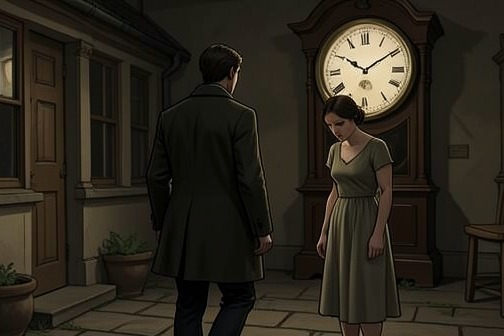
Bingley’s withdrawal from Netherfield is not merely a change of residence but a moral and emotional retreat. [Charles Bingley](entity:character-recall-character-charles-bingley-d470295e8e11) leaves the estate immediately after the [Meryton Assembly](entity:action-recall-action-a094673fbf1a), abandons his obligations to its tenants and servants, and allows his sisters to close the house in his absence. The departure turns an apparently promising courtship with [Jane Bennet](entity:character-recall-character-jane-bennet-1913002c8ec6) into a lesson about weakness, family influence, social reputation, and the responsibilities attached to landed wealth.
## Causes and Background
Charles Bingley had arrived at [Netherfield Park](entity:location-recall-location-netherfield-park-5ab7b1301fde) as a charming, attentive, and apparently good-natured young man. Jane Bennet’s first impression of him was confirmed by his politeness and friendliness, and she became genuinely interested in him. Yet her experience at Netherfield altered that judgment. While Jane was ill after being made to ride in the rain, she observed that Bingley’s amiability did not amount to independence. His sister, [Caroline Bingley](entity:character-recall-character-caroline-bingley-9475b9ccc779), treated [Elizabeth Bennet](entity:character-recall-character-elizabeth-bennet-f97b53a479cc) with sustained personal and social contempt, while Bingley failed to restrain her or defend Elizabeth.
Jane came to see Bingley’s principal defect as retreat. He withdrew from conflict in pursuit of a quiet life, a pattern she associated with [Thomas Bennet](entity:character-recall-character-thomas-bennet-fdb1df6a4cdd)’s tendency to evade domestic difficulty. His relationship with Caroline Bingley therefore became central to the departure: Bingley was capable of kindness, but he would not use his authority to oppose the sister who dominated his household and helped determine his actions.
The decision also reflected Bingley’s uncertain relationship to the life of a landed gentleman. [Fitzwilliam Darcy](entity:character-recall-character-fitzwilliam-darcy-ad3b1ecc1d50) understood that Bingley had worked hard during the previous five years and had long desired an estate because it had been his father’s dream. Nevertheless, less than two months at Netherfield suggested that the role did not suit him. Bingley moved on from the leased estate and treated it as a bad investment even though it was nearby and might still have been salvaged after only three months of neglect. His withdrawal thus joined personal indecision to an unwillingness to undertake the practical duties of ownership.
## What Happens
The decisive sequence begins after the ball. Bingley leaves for [London](entity:location-recall-location-london-420923d4a60a) the morning after the Assembly, claiming that he will be away for four days. Darcy accompanies him. Bingley does not return when expected, however, and never comes back to prepare Netherfield for winter, thank the tenants and servants on [Boxing Day](entity:time-recall-time-boxing-day-2eb8df98b559), or issue instructions to his steward. His sisters begin closing the house on the very day he departs and leave for London the following morning.
The absence is made more damaging by its silence. There is no correspondence from Bingley and no sign that he intends to resume his responsibilities. The tenants receive no assistance from their absent master, and the servants receive none of the customary seasonal attention or gifts. What might have been interpreted as a temporary journey becomes an abandonment of Netherfield and of the people dependent on its management.
[Caroline Bingley’s letter to Jane Bennet](entity:object-recall-object-caroline-bingley-s-let-3d6f36ebcf1d) compounds the injury. Instead of offering a straightforward explanation, the letter presents a deliberately distorted account, including the claim that Charles Bingley is courting [Georgiana Darcy](entity:character-recall-character-georgiana-darcy-1674b422333a), who is only fifteen and several years away from entering society. Jane keeps the letter and gives it to Elizabeth. The false report threatens Georgiana Darcy’s reputation and would be especially inflammatory because Fitzwilliam Darcy would regard its public circulation as a serious lie.
## Effects on Jane and Elizabeth
Jane’s feelings for Bingley diminish as his conduct becomes clearer. She recognizes that her original attraction may have been an infatuation produced by his being the first new unmarried man to appear in the neighborhood for a year, rather than the deepest love she had once imagined possible. The discovery is painful, but it occurs before marriage could bind her to a household in which Caroline Bingley would have exercised continual influence.
Jane becomes particularly grateful that she has seen the family’s character in time. She judges the Bingleys as selfish and chiefly concerned with personal advantage, while acknowledging that the comparison is not fair to [Edward Gardiner](entity:character-recall-character-edward-gardiner-ff481a4f187c), who would not neglect tenants and servants in the same circumstances. Her revulsion is practical as well as emotional: she shudders at the thought of marrying Charles Bingley and having Caroline Bingley installed in the same house.
Elizabeth’s response is sharper. She sees Bingley’s failure to act as evidence of weakness and regards the neglected estate as part of the same pattern that governs his treatment of his sister and Jane. The departure also becomes one of the reasons Elizabeth leaves [Longbourn](entity:location-recall-location-longbourn-09a641b38d11) and enters the household of Edward Gardiner and [Madeline Gardiner](entity:character-recall-character-madeline-gardiner-932ce19b654c). The personal consequences of Bingley’s absence therefore extend beyond a disappointed attachment, contributing to Elizabeth’s movement away from her family and toward a more independent life.
## Social and Narrative Consequences
The withdrawal exposes the difference between possessing money and fulfilling the obligations of a master of an estate. Elizabeth has learned from Madeline Gardiner and [Radha Bhimani Pentland](entity:character-recall-character-radha-bhimani-pentl-686fbe966898) that responsible gentility consists in daily practical care: visiting tenants, understanding their circumstances, and treating welfare as a direct responsibility rather than an ornamental aspect of rank. Against that standard, Bingley’s disappearance is not harmless bachelor movement. It is managerial negligence.
The event also sharpens the contrast between Charles Bingley and Fitzwilliam Darcy. Darcy has tolerated Caroline Bingley partly because of his friendship with Charles, but the situation eventually becomes untenable. He recognizes that Bingley must become his own man and that Caroline must no longer be permitted to govern their social and personal arrangements. Bingley’s abandonment of Netherfield consequently contributes to Darcy’s reassessment of both his friend and his own attachment to Elizabeth.
At the level of narrative structure, the departure changes the value of Bingley’s connection with Jane from hopeful possibility to disillusionment. The promised return fails to occur; the estate that should have been prepared for winter is instead closed; and the courteous new neighbor is revealed through omission rather than open confrontation. The gap between expectation and result gives the event its force. Bingley does not dramatically reject Jane in person. He disappears, and the practical consequences of that disappearance speak for him.
## Significance
Bingley’s withdrawal from Netherfield is a turning point in the novel’s critique of social double standards and inherited privilege. A man praised for charm can still evade responsibility, permit a powerful sister to injure others, and leave an estate and its dependents without explanation. Jane’s disappointment is therefore also an education: affection must be tested against conduct, and pleasant manners cannot substitute for courage or duty.
The event prepares the later separation between Darcy and Charles Bingley and helps redirect both Bennet sisters. Jane escapes a marriage that might have placed her under Caroline’s control, while Elizabeth gains another reason to distrust the social performance of wealthy families. Netherfield’s closure becomes the visible emblem of Bingley’s character at this stage: attractive, prosperous, and seemingly benevolent, yet absent when presence and responsibility matter most.
Event 29
Elizabeth Begins Volunteering at the Orphanage
[Elizabeth Bennet](entity:character-recall-character-elizabeth-bennet-f97b53a479cc)’s beginning volunteer work at the [Asylum for Female Orphans](entity:location-recall-location-asylum-for-female-or-4f260edd15a7) is a decisive movement from intellectual sympathy to organized female service. Her weekly commitment places her among two hundred girls who require food, clothing, literacy, and preparation for employment, and gives concrete public form to the ethic of care she has learned from [Madeline Gardiner](entity:character-recall-character-madeline-gardiner-932ce19b654c) and [Lady Radha Pentland](entity:character-recall-character-lady-radha-pentland-8550d21cca9a). The event also expands Elizabeth’s social world beyond family, courtship, and estate life: she enters an institution shaped by male governance but sustained by the practical labor of women.
## Decision and Context
Elizabeth makes the Asylum the fixed point around which her week will revolve after returning to [London](entity:location-recall-location-london-420923d4a60a). Although [Edward Gardiner](entity:character-recall-character-edward-gardiner-ff481a4f187c) and Madeline Gardiner oppose her seeking a paid position as a governess or companion, Elizabeth agrees not to fill her time immediately with employment. She instead assists her cousin’s governess during selected periods and reserves several mornings and afternoons for correspondence with [Vivian Harkness](entity:character-recall-character-vivian-harkness-4b541bfd881c) and [Violet Harkness](entity:character-recall-character-violet-harkness-9bcb3ea8feb1). The arrangement is presented as respectable scheduling, but everyone understands that it also preserves Elizabeth’s continuing intellectual and personal connection with [Sir David Pentland](entity:character-recall-character-sir-david-pentland-9d7df8c780b8) and the dower house.
Her Wednesday work at the Asylum gives that otherwise unsettled period a clear purpose. Elizabeth has not yet visited the institution when she writes of it, but its association with the women’s refuge supported by Lady Radha Pentland makes it feel close to her heart. The choice is therefore neither an ornamental act of charity nor an attempt to purchase social approval. It is a deliberate use of time by a young woman whose education, curiosity, and desire for practical independence exceed the narrow occupations her relatives consider proper.
## The Institution and Its Work
The Asylum for Female Orphans stands south of the River Thames, near [St. George’s](entity:location-recall-location-st-george-s-b4bca741221c) Fields. Elizabeth’s first journey there is significant in spatial as well as social terms: it is the first time she has crossed the river, despite the Gardiner warehouses lying within sight of London Bridge. To avoid the traffic on that bridge, Madeline Gardiner and Elizabeth travel west and cross at [Blackfriars Bridge](entity:location-recall-location-blackfriars-bridge-26da472f42d8) before turning south and then west toward the charity. The route carries Elizabeth out of the familiar commercial and domestic geography of [Gracechurch Street](entity:location-recall-location-gracechurch-street-4070ca0d2619) and into a district associated with institutional care.
The building is large and forbidding, yet it contains both deprivation and organized hope. The resident girls are between nine and fourteen years old, and there are approximately 200 girls in residence at any one time. Many arrive needing immediate cleaning and food, sometimes after going without either for days. The Asylum’s stated purpose is not merely to house them but to educate them and prepare each young woman for employment once she reaches fourteen.
That education is heavily practical because most of the girls will enter domestic service as maids of all work or kitchen maids. The syllabus therefore includes training in household duties, with volunteer ladies and staff giving the girls opportunities to practise the skills required by the employers they hope to enter. Yet the curriculum also includes reading, writing, simple arithmetic, and needlework. The girls make their own clothing and the institution’s linens, while older and more proficient students undertake paid work that provides a modest subsidy for the Asylum’s operating costs.
## Elizabeth’s Participation
Elizabeth is impressed that the Asylum provides a more formal and comprehensive education than is available to all but the gentry in [Meryton](entity:location-recall-location-meryton-84bf7e41468e). Although many children learn portions of these skills from their parents, the institution offers a structured combination of domestic training, basic academic instruction, and supervised practice. Her volunteering therefore connects directly with her belief that useful knowledge should improve people’s lives rather than remain a private accomplishment.
From the beginning Elizabeth enjoys the work. [Lily](entity:character-recall-character-lily-96089ba009e2), her cousin, is only eleven and remains safe at Gracechurch Street, but Elizabeth recognizes something of Lily’s vulnerability in the residents. Madeline Gardiner appears to share that recognition. The comparison prevents the girls from being reduced to an abstract charitable cause: they are children whose age, dependence, and prospects make their care a continuing responsibility.
Elizabeth is briefly introduced to the institution’s Secretary, a kind man who manages its daily affairs and also serves as Chaplain, before being taken to a schoolmistress and put to work. The volunteers’ introductions are fleeting, emphasizing that the Asylum depends less on ceremonial sociability than on labor. Elizabeth is not there merely to be seen giving money or to enjoy the distinction of helping. She is assigned tasks within an operating institution and becomes useful through participation.
## Gender, Governance, and Social Responsibility
The Asylum is governed by a committee of nineteen gentlemen, a fact that prompts Elizabeth to roll her eyes when Madeline Gardiner explains it. Its royal patron is Queen Charlotte, and one of her sons serves as President, so the institution possesses public legitimacy and elite sponsorship. Nevertheless, its daily effectiveness depends on work that the formal structure does not fully represent: instruction, supervision, sewing, emotional attention, and the repeated practical acts required to prepare vulnerable girls for adult employment.
This division exposes a tension in Elizabeth’s understanding of respectable womanhood. The institution is controlled by men, yet women volunteers and female teachers perform much of the direct educational and caring labor. Elizabeth’s contribution thus operates inside existing social restrictions while quietly challenging their assumptions about women’s proper activity. Her service is socially acceptable because it is charitable, but it also gives her authority, experience, and a public role beyond marriage-market display.
The Asylum further clarifies Elizabeth’s developing belief that welfare is a responsibility rather than a gesture. Her earlier life has taught her to pay attention to tenants, household management, and the consequences of neglect. Lady Radha Pentland’s example has shown her that a woman’s value cannot be measured by public fashion, fertility, or frequency of social appearances. At the Asylum, those principles become institutional practice: girls must be fed, taught, equipped, and helped toward work rather than simply pitied.
## Narrative Significance
The volunteering broadens Elizabeth’s character without separating it from her previous experience. Her escape from the strained atmosphere at [Longbourn](entity:location-recall-location-longbourn-09a641b38d11), where she often walked toward [Oakham Mount](entity:location-recall-location-oakham-mount-db91bc9c688c) and found peace along the estate’s northern brook, had established movement and observation as forms of self-preservation. Her later conversations with Sir David Pentland made questioning—especially the repeated question “why?”—a method of learning about business, authority, and responsibility. At the Asylum, that curiosity enters a setting where knowledge has immediate material consequences.
The event also links several histories of women’s constrained movement. Lady Radha Pentland was born in [Kutch](entity:location-recall-location-kutch-9cd484dc0f71), displaced by conflict, kidnapped for sale into slavery, rescued near the [Arabian Peninsula](entity:location-recall-location-arabian-peninsula-f00d52e55f25), forced into a Spanish nunnery outside [Cadiz](entity:location-recall-location-cadiz-6779628989a5), captured again by pirates, and finally cared for in [Barbados](entity:location-recall-location-barbados-a285bae3d98a) before marrying Sir David Pentland and settling in Britain. Elizabeth’s own access to public service is far safer, but it remains negotiated through family approval, chaperonage, and the conventions governing a young gentlewoman. The Asylum becomes a place where such restrictions are redirected toward collective usefulness.
Elizabeth’s work eventually proves important to her public identity. Unlike the theatre outing in which she enters an Earl’s box on [Fitzwilliam Darcy](entity:character-recall-character-fitzwilliam-darcy-ad3b1ecc1d50)’s arm and becomes conspicuous to the audience, the Asylum offers visibility through service rather than display. It is also distinct from the carefully managed routes and chaperoned meetings that allow her to communicate with Sir David. At the Asylum, her presence is justified by what she does. The beginning of her volunteering therefore marks an ethical and narrative turning point: Elizabeth’s education, sympathy, and independence are no longer only personal qualities but resources placed at the disposal of other women and girls.
Event 30
Elizabeth and Darcy Reunite at the Orphanage
[Elizabeth Bennet](entity:character-recall-character-elizabeth-bennet-f97b53a479cc) and [Fitzwilliam Darcy](entity:character-recall-character-fitzwilliam-darcy-ad3b1ecc1d50)’s reunion at the [Asylum for Female Orphans](entity:location-recall-location-asylum-for-female-or-4f260edd15a7) is the first decisive encounter in their renewed relationship. Elizabeth has established a purposeful life through volunteer work, while Darcy arrives burdened by remorse over his conduct at the [Meryton Assembly](entity:action-recall-action-a094673fbf1a) and by the moral consequences of his family’s protection of [George Wickham](entity:character-recall-character-george-wickham-93fa026a5574). Their meeting therefore begins not with romantic ease but with an imbalance of knowledge, injury, and judgment: Elizabeth sees the arrogant man who has failed the people around [Meryton](entity:location-recall-location-meryton-84bf7e41468e), whereas Darcy is forced to confront a woman whose independence makes his usual social power ineffective.
## The Asylum as a New Meeting Ground
Elizabeth encounters Darcy in a corridor while walking to meet the schoolmistress. Her presence at the Asylum for Female Orphans is not ornamental or socially strategic; she is a volunteer with regular duties, and she is already absorbed in the practical work of assisting the institution. Darcy’s startled question about what she is doing there implicitly treats her presence as unexpected, and Elizabeth immediately resists the assumption that she must justify herself. She curtseys only perfunctorily, explains that she is a volunteer, and leaves to accompany Emily, an older resident pupil, to her appointment.
The setting changes the terms of their acquaintance. At the Meryton Assembly, Darcy’s rank and reserve had helped him dominate the social atmosphere even while his insult wounded Elizabeth. At the Asylum, Elizabeth possesses an authority grounded in service rather than inheritance. She is occupied, needed, and moving toward work; Darcy is the one left standing as she walks away. The encounter thus places his social prestige beside her practical usefulness and allows the institution’s charitable purpose to expose the limits of his previous assumptions.
## Elizabeth’s Refusal to Reopen the Wound
Elizabeth’s response is brief because she has no intention of turning the meeting into a polite reconciliation. Darcy’s form of address and his surprised demand provoke the feeling that she is being examined as though she has no independent right to occupy the place. Her curtsey is deliberately perfunctory, and her departure is even less ceremonious. The scene preserves the sharpness of their earlier conflict rather than softening it into conventional civility.
Yet Elizabeth’s irritation is complicated by an unwelcome awareness of Darcy’s attractiveness. As she tries to put him out of her mind, she recognizes that his handsomeness makes resistance more difficult, even though his conduct continues to offend her. The result is not surrender but rueful self-awareness: attraction exists alongside anger, and neither cancels the other. Her emotional contradiction gives the reunion its charge, because the encounter confirms that Darcy remains capable of unsettling her without yet deserving her trust.
## Darcy’s Retrospection and Moral Discomfort
Darcy watches Elizabeth leave and measures the moment against the preceding three months of introspection. After departing [Netherfield Park](entity:location-recall-location-netherfield-park-5ab7b1301fde), he initially felt relief at escaping the estate and the neighborhood. On the road to [Pemberley](entity:location-recall-location-pemberley-6985fcf27de4) and afterward in [London](entity:location-recall-location-london-420923d4a60a), however, he understood that part of this relief came from escaping the stain his own behavior had placed upon his honor. The Asylum encounter therefore catches him at a point when shame has begun to replace self-satisfaction, but before that change has been tested through action.
His memory returns to the first time Elizabeth walked away from him, at the Meryton Assembly. He had attended reluctantly, emotionally strained by [Georgiana Darcy](entity:character-recall-character-georgiana-darcy-1674b422333a)’s recent ordeal, wary of [Caroline Bingley](entity:character-recall-character-caroline-bingley-9475b9ccc779)’s attempts to compromise him, and already soured by years of being pursued within society. What had seemed to him an accumulation of irritations now appears as context for, not an excuse for, his insult. Elizabeth’s repeated refusals force him to examine the conduct he once treated as merely natural to his rank.
Darcy is also haunted by his failure concerning Wickham. He knows that the Darcy family had excused, concealed, and enabled Wickham’s behavior, allowing a man who had ruined numerous women and fathered three children by three different mothers to remain dangerous in Meryton. Elizabeth’s anger is sharpened by the fact that Darcy knew more than she did yet had done nothing to protect the local people. Their confrontation is therefore not simply a lovers’ quarrel: it is an argument about class responsibility, moral negligence, and the difference between possessing knowledge and using it to prevent harm.
## From Humiliation to Deliberate Courtship
The earlier confrontation leaves Darcy stunned. Elizabeth had accused him of arrogance, pomposity, disdain for other people’s feelings, and failure to behave as a gentleman; she had even declared that he deserved to have his face slapped. He cannot dismiss her as merely impertinent, because her charge is connected to facts he knows to be true. Her anger becomes a form of moral pressure, compelling him to recognize the consequences of a family’s indifference to suffering beyond its own circle.
At [Darcy House](entity:location-recall-location-darcy-house-64c107ab30fe), his thoughts return repeatedly to Elizabeth. He is fascinated precisely because she does not flatter him, flirt with him, or treat his position as an irresistible advantage. She is the daughter of an insignificant, entailed country estate, yet she has more substance and reality for him than any other young woman he knows. Her voluntary work at the Asylum further distinguishes her from the fashionable young women who ordinarily surround him. It suggests a permanent purpose in London and gives him a reason to encounter her outside the rituals of the marriage market.
The reunion consequently becomes a turning point in the romance’s structure. Elizabeth still walks away from Darcy, but Darcy no longer treats her resistance as an insult to be overcome through rank or command. After imagining a life with a woman who might disdain him rather than admire him, he makes a conscious decision to return. He resolves to be at the Asylum at 2:55 the following Wednesday, when Elizabeth and [Lady Maitland](entity:character-recall-character-lady-maitland-18908ab235b8) customarily meet there for tea and biscuits between three and four. The precision of that decision matters: fascination becomes intention, and intention becomes repeated presence.
## Narrative Significance
The scene’s decisive value shift runs from social hostility toward the possibility of accountable acquaintance. Elizabeth does not forgive Darcy, and Darcy does not yet repair the damage he has caused, but the encounter transforms their antagonism into a relationship that can develop through observation and changed conduct. The Asylum offers a setting in which Elizabeth’s work, rather than her family’s social position, defines her, while Darcy must approach her without the protection of an Assembly’s formal hierarchy.
The event also establishes a contrast between two kinds of survival. [Lady Radha Pentland](entity:character-recall-character-lady-radha-pentland-8550d21cca9a)’s history has shown Elizabeth how a woman can survive kidnapping, enslavement, pirate violence, forced religious confinement, severe injury, and social shunning before building a life with [Sir David Pentland](entity:character-recall-character-sir-david-pentland-9d7df8c780b8). Elizabeth carries that example into her own conduct at the Asylum, where care for vulnerable girls becomes active rather than sentimental. Darcy, meanwhile, must survive the collapse of his former moral self-image. His encounter with Elizabeth begins that process by making him witness both her independence and the consequences of his earlier failures.
The reunion does not resolve the questions surrounding Wickham, social prejudice, or the safety of women. Instead, it makes those questions personal for Darcy and gives Elizabeth’s judgment a continuing place in the plot. Her refusal to pause for him becomes the condition of his education: if he wants any future connection with her, he must return not as the unquestioned Master of Pemberley, but as a man capable of reflection, responsibility, and sustained effort.
Event 31
达西向伊丽莎白道歉
Darcy’s apology to Elizabeth is the first substantial repair of the breach created at their initial meeting. In the presence of [Lady Maitland](entity:character-recall-character-lady-maitland-18908ab235b8), [Fitzwilliam Darcy](entity:character-recall-character-fitzwilliam-darcy-ad3b1ecc1d50) directly accepts responsibility for his conduct at the [Meryton Assembly](entity:action-recall-action-a094673fbf1a), and [Elizabeth Bennet](entity:character-recall-character-elizabeth-bennet-f97b53a479cc) accepts his apology while remaining surprised, confused, and suspicious. The scene changes their relationship not by erasing the insult, but by replacing Darcy’s unexamined hauteur with accountable speech and giving Elizabeth the authority to decide what that change means.
## Setting and Circumstances
The apology occurs at the [Asylum for Female Orphans](entity:location-recall-location-asylum-for-female-or-4f260edd15a7), where Elizabeth has begun volunteering. She has spent the day assisting an assistant schoolmistress with the youngest residents, girls aged nine to eleven who are attentive during basic introductory lessons. Earlier, Elizabeth had noticed Lady Maitland but had not found an opportunity to speak with her. In only a few weeks, the two women have begun seeking each other out at the end of the day, although Elizabeth still hesitates to call Lady Maitland a friend because she fears the word presumptuous.
That private uncertainty is interrupted when Elizabeth enters the small sitting room and discovers Darcy already waiting with Lady Maitland. A matron discreetly leaves, preserving the propriety of the meeting while also making its personal significance unmistakable. Elizabeth sits beside Lady Maitland, while Darcy takes the chair opposite her. His nervousness is visible: he appears flustered and runs a hand through his hair before beginning. The setting therefore places a socially unequal man in a situation where he must speak plainly to a woman he previously dismissed, with Lady Maitland serving as witness and social protection.
## The Apology
Darcy opens by saying that he needs to make amends for his behavior, actions, and words at the Meryton Assembly, where they first met. He admits that he cannot even identify a proper introduction because he had not requested one. He also recognizes that waiting five months to apologize is itself nearly unpardonable, yet he seeks forgiveness nonetheless. The delay matters: the apology is not an impulsive response to immediate embarrassment but an act undertaken after conscience has had time to trouble him.
He then identifies the precise wrong. He said something manifestly untrue about a woman to whom he had not been formally introduced, and he said it aloud—loudly enough for Elizabeth to hear over the noise of the Assembly, without her having eavesdropped. His apology is therefore directed at both the content of the insult and its public manner. Darcy does not hide behind misunderstanding, social custom, or the noise of the room; he acknowledges that he judged Elizabeth without knowing her and made the judgment a public humiliation.
Elizabeth listens in wonder because she has not expected this opening or known what to make of it. What she recognizes as obvious is that Darcy’s apology is heartfelt. After he finishes, she gives the concise answer that restores civility without promising intimacy: “I accept your apology Mr. Darcy.” Her response is controlled rather than effusive. Acceptance closes the immediate dispute, but it does not require her to declare the injury forgotten or to revise her opinion of his character all at once.
## Elizabeth’s Response and Darcy’s Conduct
The apology produces mixed effects in Elizabeth. She feels satisfaction, though she cannot immediately determine whether it comes from the apology itself, from Darcy’s admission of fault, or from the restoration of her dignity before a witness. At the same time, she is aware of the difference between their social stations and assumes that their paths are unlikely to cross often. Her acceptance is thus both gracious and guarded: she permits a civil future while refusing to manufacture a personal one.
Darcy thanks her, smiles, and leaves after less than thirty minutes, saying that he has imposed on them long enough. Lady Maitland guides the conversation and pours the tea while Elizabeth maintains her composure and wit, though she is quieter than usual. Darcy’s departure reveals how carefully limited the encounter remains. He has made the necessary acknowledgment, but he has not claimed entitlement to Elizabeth’s attention, affection, or immediate trust.
Even so, the scene unsettles Elizabeth. She has always known that Darcy is handsome, but his smile reveals dimples, and the new impression complicates her settled hostility. The physical detail does not cancel the moral issue; it shows how an act of humility can make a previously remote figure newly legible and attractive. Darcy is no longer only the man who insulted her publicly. He is also a man capable of recognizing the wrong and exposing himself to the discomfort of admitting it.
## Lady Maitland’s Witness and Elizabeth’s Suspicion
After Darcy leaves, Lady Maitland tells Elizabeth that she had known his conscience was troubling him but had not expected him to appear for tea. The meeting was not a scheme: the matron had arranged an extra place only shortly before Elizabeth arrived. This clarification matters because Elizabeth might otherwise suspect that Lady Maitland engineered the encounter to force a reconciliation. Instead, Darcy has come of his own accord, and Lady Maitland’s role is that of discreet witness and trusted confidante.
When Lady Maitland asks how Elizabeth is coping, Elizabeth answers with three precise states: surprised, confused, and tinged with suspicion. She has genuinely accepted the apology because Darcy plainly meant it, but she cannot easily excuse the original behavior. He apologized only after learning that she and Lady Maitland were acquainted, and that timing makes Elizabeth wonder whether his respect depends on her connection to a higher-ranking woman. Her objection reaches beyond personal pride. She was, in Darcy’s original eyes, merely an unconnected country miss, and she remains alert to the social arrogance that made the insult possible.
The event therefore establishes a distinction between forgiveness and trust. Elizabeth can recognize sincerity without granting moral absolution, and she can return to civility without abandoning her analysis of class privilege. Her suspicion keeps the apology from becoming a sentimental shortcut. Darcy has changed his conduct, but Elizabeth insists that the meaning of that change must be tested over time.
## Narrative Consequences and Significance
The apology functions as a turning point in the [Darcy–Elizabeth courtship](entity:state-recall-state-a43d21670c3b). Earlier, Darcy’s contempt had contributed to the conflict surrounding his knowledge of [George Wickham](entity:character-recall-character-george-wickham-93fa026a5574)’s misconduct. Elizabeth had condemned his family for excusing, covering up, and enabling Wickham while leaving the women he harmed exposed to the consequences. Her anger toward Darcy was therefore not limited to one rude sentence at a dance; it was tied to a larger judgment about aristocratic responsibility and the damage caused when powerful men treat local suffering as beneath their attention.
Against that background, Darcy’s apology is a small but meaningful act of moral reorientation. It does not yet address every failure connected with Wickham, nor does it prove that Darcy has become consistently responsible. It does demonstrate that he can identify a wrong committed against a woman whom he once considered socially insignificant, name the wrong without euphemism, and accept the discomfort of being judged by her. Elizabeth’s acceptance creates the possibility of renewed acquaintance, while her reservation preserves the ethical pressure of the scene.
The event also uses narrative reversal. At the Assembly, Darcy possessed social power and Elizabeth bore the public injury; at the Asylum, Darcy is the nervous petitioner and Elizabeth is the person empowered to accept or refuse his appeal. The value shift is from humiliation to acknowledged dignity, but not yet from distrust to love. That incompleteness gives the apology its force: reconciliation begins as a change in behavior and moral language, not as an instant emotional resolution.
Event 32
Darcy visits the Gardiners and resumes courting Elizabeth
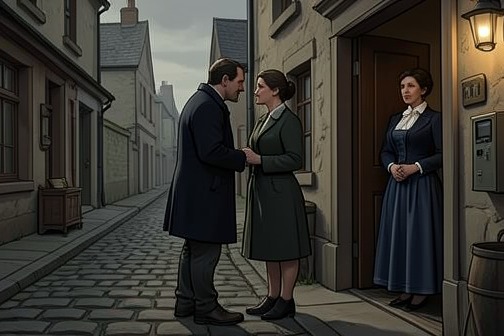
[Darcy visits the Gardiners and resumes courting Elizabeth](entity:event-recall-event-4de5ea3e92e2) at [Gracechurch Street](entity:location-recall-location-gracechurch-street-4070ca0d2619) in a carefully limited but decisive turning point. He does not arrive with a formal proposal; he asks instead for the opportunity to know Elizabeth better and to replace the rude impression he created in [Hertfordshire](entity:location-recall-location-hertfordshire-3be0dd22bb53) with evidence of his real character. Elizabeth’s guarded acceptance transforms their relationship from damaged acquaintance into the opening of an active courtship.
## The Visit to Gracechurch Street
Elizabeth and her relatives have returned to Gracechurch Street after spending the day together when Darcy unexpectedly calls. His arrival throws their plans into disarray, and Elizabeth is genuinely astonished by the visit. She reminds him that she has already accepted his apology and sees no practical reason for another call. Her blunt question—why he has come when he does not like her—forces the encounter into unusual candour rather than allowing it to remain a conventional social performance.
Darcy answers that he does not dislike her, but his response is only the beginning of the scene’s reversal. Elizabeth’s assumption that the relationship has ended is met by Darcy’s decision to reopen it, while his former reserve gives way to a direct account of his own failure. The value at stake is not merely romantic possibility but the possibility of being judged accurately after both parties have behaved badly.
## Darcy’s Self-Reassessment
Darcy explains that he has spent considerable time thinking about his poor conduct during his two months in Hertfordshire. His anger toward one person and irritation with another had distorted his attitude toward the entire visit. In retrospect, however, he recalls the conversations he shared with Elizabeth and recognizes that they had depth and substance. He had treated their intellectual and moral force as an annoyance, allowing habitual pride and irritation to make him deaf to what was actually valuable in her.
This admission marks a significant change in Darcy’s method of courtship. Rather than presenting rank, wealth, or family approval as reasons for Elizabeth to accept him, he acknowledges that he must alter the understanding created by his own behaviour. His stated aim is to show her the gentleman concealed behind the rude semblance she encountered in the autumn. The courtship therefore begins as an ethical undertaking: Darcy must become legible to Elizabeth through conduct, not merely through status.
## Elizabeth’s Conditional Acceptance
Elizabeth is completely flummoxed by the proposal that Darcy should call on her again. His presence in her aunt and uncle’s parlour makes the renewed acquaintance immediate and undeniable, but she knows that this is not yet a declaration of love or a formal courtship. She needs time, and she deliberately steadies herself before answering. Her acceptance is brave precisely because it is limited: she does not surrender her judgment, but agrees to test whether they can behave better toward one another than they did in the autumn.
Her reply establishes reciprocity. Darcy may return, but he cannot presume that the past has vanished or that renewed access constitutes forgiveness without proof. Elizabeth accepts the possibility of improvement while retaining control over the pace and meaning of their relationship. The second beginning is thus neither Darcy’s unilateral pursuit nor Elizabeth’s passive response; it is an arrangement founded on mutual reassessment.
## From Reconciliation to Courtship
Elizabeth’s acceptance produces Darcy’s second display of dimples, a small physical sign of pleasure that contrasts with the stiffness and hostility associated with their earlier encounters. He thanks her and looks forward to spending time with her. From Darcy’s perspective, the visit is more than a successful call: as he rides back to [Darcy House](entity:location-recall-location-darcy-house-64c107ab30fe) on Grosvenor Square, he understands it as the beginning of his suit.
The immediate cause of his decision is also connected to [Caroline Bingley](entity:character-recall-character-caroline-bingley-9475b9ccc779)’s behaviour. Darcy privately recognizes that her conduct helped convince him Elizabeth was the right woman for him, an ironic reversal in which Caroline’s attempt to demean or obstruct Elizabeth contributes to Darcy’s renewed commitment. The event consequently changes the trajectory of the [Elizabeth Bennet–Fitzwilliam Darcy relationship](entity:relation-recall-relation-elizabeth-bennet-fit-2771837e12df): hostility and wounded pride do not disappear, but they are placed within a new process of deliberate courtship.
## Narrative Significance
The visit functions as a recognition scene for Darcy. He understands that the conversations he dismissed contained the very qualities he should have valued, and Elizabeth recognizes that his return may represent genuine reflection rather than a merely ceremonial apology. The event also creates a contrast with the wider failures surrounding [George Wickham](entity:character-recall-character-george-wickham-93fa026a5574). Elizabeth’s anger has been sharpened by the knowledge that Darcy’s family enabled Wickham and failed to protect women he harmed; Darcy’s renewed approach must therefore answer not only to romantic misunderstanding but to a moral judgment of his conduct and responsibilities.
The surrounding history of [Lady Radha Pentland](entity:character-recall-character-lady-radha-pentland-8550d21cca9a) gives the event an additional ethical frame. Lady Radha Bhimani endured displacement from [Kutch](entity:location-recall-location-kutch-9cd484dc0f71), kidnapping intended to sell her into slavery, forced religious confinement near [Cadiz](entity:location-recall-location-cadiz-6779628989a5), pirate captivity, and a nearly fatal sword wound before [Sir David Pentland](entity:character-recall-character-sir-david-pentland-9d7df8c780b8) rescued and cared for her. Elizabeth has learned from Lady Radha that dignity is enacted through practical responsibility and sustained care, not inherited title. Darcy’s visit matters because he begins, however imperfectly, to approach Elizabeth on those terms: by examining his failures, naming the substance he once ignored, and asking to demonstrate change rather than demanding trust.
That movement is the event’s decisive significance. A social call becomes the threshold of courtship because Darcy accepts that affection requires self-knowledge and Elizabeth refuses to confuse renewed attention with proof. Their relationship advances not through the erasure of injury, but through the possibility that conduct after recognition can carry a different value from conduct before it.
Event 33
Wickham’s drowning death

[Wickham’s drowning death](entity:event-recall-event-fd7006b724e4) is an offstage but decisive turning point: [George Wickham](entity:character-recall-character-george-wickham-93fa026a5574) dies in the [River Lea](entity:location-recall-location-river-lea-67a35fdb05b8) after leaving a village inn intoxicated, and his death extinguishes the danger that his knowledge posed to [Georgiana Darcy](entity:character-recall-character-georgiana-darcy-1674b422333a). The event is presented retrospectively to [Elizabeth Bennet](entity:character-recall-character-elizabeth-bennet-f97b53a479cc) and [Fitzwilliam Darcy](entity:character-recall-character-fitzwilliam-darcy-ad3b1ecc1d50), transforming what had been an active moral and social threat into a matter of belated knowledge, relief, and uneasy judgment.
## Circumstances of the Death
Elizabeth Bennet tells Fitzwilliam Darcy that he need do nothing about Lieutenant Wickham because Wickham is already dead. The death occurred roughly two weeks after Darcy left [Hertfordshire](entity:location-recall-location-hertfordshire-3be0dd22bb53), perhaps a day or two later than the remembered date of December 11. By the time Elizabeth recounts it, Wickham has been dead for three months, although Darcy has received no information about the event.
The circumstances are mundane, reckless, and fatal. Wickham had been drinking at the village inn. When he departed, he stole a bottle of brandy and drank from it while walking back toward the militia camp. The exact moment of the fall could not be established, but he went down the river bank and drowned in the River Lea. His body was later found caught by the weir three miles downstream. The physical evidence fixed the route of the accident: scraps of his coat remained on two branches where he had entered the water, and the empty brandy bottle lay at the foot of the bank.
## The Revelation to Darcy
Darcy’s response gives the event its immediate dramatic force. He stops in his tracks when Elizabeth says that Wickham is dead and asks whether she means that he has died. Darcy had not known, and the revelation makes clear that he has been carrying the possibility of Wickham’s return, exposure, or renewed harm without knowing that the danger has already disappeared.
The news is especially consequential because Wickham’s death takes with him the threat that Georgiana Darcy’s past mistake might be exposed. The narration states that the danger of that exposure died with Wickham. Darcy therefore experiences relief, even joy, at the death of another human being, an emotion he recognizes as morally uncomfortable. Elizabeth notices that he has not handled the matter as a gentleman would have, but she refuses to continue fighting over a dead man; with no living antagonist left to confront, the argument has no further practical object.
Darcy distinguishes between the child he once knew and the adult Wickham became. He mourns the boy rather than the man, preserving a remnant of personal loyalty while refusing to sentimentalize Wickham’s later conduct. This distinction compresses their long hostility into a final moral verdict: Wickham’s corruption is not erased by death, but neither is the earlier bond entirely denied.
## Consequences for the Plot
Wickham’s drowning death closes a line of danger that had depended on his continued presence. Darcy no longer needs to manage Wickham, negotiate with him, or fear that he will use Georgiana’s past against the Darcy family. The event also changes the emotional meaning of Darcy’s recollection of his enemy. Wickham had been a living source of uncertainty; after the disclosure, he becomes evidence of how much of the story has unfolded outside Darcy’s knowledge.
Elizabeth uses the revelation as a temporary interruption before returning to Darcy’s original question about the changes in her life. The conversation moves from Wickham’s death to her unwelcome encounter with [William Collins](entity:character-recall-character-william-collins-a95fe9afaea4) and his disagreeable proposal. In this structure, Wickham’s death functions not as a full death scene but as a hinge between past danger and Elizabeth’s altered circumstances: it settles one threat so that the narrative can resume the account of her social, financial, and personal transformation.
## Narrative and Thematic Significance
The event is a form of delayed justice, but not a triumph staged by a hero. Wickham is not confronted, tried, or punished in a public reckoning; his own theft, drinking, and careless walk beside the river lead to an accidental death. The result nevertheless carries the force of consequence. His conduct produces the conditions of his end, while the lack of a witnessed final moment leaves the reader with material traces rather than a complete explanation.
That incompleteness matters. The coat caught on branches, the bottle at the bank, and the body trapped downstream establish what happened while preserving uncertainty about the precise fall. The account is therefore neither a heroic execution nor an entirely abstract report. It is an inferred sequence reconstructed from evidence, and its emotional climax lies less in Wickham’s final action than in Darcy’s sudden recognition that an old threat has vanished.
Wickham’s drowning also reinforces the novel’s contrast between inherited wealth transformed into durable responsibility and personal appetite allowed to collapse into self-destruction. The Pentland fortune began with [Sir David Pentland](entity:character-recall-character-sir-david-pentland-9d7df8c780b8)’s rescue of treasure from a wrecked Spanish galleon during a hurricane and was later preserved through quiet living, investment, and estate management. Against that history of salvaged wealth and planned stewardship, Wickham’s stolen brandy and fatal descent present a miniature counter-history of squandered opportunity. His death does not repair every injury he caused, but it removes his power to cause more and leaves the surviving characters to reckon with the relief, guilt, and unfinished judgment that follow.
Event 34
罗德里戈城战役
The Battle of Ciudad Rodrigo is a Peninsular War engagement remembered in the novel not as a detached military episode but as a report whose casualties reshape how [Elizabeth Bennet](entity:character-recall-character-elizabeth-bennet-f97b53a479cc) understands privilege, absence, and the apparent triviality of civilian complaints. The battle is associated with the death of General Craufurd, the death of General MacKinnon, the wounding of General Sir Ormsby Vandeleur, and more than 1,000 dead and injured; its consequences therefore enter the narrative through both public news and private fear.
## Military Context and Participants
The battle occurs during the long Peninsular War, which has already lasted four bloody years when Elizabeth discusses it with [Lady Maitland](entity:character-recall-character-lady-maitland-18908ab235b8) in [London](entity:location-recall-location-london-420923d4a60a). Lady Maitland is staying in London because her husband, General [Sir Thomas Maitland](entity:character-recall-character-sir-thomas-maitland-011ab301a706), has moved from a governorship in [Ceylon](entity:location-recall-location-ceylon-42512ecf2447) to an active military posting in Sicily, where he serves on Lord Bentinck’s staff against the threat of French invasion. Her brother, General Sir Ormsby Vandeleur, is serving with the Army in [Spain](entity:location-recall-location-spain-336a02c89dc7), placing the battle within her immediate family as well as within the wider British war effort.
Elizabeth identifies General Sir Ormsby Vandeleur as one of the heroes of Ciudad Rodrigo. Her knowledge is specific rather than based on a headline: she has read that he took over the breach after General Craufurd was killed and that he was seriously wounded. The breach thus functions as the battle’s emblematic point of danger, linking military honour to a physically exposed act of succession after a commander’s death.
## Casualties and Personal Stakes
Lady Maitland can report that General Sir Ormsby Vandeleur has survived the immediate danger. Although he was seriously wounded, the danger of infection has passed, and weeks of recuperation remain before recovery. The distinction matters because survival is not presented as an effortless triumph; it is a precarious condition dependent on the passing of infection and followed by prolonged weakness.
The battle’s cost extends beyond Lady Maitland’s brother. Elizabeth has carefully noted the deaths of Generals Craufurd and MacKinnon, as well as the broader figure of more than 1,000 dead and injured. Her response is not to convert the losses into decorative heroism. She places the number beside the empty dance floor of the local assembly, explaining that when she sits out dances because there are too few young men present, reports such as Ciudad Rodrigo show why the shortage exists. The social inconvenience is real, but the battle exposes it as a painfully diminished reflection of a much greater national loss.
## News, Reading, and Recognition
Elizabeth’s understanding of Ciudad Rodrigo comes through disciplined reading. She has formed the habit of examining military reports carefully, partly because a retired naval captain who owned the neighbouring estate where she grew up explained technical details that newspapers left unclear. Her uncle, [Edward Gardiner](entity:character-recall-character-edward-gardiner-ff481a4f187c), works in import and export, so the outcome of the war also bears on the commercial world in which her family lives.
This background makes Elizabeth’s conversation with Lady Maitland an unexpected encounter between domestic sociability and informed public attention. Elizabeth knows the names of the dead, the circumstances of the breach, the seriousness of General Sir Ormsby Vandeleur’s wound, and the scale of the casualties. Lady Maitland recognises that such knowledge cannot have come from casual reading. Elizabeth’s instinctive gesture of patting her hand is socially unconventional, but Lady Maitland accepts it because the gesture answers the personal anxiety beneath the military facts.
## Narrative Consequences and Significance
Ciudad Rodrigo changes the moral scale of Elizabeth’s self-judgment. She admits that her frustration at having too few partners for dances becomes pathetic when set against reports of the battle. The contrast does not erase the ordinary life of assemblies; instead, it makes the relationship between that life and the war visible. Young men are absent from civilian society because they are dead, wounded, serving abroad, or recovering from service, while women experience the war through waiting, reading, mourning, and altered social possibilities.
The battle also exemplifies the novel’s wider movement across imperial and military spaces. Elizabeth’s world is connected to Spain through newspapers, to military families through conversation, and to overseas conflict through the commercial interests of Edward Gardiner. The event is therefore not merely background history. It demonstrates how distant violence enters English homes as names, wounds, empty places, and anxious relatives, while Elizabeth’s careful attention turns public reporting into an act of sympathy and moral comprehension.
Event 35
Elizabeth and Darcy Share Their Histories in a London Park
[Elizabeth Bennet](entity:character-recall-character-elizabeth-bennet-f97b53a479cc) and [Fitzwilliam Darcy](entity:character-recall-character-fitzwilliam-darcy-ad3b1ecc1d50)’s [London](entity:location-recall-location-london-420923d4a60a) park walk is a decisive conversation in which a relationship once defined by insult and guarded judgment begins to acquire trust. Their exchange moves from polite silence to reciprocal disclosure: Darcy offers the structure of his family and his responsibilities toward [Georgiana Darcy](entity:character-recall-character-georgiana-darcy-1674b422333a), while Elizabeth explains why she left [Longbourn](entity:location-recall-location-longbourn-09a641b38d11), rejected [William Collins](entity:character-recall-character-william-collins-a95fe9afaea4), and became dependent on [Edward Gardiner](entity:character-recall-character-edward-gardiner-ff481a4f187c) and [Madeline Gardiner](entity:character-recall-character-madeline-gardiner-932ce19b654c). The walk therefore changes their acquaintance from a remembered [Hertfordshire](entity:location-recall-location-hertfordshire-3be0dd22bb53) encounter into a more intimate understanding shaped by vulnerability, candour, and deliberate choice.
## Setting and Opening
An exchange of notes brings Fitzwilliam Darcy to [Gracechurch Street](entity:location-recall-location-gracechurch-street-4070ca0d2619) early on a blustery Monday morning in March. He and Elizabeth Bennet set out for the local park, accompanied by a footman and a maid who now serve as chaperones rather than security. The practical arrangement gives the meeting a public respectability while leaving the pair sufficient privacy for serious conversation. At first neither knows how to begin, and the walk proceeds in silence.
Elizabeth breaks the silence with an apparently easy request. Since Fitzwilliam Darcy has met her family except for Edward Gardiner, she asks him to tell her about his own. The question is socially natural, but it also establishes the method of the scene: each will reveal personal circumstances only after the other has made disclosure possible. The conversation is not a sudden declaration but a controlled movement from safe family information toward more difficult subjects.
## Darcy’s Family and Responsibilities
Fitzwilliam Darcy explains that both his parents are dead. His mother died not long after the birth of Georgiana Darcy, and his father died nearly six years earlier, leaving only the two siblings in the immediate household. He describes the wider family through its surviving branches: [Catherine de Bourgh](entity:character-recall-character-catherine-de-bourgh-b7f4e7ab5e16) is his widowed aunt, with one unmarried daughter; the [Earl of Matlock](entity:character-recall-character-earl-of-matlock-54e80ec38ed2) and the [Countess of Matlock](entity:character-recall-character-countess-of-matlock-1d746f6b845a) are his maternal uncle and aunt, with two unmarried sons; and Colonel Richard Fitzwilliam, the younger of those sons, is as close to him as a brother.
The account also clarifies the obligations beneath Darcy’s reserve. Colonel Richard Fitzwilliam is serving with Wellington in [Spain](entity:location-recall-location-spain-336a02c89dc7) and is expected to return to Horseguards the following month. Fitzwilliam Darcy shares guardianship of Georgiana Darcy with him, so his family position is not merely one of inheritance and rank. It includes active responsibility for a younger sister whose mother died at her birth. By giving Elizabeth this information, Darcy presents a less public and more accountable version of himself: not simply the proud man she encountered at the [Meryton Assembly](entity:action-recall-action-a094673fbf1a), but a brother and guardian within a small, bereaved family.
## Elizabeth’s Changed Circumstances
When Fitzwilliam Darcy observes that much seems to have changed in Elizabeth Bennet’s life since their last meeting in Hertfordshire, she confirms the change while recalling the night of the Netherfield Ball. The immediate cause was William Collins’s courtship. The morning after the ball, he proposed to Elizabeth, and she refused him despite the precarious position created by the entail on Longbourn and her lack of a substantial dowry.
William Collins then proposed to [Charlotte Lucas](entity:character-recall-character-charlotte-lucas-5bc2f625c79b), who accepted. Elizabeth gives Fitzwilliam Darcy the sequence precisely: the ball occurred on Wednesday, William Collins proposed to her on Thursday morning, left Longbourn with Charlotte Lucas that afternoon, and proposed to Charlotte on Saturday. After their acceptance and marriage early in the year, Charlotte Lucas became the prospective mistress of Longbourn. The practical consequence is severe. Elizabeth’s refusal has not merely ended one unwanted courtship; it has placed the future of her home in the hands of the man she rejected and the friend who accepted him.
Elizabeth also describes the reaction within her family. [Fanny Bennet](entity:character-recall-character-fanny-bennet-32517e125a1f) was virulently angry with her, at times seeming close to physical violence, and Elizabeth doubts that she will be welcome at Longbourn again. Once she reaches the age of majority in January, she moves to the London household of Edward Gardiner and Madeline Gardiner. She had come to London intending to seek work as a governess or companion, although her aunt and uncle have temporarily persuaded her not to act on that plan. Her new independence is therefore mixed with economic vulnerability: she has exercised moral and personal judgment, but the immediate cost is displacement from her parental home.
## Wickham and the Ethics of Judgment
The walk briefly turns to [George Wickham](entity:character-recall-character-george-wickham-93fa026a5574), whom Fitzwilliam Darcy had expected to discuss when considering Hertfordshire. Elizabeth answers that Darcy need do nothing about Lieutenant Wickham because Wickham is dead. Darcy rejects the suggestion that he feels no grief, explaining that Wickham was his father’s godson and that he mourns the boy Wickham once was, not the man he became.
This exchange is brief but important because it revises the earlier conflict between the two men. Elizabeth still believes that Darcy did not handle the matter as a gentleman, yet she refuses to continue fighting over a dead man. Darcy, meanwhile, distinguishes personal mourning from approval of Wickham’s adult conduct. Their positions remain morally complex rather than identical, but the conversation no longer produces the explosive antagonism associated with their first acquaintance. The dead man becomes a test of whether they can discuss injury, responsibility, and judgment without allowing old resentment to control the present.
## Invitation and Narrative Significance
The conversation ends by crossing from explanation into renewed social intimacy. Elizabeth Bennet invites Fitzwilliam Darcy to join her and Madeline Gardiner for tea, and he accepts with evident pleasure. The invitation carries more weight than its domestic simplicity suggests. Elizabeth is not merely permitting an accidental meeting; she is bringing Darcy into the household that has sheltered her after Longbourn became hostile. Darcy, in turn, enters a family environment in which Elizabeth’s intelligence and conduct are known independently of the aristocratic assumptions surrounding him.
At tea, [Lily](entity:character-recall-character-lily-96089ba009e2) and Eddy, the two eldest Gardiner children, remain with Madeline Gardiner. She introduces Darcy and explains that he is a governor at the [Asylum for Female Orphans](entity:location-recall-location-asylum-for-female-or-4f260edd15a7), where Elizabeth Bennet volunteers. The children know that their mother once volunteered there regularly before the demands of four children consumed her time, and Darcy is impressed by their manners. The scene thus extends the walk’s central movement: private disclosure becomes ordinary social inclusion.
The event also gains depth from the earlier history Elizabeth has learned from [Radha Bhimani Pentland](entity:character-recall-character-radha-bhimani-pentl-686fbe966898). Radha’s life crossed [Kutch](entity:location-recall-location-kutch-9cd484dc0f71), the [Arabian Peninsula](entity:location-recall-location-arabian-peninsula-f00d52e55f25), Spain, [Cadiz](entity:location-recall-location-cadiz-6779628989a5), [Cartagena](entity:location-recall-location-cartagena-a586cc897c9b), [Barbados](entity:location-recall-location-barbados-a285bae3d98a), and Britain through conquest, kidnapping, slavery, piracy, forced religious confinement, rescue, and resettlement. [Sir David Pentland](entity:character-recall-character-sir-david-pentland-9d7df8c780b8)’s care, his willingness to court her after learning what she had endured, and his decision to resign from the British naval career after Radha was shunned on Barbados provide Elizabeth with a model of dignity surviving violent displacement. Elizabeth later identifies both Radha and Madeline Gardiner as teachers in what it means to be a gentle-born lady, especially through practical care for dependants and tenants. Against that background, the London walk represents Elizabeth practicing the same ethic of reciprocal attention: she listens to Darcy’s family history, tells him the truth of her own altered position, and allows a relationship to proceed through knowledge rather than assumption.
As a narrative event, the walk shifts the value of the Darcy–Elizabeth relationship from guarded possibility toward active trust. The blustery weather, the initial silence, the orderly exchange of family histories, the painful account of William Collins, and the final invitation to tea form a sequence in which expectation repeatedly meets a gentler result. Elizabeth does not erase the past, and Darcy does not demand that she do so. Instead, both make room for the other’s history, leaving the acquaintance ready for renewed courtship without reducing that courtship to a sudden or unsupported romantic resolution.
Event 36
Elizabeth Bennet leaves Longbourn

[Elizabeth Bennet leaves Longbourn](entity:event-recall-event-elizabeth-bennet-leaves-6f362c5f8bbd) two days after coming of age and does not return to live there. Moving into the [London](entity:location-recall-location-london-420923d4a60a) household of [Edward Gardiner](entity:character-recall-character-edward-gardiner-ff481a4f187c) and [Madeline Gardiner](entity:character-recall-character-madeline-gardiner-932ce19b654c) transforms an apparently domestic quarrel into an act of legal, emotional, and practical self-separation: she abandons the house that has been her childhood home in order to secure a life in which her judgment, work, and future are not controlled by her mother’s demands.
## Causes and Background
The departure follows a long history of conflict between Elizabeth and [Fanny Bennet](entity:character-recall-character-fanny-bennet-32517e125a1f). At [Longbourn](entity:location-recall-location-longbourn-09a641b38d11), Fanny’s voice repeatedly becomes shrill, and Elizabeth’s habitual answer is to take her spencer and escape through the kitchen. Her preferred walk is toward [Oakham Mount](entity:location-recall-location-oakham-mount-db91bc9c688c), but because that route can be seen from the parlour window, she instead circles around the western side of the house and heads north toward the brook marking the estate’s boundary. The route is more than a convenient path: it gives Elizabeth temporary distance from a household in which she expects to be stopped as much as she expects to be noticed.
Elizabeth’s position within the family is sharply divided. Fanny considers her the least favourite daughter, and their incompatible temperaments have produced harsh words for as long as Elizabeth can remember. [Thomas Bennet](entity:character-recall-character-thomas-bennet-fdb1df6a4cdd), by contrast, favours Elizabeth because she is the most academically gifted of his five daughters and shares his attachment to books and curiosity about the wider world. The protection provided by that bond is limited, however. Elizabeth’s eventual decision shows that paternal affection cannot compensate for the household’s broader instability or for the pressure placed upon her as a marriageable daughter.
The immediate crisis is connected with Elizabeth’s refusal of [William Collins](entity:character-recall-character-william-collins-a95fe9afaea4). She rejects the idea that a bride can be forced into marriage and argues that her mother’s concern is directed less toward Elizabeth’s feelings than toward retaining Longbourn. Fanny’s reaction confirms the coercive nature of the conflict: after William Collins becomes engaged to [Charlotte Lucas](entity:character-recall-character-charlotte-lucas-5bc2f625c79b) and [Charles Bingley](entity:character-recall-character-charles-bingley-d470295e8e11) leaves the neighbourhood, Fanny assigns the blame to Elizabeth, even though [Jane Bennet](entity:character-recall-character-jane-bennet-1913002c8ec6) has explained that Jane herself chose to refuse Charles Bingley.
## The Departure and New Household
Only two days after reaching majority, Elizabeth walks out of Longbourn and moves in with Edward Gardiner and Madeline Gardiner in London. The narrative treats the act as final rather than theatrical. Jane Bennet and [Mary Bennet](entity:character-recall-character-mary-bennet-3ad0e066a036) are shocked and spend many hours discussing whether Elizabeth has somehow violated a commandment; a letter containing the reference to Ephesians intensifies their examination of the decision. Their repeated reading of the passage recognizes, too late, the difference between parental authority and the duty not to provoke children to anger. Elizabeth is not returning, and the family’s attempt to interpret the departure after the fact cannot undo it.
Her new residence is not merely a refuge from Fanny Bennet. With the Gardiners, Elizabeth enters a household marked by affection, practical competence, and intellectual exchange. She later explains that Madeline Gardiner and [Radha Bhimani Pentland](entity:character-recall-character-radha-bhimani-pentl-686fbe966898) taught her what it meant to be a lady through daily conduct rather than rank alone. Madeline is the wife of a London tradesman, a mother of four young children, and a frequent hostess who supports Edward’s business; Radha Bhimani Pentland is a woman born in [Kutch](entity:location-recall-location-kutch-9cd484dc0f71) who survived repeated kidnapping, pirate violence, forced religious confinement, and severe injury. Elizabeth’s understanding of respectable womanhood therefore comes from examples of responsibility and endurance rather than from Fanny’s insistence on marriage and social display.
The move also places Elizabeth within the network surrounding the [Grenadine Reef](entity:location-recall-location-grenadine-reef-ad0be7a0e4a4) women’s refuge. Her earlier habit of walking away from Longbourn develops into purposeful mobility: she can travel to the [Asylum for Female Orphans](entity:location-recall-location-asylum-for-female-or-4f260edd15a7), situated south of the River Thames in [St. George’s](entity:location-recall-location-st-george-s-b4bca741221c) Fields, and participate in work for girls aged nine to fourteen. The institution houses about 200 girls, feeds and cleans them on admission, provides practical education, and prepares most of them for domestic service. Elizabeth’s departure thus opens into a life of useful activity rather than idle dependence.
## Consequences for Longbourn and Its Daughters
Elizabeth’s absence immediately exposes how much responsibility she had been carrying at Longbourn. Jane, Mary, and sometimes [Kitty Bennet](entity:character-recall-character-kitty-bennet-e68b587aa3bf) continue the tenant visits that Fanny never undertakes, while Thomas Bennet becomes an even more indolent master of the estate without Elizabeth present to chide him. Fanny continues spending freely and spoiling [Lydia Bennet](entity:character-recall-character-lydia-bennet-0020f0bd0490) even as she worries about the family’s future after Thomas’s death. The contradiction reveals the practical weakness beneath her loud concern: she fears poverty but does little to manage the estate that might sustain the daughters.
The family’s emotional balance also changes. Elizabeth had long served as Fanny’s favourite target, so when she disappears, Fanny redirects her complaints toward Jane. Jane and Mary are not merely offended by Elizabeth’s independence; they are confused and afraid because they understand that their upbringing leaves them expected to marry and leave home. Jane’s continuing work at Longbourn makes the economic danger visible, while Charles Bingley’s prolonged silence and [Caroline Bingley](entity:character-recall-character-caroline-bingley-9475b9ccc779)’s letter reinforce Jane’s conclusion that he was not a serious suitor. Elizabeth’s departure therefore becomes a warning about the difference between marriage as social expectation and marriage as a relationship worthy of trust.
Elizabeth’s weekly joint letters to Jane and Mary provide the clearest evidence of the move’s result. She never needs to write the sentence that she is happy, because her joy is evident throughout the pages. The letters preserve the sisterhood while confirming the separation from Longbourn: Elizabeth has not abandoned Jane and Mary, but she has refused to return to the conditions from which she escaped.
## Significance and Later Development
The departure is the first unmistakable public act of Elizabeth’s adult independence. It follows her refusal to be treated as property in William Collins’s proposal and rejects the logic that a daughter must sacrifice her judgment to preserve an estate. Her use of the Ephesians passage makes the argument in moral as well as personal terms: obedience cannot excuse parental anger, emotional neglect, or an attempt to force marriage.
The event also reorients Elizabeth’s social geography. From Longbourn’s kitchen exits, northern brook, and tenant fields, she moves into London, where the Gardiners’ household, the Asylum for Female Orphans, and later public spaces such as the theatre provide new forms of movement and visibility. Her first theatre outing from a prominent box, entering on [Fitzwilliam Darcy](entity:character-recall-character-fitzwilliam-darcy-ad3b1ecc1d50)’s arm before the gaze of the audience, demonstrates how far her life has shifted from concealed flight through the kitchen. The journey from private escape to public presence is gradual, but the decisive step is taken when she leaves Longbourn.
Her departure also connects the Bennet family’s domestic conflict with the larger history Elizabeth has learned from Radha Bhimani Pentland. Radha’s life began with forced displacement from Kutch, continued through rescue near the [Arabian Peninsula](entity:location-recall-location-arabian-peninsula-f00d52e55f25), involuntary confinement outside [Cadiz](entity:location-recall-location-cadiz-6779628989a5), pirate capture, and eventual resettlement in [Barbados](entity:location-recall-location-barbados-a285bae3d98a) and Britain. Her marriage to [Sir David Pentland](entity:character-recall-character-sir-david-pentland-9d7df8c780b8) and the later refuge associated with Grenadine Reef teach Elizabeth that survival may require movement across borders and that a new household can be created through care rather than inherited security. Against that history, Elizabeth’s move to London is less an impulsive flight than a controlled act of resettlement.
The decisive value shift is from constrained dependence to chosen safety and happiness. Longbourn remains Elizabeth’s childhood home, and she has known its tenants and fields since accompanying Jane on visits at the age of ten; nevertheless, familiarity cannot make an injurious household secure. By leaving at the threshold of legal adulthood and prospering with the Gardiners, Elizabeth turns separation into the foundation for later work, relationships, and control over her own future.
Event 37
Darcy and Elizabeth's public theatre outing

[Darcy and Elizabeth's public theatre outing](entity:event-recall-event-darcy-and-elizabeth-s-p-21d03785add0) is the moment when [Fitzwilliam Darcy](entity:character-recall-character-fitzwilliam-darcy-ad3b1ecc1d50) and [Elizabeth Bennet](entity:character-recall-character-elizabeth-bennet-f97b53a479cc) move their developing relationship from guarded private visits into the full visibility of [London](entity:location-recall-location-london-420923d4a60a) society. The invitation to the Earl’s box is not merely entertainment: it gives Elizabeth a recognized place beside Darcy, exposes her to public scrutiny, and makes their association legible to the very social world that has previously kept her at its edges.
## The Invitation and Its Stakes
Elizabeth’s life had settled into a repeated pattern: Fitzwilliam Darcy called at [Gracechurch Street](entity:location-recall-location-gracechurch-street-4070ca0d2619) on Monday and Thursday mornings, while a social outing took place in town on Friday or Saturday. During these visits, Elizabeth also ensured that the courier remained below stairs until Darcy had departed, preserving the privacy of their dealings. The theatre invitation therefore represented a deliberate change in scale and meaning.
Darcy had been offered the Earl’s box for the Saturday evening and invited Elizabeth, [Edward Gardiner](entity:character-recall-character-edward-gardiner-ff481a4f187c), and [Madeline Gardiner](entity:character-recall-character-madeline-gardiner-932ce19b654c) as his guests. He proposed that they dine first at [Darcy House](entity:location-recall-location-darcy-house-64c107ab30fe), where he would introduce Elizabeth’s party to [Georgiana Darcy](entity:character-recall-character-georgiana-darcy-1674b422333a) and Richard Fitzwilliam. The arrangement joined the Gardiners and Darcy’s family before placing the whole group in a highly visible public setting. Its purpose was social as much as personal: Elizabeth would no longer be treated as someone encountered discreetly at the margins.
## Entering the Earl’s Box
The outing made its significance explicit by taking place “Out in public,” not at the edges of society but “right in the heart of it.” Every participant understood that the gesture carried consequences. The theatre was a public stage, and the Earl’s box amplified that quality: it offered an excellent view of the performance while making its occupants conspicuous to the audience below.
Elizabeth had attended plays before with the Gardiners and had occasionally watched from a box, but this was her first experience of occupying such a prominent position. Her entrance on Darcy’s arm was visible to all. She maintained an iron grip on herself, resisting the temptation to turn her head and absorb the theatre’s grandeur or the reactions of its patrons. Darcy had timed their arrival so carefully that they had no opportunity to linger in the foyer, where immediate curiosity might have surrounded them.
Once inside the box, however, concealment became impossible. Elizabeth felt that half the theatre was watching her, though the actual number was smaller. The attention was nevertheless far more pointed than she was accustomed to receiving. She occupied the centre seat in the front row, with Darcy and Georgiana Darcy on either side of her, while Richard Fitzwilliam sat in the raised row behind with Edward and Madeline Gardiner. The physical arrangement itself displayed Elizabeth’s position: she was placed at the centre of Darcy’s family party rather than left among its peripheral guests.
## The Performance and Elizabeth’s Self-Control
The extinguishing of the lights redirected the theatre’s attention to the stage and allowed Elizabeth to become absorbed in the performance. The play offered a temporary release from the pressure of being observed, but the first intermission interrupted that protection. Darcy asked whether she wished to step outside for refreshments or to stretch her legs. Elizabeth did not wish to leave the box, and a quick glance toward Madeline Gardiner confirmed that her aunt was content for her to remain.
The exchange reveals the practical tension beneath the outing’s apparent ease. Elizabeth had been brought into public view, but she still had to manage the attention that followed. Remaining in the box meant accepting the scrutiny attached to Darcy’s invitation; leaving might have made the scrutiny more conspicuous rather than less. Her decision to stay demonstrates composure and an active willingness to inhabit the position Darcy had offered her.
## Public Courtship and Social Consequence
The theatre outing transformed the meaning of Darcy’s earlier calls. Private visits could be interpreted, denied, or explained away; a formal invitation to the Earl’s box, preceded by dinner at Darcy House and accompanied by Darcy’s sister and cousin, was far harder to classify as casual acquaintance. It presented Elizabeth as Darcy’s chosen companion before an audience that could observe both their proximity and the family’s participation in the evening.
For Edward and Madeline Gardiner, the outing also clarified what had previously remained uncertain. The exact nature of Elizabeth’s relationship with Darcy had already given them much to consider, and the public theatre appearance supplied a powerful answer without requiring either party to make a formal declaration. Darcy’s action functioned as a social acknowledgment: he was willing to associate Elizabeth with himself and his family where others could see.
The event’s decisive value shift lies in the movement from privacy to exposure. Elizabeth begins the evening as a woman accustomed to guarded encounters and conscious of the danger of public interpretation. She ends it installed in the centre of Darcy’s family party, visibly connected to him in one of London’s most socially legible spaces. The outing does not complete their courtship, but it changes its conditions: their relationship has entered society’s field of vision, where it can be judged, discussed, and no longer easily hidden.
Event 38
The rumour that Elizabeth Bennet is Darcy's mistress
[The rumour that Elizabeth Bennet is Darcy's mistress](entity:event-recall-event-the-rumour-that-elizabe-5e85bc92bc49) is the first major social assault on [Elizabeth Bennet](entity:character-recall-character-elizabeth-bennet-f97b53a479cc) after her public theatre outing with [Fitzwilliam Darcy](entity:character-recall-character-fitzwilliam-darcy-ad3b1ecc1d50). Begun by [Caroline Bingley](entity:character-recall-character-caroline-bingley-9475b9ccc779), it turns an identifiable but initially limited piece of gossip into a charge of sexual impropriety, placing Elizabeth's reputation, social entry, and relationship with Darcy under immediate pressure. The episode also reveals how quickly the Ton can convert uncertainty into apparent knowledge while making the origin of the accusation difficult to confront.
## Caroline Bingley's Campaign
Caroline Bingley spends an afternoon visiting some of the most indiscreet women in her acquaintance and supplies a name for the newspaper's reference to the “lady who accompanied Mr. D of Derbyshire.” The newspaper item itself is treated as the main subject of gossip that morning, but Caroline does not stop at the available facts: an unknown country miss with little dowry and no connections. She adds the decisive slander by accusing Elizabeth of being Darcy's mistress.
The campaign is calculated to wound Elizabeth before Elizabeth has properly entered [London](entity:location-recall-location-london-420923d4a60a) society. The accusation is therefore not merely private malice. It is an attempt to define Elizabeth publicly through sexual shame before she can establish her own identity, connections, or standing. Caroline's hostility also carries a strategic risk for herself: if Darcy is serious about Elizabeth, the attack may rebound upon its author.
## How the Rumour Spreads
The rumour moves through the Ton with remarkable speed. Caroline Bingley begins circulating it immediately after lunch on Monday, and by Tuesday evening it has reached [Lady Maitland](entity:character-recall-character-lady-maitland-18908ab235b8). Its transmission is carefully hedged. Rather than making categorical claims, the women repeat formulas such as “I am led to believe,” “the latest rumour is,” and “my maid passed on the most delicious titbit.” These phrases preserve the pleasure of accusation while allowing each speaker to deny direct responsibility.
The social mechanism is presented as a collective appetite for destruction. With little else to occupy their time, the women of the Ton take delight in tearing down people thought to have reached too high. The rumour thus depends on more than Caroline's initiative: it is sustained by a community that treats another woman's reputation as entertainment. One woman who repeated the allegation was warned that Elizabeth was not Darcy's mistress and that spreading it could be dangerous because Darcy possessed both a long reach and deep pockets. That warning cauterises one wound, but the damage continues through many other channels.
## Elizabeth Learns the Charge
Lady Maitland seeks Elizabeth as soon as Elizabeth arrives at the [Asylum for Female Orphans](entity:location-recall-location-asylum-for-female-or-4f260edd15a7) on Wednesday morning. She leads Elizabeth urgently into a private sitting room and closes the door before delivering the news that a rumour is circulating through town identifying Elizabeth as Darcy's mistress. Elizabeth's immediate uncertainty is not simple credulity or panic. She weighs tears at the terrible lie and anger at the gross falsehood, then recognises that neither response would solve the practical problem of proving a negative.
The exact wording gives Elizabeth the clue she needs: “That a Miss Eliza Bennet, who accompanied Mr. Darcy to the theatre on Saturday night, is his new mistress.” The shortened form of her name points back to [Hertfordshire](entity:location-recall-location-hertfordshire-3be0dd22bb53), where one family uses it, and Elizabeth knows that only one other acquaintance does so. The rumour therefore contains its own trace of origin. Her reaction changes from stunned helplessness to controlled, predatory resolve; the smile observed by Lady Maitland is described as distinctly lupine. Elizabeth then asks for a pen, ink, and an envelope, indicating that she intends to answer the attack through deliberate action rather than emotional protest.
## Social Stakes and Narrative Function
The event makes reputation a visible instrument of power. Elizabeth's poverty, limited dowry, and lack of connections are treated as vulnerabilities that can be translated into sexual suspicion once she is seen beside Darcy. The charge is especially effective because it exploits the Ton's assumption that a socially unplaced woman accompanying a wealthy gentleman must be explained through the language of sexual possession.
At the same time, the rumour exposes the double structure of aristocratic gossip: its speakers claim merely to pass on information, yet their repeated insinuations create real social consequences. The episode moves from newspaper reference, to Caroline Bingley's embellishment, to anonymous repetition, and finally to Elizabeth's discovery of the wording. It is both a reputational crisis and an investigation into its source. Elizabeth's recognition of the distinctive name “Eliza” converts the scandal from an apparently impersonal social tide into an attack with a recoverable author, preparing the ground for her rebuttal and for the eventual consequences of Caroline's campaign.
Event 39
Darcy and Elizabeth's public rebuttal of the mistress rumour

[Darcy and Elizabeth's public rebuttal of the mistress rumour](entity:event-recall-event-darcy-and-elizabeth-s-p-a189b76ebbbe) is a calculated social counterattack in which a threatened reputation is defended by visibility, propriety, and controlled ambiguity. The rumour has already spread through selective hearing and sight, and Darcy has told the Gardiners that the associated letter is “full of lies” capable of harming others. Rather than expose its details or allow the gossip to dictate their movements, he proposes an outing so conspicuously respectable that the charge becomes difficult to sustain: Elizabeth and [Madeline Gardiner](entity:character-recall-character-madeline-gardiner-932ce19b654c) will be seen in his company, alongside [Georgiana Darcy](entity:character-recall-character-georgiana-darcy-1674b422333a) and Richard Fitzwilliam, across several fashionable [London](entity:location-recall-location-london-420923d4a60a) locations. The event shifts the public meaning of Darcy and Elizabeth’s association from suspected illicit intimacy toward an unmistakable, if not yet formally announced, courtship.
## Rumour and the Problem of Reputation
Darcy presents the gossip as a compound failure of observation and judgment. The story circulating about him and Elizabeth includes a letter, but he refuses to repeat its particulars; his concise account is that the letter consists of lies that could injure other people. This restraint matters because the rumour thrives on insinuation. A detailed defence might grant the accusation a seriousness it does not deserve, whereas refusing to rehearse the allegation keeps its falsehood from becoming the centre of the conversation.
The Gardiners nevertheless recognize that silence alone will not repair Elizabeth’s reputation. Madeline Gardiner asks what can be done to “salvage Elizabeth’s reputation,” making the event’s immediate stake explicit: the danger is not merely Darcy’s embarrassment but the social consequences attached to Elizabeth’s name. In a society where a woman’s respectability can be damaged by suggestion rather than proof, the burden of correction falls upon public appearances as much as upon truth. The response therefore treats reputation as something produced and contested in social space.
## The Public Strategy
Darcy’s plan is intentionally bold. He points out that Georgiana Darcy was seated to Elizabeth’s left during the theatre performance, in full view of the audience and in the [Earl of Matlock](entity:character-recall-character-earl-of-matlock-54e80ec38ed2)’s box. He reasons that anyone familiar with the supposed “correct” arrangement for a mistress would not place such a woman beside a fifteen-year-old sister in so prominent a setting. The argument uses the conventions of the very society that created the rumour: propriety, family presence, rank, and theatrical visibility become evidence against the accusation.
The proposed sequence extends that logic beyond the theatre. Darcy wants to escort Elizabeth and Madeline Gardiner to the British Museum, have lunch somewhere fashionable, stroll down New Bond Street, and finish at [Gunther’s](entity:location-recall-location-gunther-s-127ff431ee14). Georgiana Darcy and Richard Fitzwilliam will accompany them, and [Lady Maitland](entity:character-recall-character-lady-maitland-18908ab235b8) later joins the party, bringing its number to six. Each location is socially legible, and the accumulation is deliberate. A single appearance might be explained away; a whole day spent in reputable, public company makes the alleged clandestine relationship increasingly implausible.
Madeline Gardiner immediately understands the force of the performance. She observes that the outing will mostly destroy the rumour that Elizabeth is Darcy’s mistress, but will almost certainly create other rumours. The distinction is the event’s central irony: the plan cannot remove Elizabeth and Darcy from the gaze of society, because society’s gaze is the instrument they must use. It can replace one interpretation with another, not abolish interpretation itself. Elizabeth and Darcy’s inability to suppress their blushes confirms that the new speculation will concern their feelings and future intentions.
## The Day in London
The outing follows a week in which distress spreads outward through the social circle. Lady Maitland is upset on Tuesday; Elizabeth learns of the rumour and becomes upset on Wednesday; Darcy and Madeline Gardiner are drawn into the disturbance on Thursday; [Edward Gardiner](entity:character-recall-character-edward-gardiner-ff481a4f187c) is involved when he returns home. On Friday, however, the week’s events are symbolically cast into the fire and reduced to ash as the party carries out Darcy’s plan. The image marks a controlled reversal: private alarm is converted into a public demonstration.
The day is not presented as effortless pleasure. Elizabeth and Darcy generally avoid the fashionable Ton and its rituals, so the itinerary is described as a necessary evil that they nevertheless manage to enjoy. [The British Museum](entity:location-recall-location-e4ef85c2a833) provides an especially pointed beginning. Elizabeth remarks that she has sometimes felt like one of the exhibits under glass, exposed to scrutiny. Her comparison acknowledges that the outing is itself a spectacle, but it also gives her a position from which to observe the mechanics of being observed. The public gaze that threatens her is made visible, and therefore temporarily manageable.
The party’s success depends on more than Darcy’s intention. Colonel Richard Fitzwilliam and Lady Maitland belong to overlapping social circles and are known by many people; they facilitate the approach of most of those encountered during the day and take delight in helping the couple. Their participation supplies the outing with social authentication. Darcy and Elizabeth are not merely seen together; they are received within recognized networks of family, rank, and acquaintance. By the end of the day, the objective has been achieved, and even the members of the party are independently speculating that an official courtship will be announced on the Monday after [Easter](entity:time-recall-time-easter-4ee721615d13). Elizabeth alone does not anticipate the request.
## Consequences and Narrative Significance
The event succeeds because it accepts the instability of public meaning instead of pretending to control it completely. Darcy and Elizabeth cannot persuade every observer to stop talking, but they can force the available story to change. The mistress rumour is answered by family proximity, fashionable public places, and sustained company; the same evidence that makes the original allegation absurd points toward a socially acceptable attachment. Reputation is shown not as a private possession but as a contested narrative assembled from arrangements, witnesses, and repeated appearances.
The scene also advances Darcy and Elizabeth’s relationship without making the courtship announcement itself occur during the outing. That delay preserves the difference between public evidence and formal declaration. The party’s six members can read the trajectory, and the Monday after Easter seems to them the natural moment for an official request, yet Elizabeth remains unaware of the plan. The event therefore closes one danger while opening the next stage of the romance: public rebuttal becomes the prelude to acknowledged courtship.
Its larger significance lies in the contrast between passive exposure and active presentation. Elizabeth has been treated as an object under glass, but she participates confidently in the countermeasure; Darcy does not hide her away or demand that she defend herself alone. Together they occupy the spaces where gossip operates and turn respectable visibility into a form of agency. The strategy does not overthrow the social order that judges Elizabeth, but it makes that order serve her by compelling its own codes—family, propriety, and public accountability—to contradict the accusation.
Event 40
Darcy cuts Caroline Bingley and separates from Charles Bingley
[Darcy cuts Caroline Bingley and separates from Charles Bingley](entity:event-recall-event-darcy-cuts-caroline-bin-b940dc3f7df2) at a moment when private malice becomes a public social consequence. After discovering Caroline’s written lies about [Georgiana Darcy](entity:character-recall-character-georgiana-darcy-1674b422333a) and confronting the damage surrounding the rumour that [Elizabeth Bennet](entity:character-recall-character-elizabeth-bennet-f97b53a479cc) is his mistress, Darcy refuses to protect Caroline through silence or family influence. He gives [Charles Bingley](entity:character-recall-character-charles-bingley-d470295e8e11) a limited chance to preserve their friendship, but makes clear that Caroline must be removed from their social world and that the friendship itself will be suspended if Charles cannot contain her conduct.
## The Letter and the Hidden Cause
The immediate turning point is a sealed letter from [Caroline Bingley](entity:character-recall-character-caroline-bingley-9475b9ccc779) to [Jane Bennet](entity:character-recall-character-jane-bennet-1913002c8ec6), passed to Darcy through [Lady Maitland](entity:character-recall-character-lady-maitland-18908ab235b8). Darcy recognizes Caroline Bingley’s handwriting and reads the document in private. Its contents are not disclosed to the wider circle, but the effect is unmistakable: the letter contains lies about Georgiana Darcy serious enough to threaten her reputation, and Darcy tells Lady Maitland that it is worse than the current gossip. The strict secrecy surrounding the letter matters. Only Caroline Bingley, the three eldest Bennet sisters, and Darcy know its full contents, so the social punishment proceeds without publicly exposing every detail of Caroline’s attack.
The letter also changes the meaning of the rumour that Elizabeth Bennet is Darcy’s mistress. Darcy cannot prove that Caroline started that rumour, and he refuses to spend time pursuing a claim that remains uncertain. Yet Caroline’s established conduct makes her impossible to defend. Her hostility toward Elizabeth Bennet, her lies concerning Georgiana Darcy, and her willingness to injure another woman’s reputation together create a pattern in which formal proof is less important than the danger she poses to everyone around her.
## Darcy’s Decision and the Friendship at Risk
Darcy tells Charles Bingley that the letter has severed all acquaintance between himself and Caroline Bingley. He will inform the [Countess of Matlock](entity:character-recall-character-countess-of-matlock-1d746f6b845a) and Lady Maitland that he is giving Caroline Bingley the cut direct, and he asks them to do the same. He also makes the consequences personal: if Caroline Bingley approaches him again, he will ignore her completely, while the Countess of Matlock, Lady Maitland, and Darcy’s own standing will combine to make Caroline socially ruined.
Darcy does not initially sever Charles Bingley from his life. Instead, he proposes a two-year separation from regular company while maintaining friendship and correspondence. During that interval Charles Bingley is expected to deal with Caroline Bingley, preferably by arranging her marriage and sending her away from [London](entity:location-recall-location-london-420923d4a60a). Darcy tells Richard Fitzwilliam that, if Caroline improves after two years, the friendship may resume in person; if not, the relationship will be severed. Richard Fitzwilliam recognizes this as a compromise consistent with Darcy’s loyalty: Darcy has few friends, but he does not abandon them without offering a path back.
The compromise is nevertheless severe. Darcy makes clear to Charles Bingley that Caroline Bingley cannot continue to appear beside him as though nothing has happened. If she attends an event by inviting herself along, Charles Bingley will be cut as well. The friendship therefore survives only conditionally, subordinated to Charles Bingley’s willingness to separate himself from his sister’s behaviour.
## The Conflict with Charles Bingley
Darcy’s conversation with Charles Bingley extends beyond Caroline’s social punishment into a frank reassessment of Charles Bingley’s life. Darcy observes that Charles Bingley is charming and welcome at balls, but may be happier and more capable in trade than as the master of a country estate. Charles Bingley’s fortune continues to grow, and Darcy distinguishes his friend’s genuine business ability from the social ambition inherited from his father and reinforced by Caroline Bingley.
Darcy presents this as advice rather than an order. Charles Bingley should decide whether he truly wants an estate, rather than follow his father’s dream or Caroline Bingley’s demands. The separation thus exposes a broader pressure within the friendship: Charles Bingley has been trying to become a landed gentleman, while his talents and inclinations remain connected to trade. Darcy’s intervention is both protective and controlling, because it asks Charles Bingley to resist Caroline Bingley while also urging him to reconsider the identity she has helped impose upon him.
Charles Bingley does not demand proof of the letter’s contents. Darcy shows enough of the handwriting to establish that Caroline Bingley wrote it and explains that she lied about Georgiana Darcy; Charles Bingley knows both Darcy and his sister well enough to accept the account. His silence is not an argument that Caroline is innocent. It is an acknowledgment that nothing he can say would mitigate what she has done.
## Caroline Bingley’s Banishment
Caroline Bingley learns from Charles Bingley that the Countess of Matlock, Lady Maitland, and Darcy will all give her the cut direct. She weeps silently, and the threat of exclusion becomes more devastating than any private reprimand. The decision is not presented as a temporary disagreement between fashionable acquaintances. It marks Caroline Bingley’s social ruin, because the people whose recognition sustains her position will refuse even the ordinary civility of acknowledgment.
Caroline Bingley is also recovering from an intimidation on New Bond Street. She suspects that her attacks on Elizabeth Bennet have provoked a threatening group response, and the memory of a boy whose skull had been crushed makes her fear that the threat could become physical. She does not reveal the attack to Charles Bingley, partly because Elizabeth Bennet was not visibly present and partly because Caroline Bingley understands that her own words have helped create the danger. Her silence leaves the family dealing only with the social consequences, while the implied threat intensifies her sense that her former power has turned against her.
Charles Bingley orders Caroline Bingley to pack. Two days later, on the Monday morning before [Easter](entity:time-recall-time-easter-4ee721615d13), the Bingley carriage leaves at first light for [Scarborough](entity:location-recall-location-scarborough-225d56329e7d). Caroline Bingley is never seen in London again. Her removal gives concrete form to Darcy’s judgment: the woman who had used fashionable society to debase Elizabeth Bennet is expelled from that same society through the coordinated withdrawal of its recognition.
## Consequences and Narrative Significance
The rupture separates two forms of loyalty. Darcy remains loyal to Charles Bingley, but he will not allow friendship to require protection for Caroline Bingley. Charles Bingley, in turn, must choose between continued attachment to his sister’s social ambitions and the possibility of preserving his friendship with Darcy. The result is not a clean reconciliation or a simple denunciation; it is a conditional arrangement in which affection survives only after accountability has been imposed.
The event also reverses the social power Caroline Bingley had previously exercised. She had relied on gossip, rank-consciousness, and repeated attacks on Elizabeth Bennet, while Darcy’s earlier failure to act against [George Wickham](entity:character-recall-character-george-wickham-93fa026a5574) had allowed another dangerous man to remain in [Meryton](entity:location-recall-location-meryton-84bf7e41468e). By contrast, Darcy now acts decisively once the evidence threatens Georgiana Darcy and confirms Caroline Bingley’s willingness to damage others. The contrast does not erase his earlier failure, but it shows a changed willingness to treat reputational harm as a real responsibility rather than as a local inconvenience.
When Darcy later tells Elizabeth Bennet about his discussion with Charles Bingley, she smiles at the knowledge that Caroline Bingley has gone from her life and then moves on. The subdued response is significant. Caroline’s departure is not treated as the final purpose of Elizabeth Bennet’s story, but as the clearing away of an obstruction. The following public visits of Darcy and Elizabeth Bennet in London reinforce that change: Caroline Bingley’s absence leaves their relationship freer to be seen, while the friendship between Darcy and Charles Bingley remains suspended, not wholly destroyed, under the pressure of moral judgment and social consequence.
Event 41
Elizabeth reveals her Grenadine Reef life to Darcy
Elizabeth reveals her [Grenadine Reef](entity:location-recall-location-grenadine-reef-ad0be7a0e4a4) life to [Fitzwilliam Darcy](entity:character-recall-character-fitzwilliam-darcy-ad3b1ecc1d50) at the Gardiners’ residence, turning an incomplete acquaintance into a relationship founded on deliberate trust. Her disclosure includes the formative influence of her mother, her education through [A Vindication of the Rights of Women](entity:object-recall-object-a-vindication-of-the-r-e8ccb93b8b20), her understanding of estate management and marriage as shared responsibility, and the concealed fortune created by the Pentland legacy. The revelation does not diminish Darcy’s interest; it leads directly to his formal request for a courtship and Elizabeth’s acceptance.
## The Setting and the Act of Disclosure
Elizabeth begins by admitting that she has previously given Darcy only an incomplete account of her life and now trusts him with more. The disclosure takes place over three hours and several cups of tea, while Mrs. Gardiner remains present to reassure Darcy that Elizabeth has always observed propriety and been properly chaperoned. The scene therefore combines intimacy with social safeguards: Elizabeth speaks personally, but the Gardiner household provides a public framework protecting the meaning of what she says.
The revelation is also an act of selection rather than a complete confession. Elizabeth has already learned from [Lady Radha Pentland](entity:character-recall-character-lady-radha-pentland-8550d21cca9a) that a survivor may allude to what is too dark to recount without surrendering control over the story. Her account to Darcy similarly distinguishes between the truth of her life and the portions she is willing to expose. What changes is not simply the amount of information Darcy receives, but his recognition that the young woman he has been courting possesses a history far beyond the ordinary expectations attached to Miss Bennet.
## Education and Intellectual Formation
One part of Elizabeth’s hidden life concerns the education that shaped her judgment. Her mother died when Elizabeth was twelve. Several years earlier, Elizabeth had repeated a commonplace that women were not rational enough to receive an education comparable to a man’s. Rather than punish her publicly, her mother gave her A Vindication of the Rights of Women to read. The book became a corrective to the belief Elizabeth had casually repeated and a foundation for her later understanding of women’s capacity and independence.
Elizabeth’s education was not confined to formal reading. She learned practical responsibility through the examples of [Madeline Gardiner](entity:character-recall-character-madeline-gardiner-932ce19b654c) and Lady Radha Pentland, two women whose circumstances could hardly have been more different. Madeline was the wife of a [London](entity:location-recall-location-london-420923d4a60a) tradesman, the mother of four children, and a frequent hostess supporting [Edward Gardiner](entity:character-recall-character-edward-gardiner-ff481a4f187c)’s household and business. Lady Radha was born in India, kidnapped three times, grievously abused by pirates, and left unable to bear children because of her injuries. Elizabeth presents both women as teachers of the same underlying lesson: a woman’s worth is expressed through love, judgment, work, and the practical realities of living responsibly.
That education also included estate administration. Elizabeth and [Jane Bennet](entity:character-recall-character-jane-bennet-1913002c8ec6) began visiting tenants when Jane was twelve and Elizabeth was ten. Their first efforts involved considerable trial and error, but the tenants themselves taught them how assistance could be made more effective. Elizabeth carried those lessons from Grenadine Reef into [Longbourn](entity:location-recall-location-longbourn-09a641b38d11), learning that the welfare of tenants is an obligation of estate ownership rather than a decorative expression of gentility.
## The Pentland History Behind Grenadine Reef
Elizabeth’s account reaches back through Lady Radha’s extraordinary displacement. Radha Bhimani was born in [Kutch](entity:location-recall-location-kutch-9cd484dc0f71) in western India, lost her mother in childbirth, and was raised by her paternal grandmother and aunts. Conflict among the Mughals, the Marathas, and the British repeatedly forced her family to flee and return. When she was only a year older than Elizabeth was at the time of the disclosure, she was kidnapped for sale into slavery.
Radha was rescued off the coast of the [Arabian Peninsula](entity:location-recall-location-arabian-peninsula-f00d52e55f25) by a Spanish ship carrying priests. The rescue removed her from immediate enslavement but did not restore her freedom: she was compelled to enter a nunnery outside [Cadiz](entity:location-recall-location-cadiz-6779628989a5) and remained cloistered there for six years. At twenty-one she was sent, without meaningful choice, on a mission to [Cartagena](entity:location-recall-location-cartagena-a586cc897c9b) with twenty-nine other members of her order. Pirates captured the ship during the voyage, and Radha suffered a stomach wound that was nearly fatal before being rescued and carried to [Barbados](entity:location-recall-location-barbados-a285bae3d98a).
[Sir David Pentland](entity:character-recall-character-sir-david-pentland-9d7df8c780b8) cared for her in his large house in Bridgetown with the help of his housekeeper and a nurse. After she recovered, he courted her and accepted the history of her abuse without treating it as a stain upon her. Social hostility toward Radha nevertheless helped drive him from the naval career in which he had earned distinction. He resigned his commission, returned to Britain, converted—willingly though superficially—to the [Church of Scotland](entity:organization-recall-organization-church-of-scotla-c72c453213dc), and married Radha near Edinburgh. Their marriage eventually brought them to London and then to the estate they purchased in [Hertfordshire](entity:location-recall-location-hertfordshire-3be0dd22bb53), which they named Grenadine Reef after the reef where Sir David recovered Spanish treasure.
## Wealth, Work, and Marriage as Partnership
The disclosure also explains why Elizabeth’s practical authority and financial position exceed what Darcy might expect from her family circumstances. Sir David’s reputation rested chiefly on his command of HMS Glory in [1770](entity:time-recall-time-1770-48b20ad9bba3). During the hurricane season, his ship encountered a Spanish treasure galleon that had run aground on a reef near the [Grenadine Islands](entity:location-recall-location-grenadine-islands-7ca836dbcab2). Sir David’s crew salvaged a substantial portion of the treasure before the wreck was destroyed and sank. He was knighted for the exploit, and his share of the prize funded the purchase of Grenadine Reef.
The Pentlands then preserved and expanded that wealth through restraint. They lived quietly, entertained little, did not maintain expensive London seasons, and had no children. Their surplus income was invested rather than consumed, and the resulting returns enlarged the surplus again. The investments later supported other investors and helped finance the expansion of Grenadine Reef and the purchase of smaller estates. Elizabeth’s understanding of money is consequently tied to stewardship: wealth is capital to be managed, used, and directed toward durable responsibilities.
Her commercial thinking is illustrated by her proposal concerning beer production. After asking the Gardiner household’s groom and male servants what beer they preferred, and arranging for Edward Gardiner to question warehouse employees and their acquaintances, she identified breweries in [Alton](entity:location-recall-location-alton-b149e804c75f) and [Lewes](entity:location-recall-location-lewes-e76396e796f2) as possible sources. She then proposed acquiring acreage for hops and barley near those towns and investigating breweries in Southampton and Portsmouth, where merchant sailors and the [Royal Navy](entity:organization-recall-organization-royal-navy-31f3701ac194) created a substantial market. Sir David responds with admiration because Elizabeth turns a small observation about servants’ preferences into a chain of agricultural, brewing, and naval-market opportunities.
These details clarify why Darcy’s response is decisive. He has spent years considering what kind of wife could share the burdens of [Pemberley](entity:location-recall-location-pemberley-6985fcf27de4), an estate of nearly 7,000 acres, as well as three smaller estates totaling another 4,000 acres in Scotland, Essex, and Dorset. He does not want a woman who merely enjoys the benefits of property; he wants a partner in its responsibilities. After hearing Elizabeth’s history, he asks for a courtship and explicitly states that nothing she has told him has lowered his opinion of her. Elizabeth accepts.
## Consequences and Long-Term Significance
The immediate consequence is a value shift from guarded attraction to acknowledged partnership. Elizabeth’s hidden identity is no longer an obstacle that Darcy must interpret from fragments. Her experiences, education, and resources become reasons for greater respect, while Darcy’s response demonstrates that his courtship is directed toward an intellectually capable woman rather than toward a simplified image of Miss Bennet.
The revelation also makes later financial arrangements intelligible. The Pentland fortune ultimately leaves Elizabeth with roughly £400,000 in assets producing close to £20,000 annually after tax, following the distribution of Sir David’s Consols and other bequests. At Grenadine Reef, the remaining 1,000 acres around the dower house later support St. Vincent Lodge, named for the nearest large island to the site of the wreck. Elizabeth and Darcy use the estate not only as family property but as part of a carefully planned succession, dividing Grenadine Reef among their children and preserving the dower-house lands for a continuing family and charitable future.
As a narrative event, the disclosure is an analeptic revelation embedded in the forward movement of the courtship. The past is not offered as ornamental background: India, forced migration, piracy, naval salvage, investment, tenant welfare, and female education are all shown to have produced the woman Darcy is being asked to know. Elizabeth’s act of telling therefore does more than expose a secret. It establishes that her life has been shaped by survival and responsibility, and that any marriage worthy of her must recognize both.
Event 42
Darcy and Elizabeth's courtship

Darcy and Elizabeth’s courtship is the decisive transition from mutual attraction and guarded acquaintance to an acknowledged relationship. [Fitzwilliam Darcy](entity:character-recall-character-fitzwilliam-darcy-ad3b1ecc1d50) offers [Elizabeth Bennet](entity:character-recall-character-elizabeth-bennet-f97b53a479cc) a formal courtship after learning that she is intelligent, educated, experienced in estate management, and bound by a hidden history that includes her years with the Pentland family. Elizabeth accepts without hesitation, and the new relationship develops through shared work, regular visits, and an increasingly explicit recognition that their attachment is founded on partnership rather than social convenience.
## Causes and Background
The courtship grows out of a relationship that has already moved beyond Darcy’s first impression of Elizabeth. His declaration is framed not as a romantic impulse alone but as a practical and ethical choice: he owns [Pemberley](entity:location-recall-location-pemberley-6985fcf27de4), an estate of nearly 7,000 acres, as well as three smaller estates in Scotland, Essex, and Dorset, and wants a wife who will share the burdens and responsibilities attached to them rather than merely enjoy their advantages. Nothing Elizabeth has told him diminishes his regard; instead, he says that her disclosures have enhanced her appeal.
Elizabeth’s concealed history gives the courtship unusual moral weight. She has spent three years learning from [Lady Radha Pentland](entity:character-recall-character-lady-radha-pentland-8550d21cca9a), first in the feminine arts and the management of a household, and later, after Lady Radha’s death, as a practical substitute and companion for [Sir David Pentland](entity:character-recall-character-sir-david-pentland-9d7df8c780b8). Through that later role she learned estate management and investing. Her experience therefore makes her both socially vulnerable and unusually prepared to understand the responsibilities Darcy wants to share. The relationship is also shaped by Lady Radha’s life: born Radha Bhimani in [Kutch](entity:location-recall-location-kutch-9cd484dc0f71), displaced by conflict among the Mughals, the Marathas, and the British, kidnapped when she was scarcely older than Elizabeth, and rescued before being sold into slavery, she was later forced into a nunnery outside [Cadiz](entity:location-recall-location-cadiz-6779628989a5) and transported toward [Cartagena](entity:location-recall-location-cartagena-a586cc897c9b) before pirates captured the ship. Sir David eventually sheltered her in Bridgetown on [Barbados](entity:location-recall-location-barbados-a285bae3d98a), cared for her through a nearly fatal infection, and married her after accepting the violence done to her without treating it as a moral stain.
## The Formal Declaration
Darcy’s proposal takes the form of a request for courtship rather than an immediate marriage proposal. He asks Elizabeth to enter a relationship in which both parties may test their compatibility openly. Elizabeth accepts, explaining that she would be honoured to court him. The exchange changes the emotional value of their association from uncertain possibility to mutual commitment: Darcy’s desire is no longer merely inferred, and Elizabeth’s consent is no longer merely provisional.
The scene also preserves Elizabeth’s independence. She does not accept because Darcy’s wealth makes him advantageous, nor does she submit to a family arrangement. She listens to the terms he presents, understands the responsibilities behind them, and gives her own answer. Her uncle’s presence and mutual nod with her show the continuing force of social habit, but Elizabeth is of age and the decision is ultimately hers. The immediate physical response of both characters reinforces the reciprocity of the moment: Darcy smiles with unusual openness, while Elizabeth blushes and smiles shyly, and each becomes more conscious of the other’s attraction.
## Candour and the Pentland Secret
The courtship obliges Elizabeth to decide how much of her past Darcy must know. When he asks what prompted her to tell him, she identifies two pressures. Her aunt has described their recent association as an unofficial or unacknowledged courtship and expected Darcy to declare himself; more importantly, Sir David Pentland urged Elizabeth to disclose the truth, judging from her description that Darcy was unlikely to be frightened away by an intelligent and educated woman. Sir David’s advice turns disclosure into a test of character: knowledge of Elizabeth’s life may repel a conventional suitor, but it should clarify whether Darcy can meet her as an equal.
That history connects the new courtship to an older marriage founded on protection, honesty, and acceptance. Radha’s passage from Kutch through the [Arabian Peninsula](entity:location-recall-location-arabian-peninsula-f00d52e55f25), [Spain](entity:location-recall-location-spain-336a02c89dc7), the Caribbean, and Britain exposes the forced migrations and religious pressures that have shaped the Pentland household. She willingly, though superficially, converted to the [Church of Scotland](entity:organization-recall-organization-church-of-scotla-c72c453213dc) before marrying Sir David near Edinburgh, after he resigned his naval commission because of the hostility directed at her on Barbados. Elizabeth’s bond with the Pentlands thus gives her a model of love that survives displacement, violence, illness, and social judgment. Darcy’s courtship is measured against that model rather than against a purely ornamental ideal of marriage.
## Courtship as Shared Work
After Elizabeth accepts, Darcy’s visits and their time together become practical as well as romantic. He works with the steward to calculate what the farms can harvest after a winter and early planting season marked by insufficient investment, then spends his mornings trying to maximise the estate’s prospects. Three times a week he rides to [Grenadine Reef](entity:location-recall-location-grenadine-reef-ad0be7a0e4a4) to see Elizabeth. Much of their time there is spent riding over the estate while Elizabeth works with Sir David’s steward. Their courtship therefore takes place not only in fashionable settings such as [Gunther’s](entity:location-recall-location-gunther-s-127ff431ee14) or Rotten Row but also amid the responsibilities of land, tenants, harvests, and administration.
The arrangement makes visible the partnership Darcy said he wanted. Elizabeth’s routine mirrors his, though on a different estate, and their shared work creates a rhythm of intimacy based on competence and attention. They are not simply displaying affection; they are learning how each approaches obligation. The narrative presents this labour as emotionally generative: the more time they spend working together, the deeper their love becomes. Darcy also begins repairing his damaged reputation in [Meryton](entity:location-recall-location-meryton-84bf7e41468e) and among the surrounding gentry through quiet apologies and substantial spending connected with his estate work, while Elizabeth’s presence and practical knowledge help give the courtship a social and administrative foundation.
## Illness, Certainty, and Narrative Significance
The courtship unfolds under the pressure of Sir David’s terminal stomach cancer. Elizabeth drives herself hard and keeps busy partly to avoid facing the reality that the man who rescued and protected Radha, and who later became her own guardian and teacher, is dying. The happiness of the new relationship therefore coexists with bereavement already approaching. Darcy’s courtship cannot be separated from Elizabeth’s obligations to Sir David or from the inheritance and refuge work that the Pentland household represents.
When Elizabeth is asked whether she loves Darcy, her answer is unequivocal: she says that she does, without a doubt, and that she will accept when he proposes. The statement confirms that the formal courtship has not created feelings from nothing; it has given an existing attachment a recognised form. Its significance lies in that movement from guarded knowledge to chosen partnership. Against a social world that treats marriage as advancement, protection, or transaction, Darcy and Elizabeth begin by identifying the burdens they must share, testing one another through work, and allowing love to become a public and practical commitment.
Event 43
Elizabeth returns to Grenadine Reef to assist Sir David

[Elizabeth returns to Grenadine Reef to assist Sir David](entity:event-recall-event-elizabeth-returns-to-gr-92efd9649004) Pentland when the estate’s elderly master is dying and can no longer rely on long-term plans. The journey turns her relationship with the Pentlands from cherished inheritance into active responsibility: she goes back not merely to comfort Sir David, but to help preserve the household, estate, and future that his marriage to [Lady Radha Pentland](entity:character-recall-character-lady-radha-pentland-8550d21cca9a) created.
## Causes and Background
The immediate warning comes during the carriage journey out of [London](entity:location-recall-location-london-420923d4a60a). [Vivian Harkness](entity:character-recall-character-vivian-harkness-4b541bfd881c) tells Elizabeth that she believes Sir David is dying, a conclusion reached from the servants’ guarded concern rather than from any public announcement. Elizabeth has not seen him for more than two months, so the deterioration is expected to strike her with particular force. The news interrupts a period in which she has established herself in London and has a man calling on her, [Fitzwilliam Darcy](entity:character-recall-character-fitzwilliam-darcy-ad3b1ecc1d50), whose relationship with her has advanced beyond their earlier acquaintance.
When Elizabeth reaches [Grenadine Reef](entity:location-recall-location-grenadine-reef-ad0be7a0e4a4), Sir David refuses euphemism. He tells her that he is dying, that the doctor has diagnosed cancer, and that the doctor doubts he will last the year. He describes a growing lump in his stomach, a constant general ache with occasional spikes of pain, and a small, diluted dose of laudanum taken before retiring to help him sleep. The disclosure makes the return an encounter with a known terminal illness rather than a vague family anxiety; his body, medical care, and remaining time become the practical conditions governing every decision that follows.
Elizabeth’s bond with Sir David is also grounded in a history that reaches across several empires and forced displacements. Lady Radha Pentland had told Elizabeth that she was born Radha Bhimani in [Kutch](entity:location-recall-location-kutch-9cd484dc0f71), that her childhood was fractured by fighting among the Mughals, the Marathas, and the British, and that she was kidnapped when she was only a year older than Elizabeth was during their first meeting. Rescued off the coast of the [Arabian Peninsula](entity:location-recall-location-arabian-peninsula-f00d52e55f25) by a Spanish ship carrying priests, she was forced into a nunnery outside [Cadiz](entity:location-recall-location-cadiz-6779628989a5), later sent on a mission toward [Cartagena](entity:location-recall-location-cartagena-a586cc897c9b), and captured again by pirates. Sir David’s household in Bridgetown, [Barbados](entity:location-recall-location-barbados-a285bae3d98a), became the place where she survived her wounds and recovered. His care led to their courtship and marriage, and his willingness to accept what had been done to her established the moral foundation of the family Elizabeth later chooses to serve.
## What Happens
Elizabeth asks Sir David directly what she can do to help. He answers that he wants her to return to Grenadine Reef and help him run the estate. The request is both intimate and administrative: he is asking the young woman he regards as a granddaughter to become his working successor in the daily conduct of a large property, while he still has enough strength to explain its needs and observe her preparations.
Elizabeth accepts without hesitation. She tells him that she would be delighted to stay and assist him and that she is honoured by his confidence. She plans to return to London in two weeks, organise her life there, and come back full time the following week. Her decision places duty before convenience, but it is not represented as a rejection of love. Elizabeth has not yet told Sir David how far her relationship with Fitzwilliam Darcy has progressed; nevertheless, she believes Darcy will understand the choice because of his own deep feeling for her and because Sir David and Lady Radha have shown her sustained kindness and compassion.
The two-week interval becomes a period of preparation. Sir David rests in the afternoon, so Elizabeth meets him in the mornings to discuss the estate and what must be done. She then tours Grenadine Reef to inspect its operation for herself. The return therefore develops through conversation, observation, and apprenticeship rather than through a single ceremonial gesture. Nearly eight years after Elizabeth, at thirteen, first saw Lady Radha riding astride her horse, Elizabeth finally experiences that form of estate life herself, crossing the boundary between protected visitor and capable participant.
## The Estate and Its Inheritance
Elizabeth’s return is necessary because Grenadine Reef is not merely a residence but the material result of Sir David’s naval past. In [1770](entity:time-recall-time-1770-48b20ad9bba3) he commanded HMS Glory, newly appointed and sent to the West Indies after a refit in Plymouth. During the opening hurricane of the season, the ship was damaged but survived. A Spanish treasure galleon attempting to reach Havana was wrecked on a reef near the [Grenadine Islands](entity:location-recall-location-grenadine-islands-7ca836dbcab2), and HMS Glory reached the remaining hull two days later. Sir David and his crew salvaged a significant amount of treasure before the wreck was destroyed and sank. The exploit earned him a knighthood, while his share of the prize financed the purchase of the estate, which was named Grenadine Reef after the reef itself.
That wealth later becomes more substantial through disciplined management. Sir David and Lady Radha lived quietly, spent little on London entertaining, and had no children, so their surplus income could be invested rather than consumed by seasons, schooling, travel, horses, or dowries. The investments grew, and money was later transferred to double the size of Grenadine Reef and purchase smaller estates. The economic structure Elizabeth is being asked to inherit thus joins maritime violence and imperial circulation to rural landholding, investment, and local administration.
Elizabeth’s practical intelligence is already relevant to this system. In London she has surveyed servants, tradesmen, workers, and their acquaintances about the beer they drink, identifying breweries at [Alton](entity:location-recall-location-alton-b149e804c75f) and [Lewes](entity:location-recall-location-lewes-e76396e796f2) and proposing that Sir David acquire acreage for hops and barley near those locations. She also suggests investigations into breweries in Southampton and Portsmouth because merchant ships and the [Royal Navy](entity:organization-recall-organization-royal-navy-31f3701ac194) consume large quantities of beer. Her return places this habit of observation and expansion directly inside the estate’s management, where an apparently small inquiry can become a chain of agricultural, commercial, and maritime investments.
## Consequences and Aftermath
The return changes the meaning of Elizabeth’s relationship with Sir David. Earlier, the Pentlands had offered her a refuge from the emotional and social failures of [Longbourn](entity:location-recall-location-longbourn-09a641b38d11) and had given her an example of practical care. Now Elizabeth accepts responsibility for sustaining what they built. Her assistance is a reciprocal answer to their protection: the rescued and isolated history of Lady Radha, and the naval fortune and domestic generosity of Sir David, are carried forward through Elizabeth’s labour rather than preserved as sentimental memories alone.
Sir David’s illness also accelerates decisions that might otherwise have taken years. He explains that he had begun considering Elizabeth’s future after Lady Radha’s death and that her need to reach legal adulthood and escape Mrs. Bennet made assistance urgent. Once cancer was discovered, the time available for longer-term arrangements contracted from a year to the summer and then to weeks. The return to Grenadine Reef therefore becomes part of a wider succession crisis, in which Elizabeth’s presence allows Sir David to transfer knowledge, authority, and protection before death makes those choices impossible.
The consequences extend beyond Sir David’s lifetime. His fortune eventually leaves Elizabeth with substantial assets and income, while the estate is later divided among the next generation. Elizabeth and Darcy plan for their seven children, allotting Grenadine Reef land to [Helena Darcy](entity:character-recall-character-helena-darcy-dc76883425b1), portions to David and Richard, and other properties to their siblings. The final thousand acres around the dower house are retained for a lodge named [St Vincent Lodge](entity:location-recall-location-st-vincent-lodge-d9908377ba3c), built near the site associated with Sir David’s discovery of the wreck. Elizabeth’s return thus helps initiate a chain of stewardship in which a rescued woman’s history, a naval prize, a country estate, and a women’s refuge remain connected across generations.
## Narrative Significance
As an event, Elizabeth’s return is a value shift from anticipated loss to purposeful action. The news that Sir David may die within a year threatens to make the Pentland household a scene of helpless bereavement. Elizabeth’s answer changes that charge: she cannot cure the cancer or extend his life, but she can offer presence, work, and continuity. The narrative treats care as an active form of agency, expressed through schedules, estate tours, investment decisions, and the willingness to learn what must be done.
The event also reverses the usual direction of rescue in the Pentland story. Sir David once rescued Radha from the aftermath of pirate violence and personally nursed her through infection in Barbados. Later, Lady Radha became a formative example for Elizabeth, teaching through her life how dignity and responsibility could survive social exclusion and bodily injury. When Elizabeth returns to assist the dying Sir David, the younger woman does not simply receive the Pentlands’ protection; she becomes the person who can protect their work from dissolution. The journey is therefore both a homecoming and a succession of roles.
Finally, the return brings Elizabeth’s transnational inheritance into the centre of her English life. Kutch, the Arabian Peninsula, Cadiz, Cartagena, Barbados, the Grenadine Islands, and Britain are not detachable episodes in the Pentland history; together they explain the wealth, trauma, marriage, and social commitments embodied by Grenadine Reef. Elizabeth’s decision to go back acknowledges that estate management is inseparable from those histories. Her assistance gives the past a practical future, even as Sir David’s terminal illness ensures that the future will be built under the shadow of farewell.
Event 44
Darcy leases Netherfield Park
[Darcy leases Netherfield Park](entity:event-recall-event-darcy-leases-netherfiel-a840365ccb81) by secretly acquiring the remainder of [Charles Bingley](entity:character-recall-character-charles-bingley-d470295e8e11)’s lease. The transaction places [Fitzwilliam Darcy](entity:character-recall-character-fitzwilliam-darcy-ad3b1ecc1d50) within five miles of [Elizabeth Bennet](entity:character-recall-character-elizabeth-bennet-f97b53a479cc), preserves their developing courtship, offers assistance to [Sir David Pentland](entity:character-recall-character-sir-david-pentland-9d7df8c780b8), and gives Darcy an opportunity to appear to the neighbourhood not merely as a remote and proud landowner but as the responsible gentleman he was raised to be.
## Causes and Background
The decision follows Elizabeth Bennet’s return to [Grenadine Reef](entity:location-recall-location-grenadine-reef-ad0be7a0e4a4) to help Sir David Pentland. Sir David had written to Darcy, and Darcy’s reply set out his plan to visit Sir David and Elizabeth on the Friday morning. Darcy already understood that Elizabeth’s obligations would draw her toward the estate, and he wanted his own arrangements to accommodate rather than obstruct them.
His choice was made possible by the condition of [Netherfield Park](entity:location-recall-location-netherfield-park-5ab7b1301fde)’s lease. Charles Bingley had done little with the property, and two thirds of the lease had already elapsed, so Bingley could not reasonably expect to recover much money. Darcy used his solicitors to obtain the remaining term while keeping his name out of the transaction. That concealment allowed him to negotiate firmly and secure the lease at a favorable price, rather than turning the purchase into an open social gesture.
## The Transaction and Its Practical Design
Darcy announces the result to Elizabeth as news close to home: he is now the tenant of Netherfield Park. Elizabeth immediately understands that he has taken over the remainder of the lease, and his action confirms that the arrangement is not a passing visit. He explains that the idea occurred while they were still at the park, when Elizabeth spoke of helping Sir David at his estate. [Hertfordshire](entity:location-recall-location-hertfordshire-3be0dd22bb53), an estate, and Netherfield Park came together in his mind because the property was perfectly situated for him.
The lease serves several practical purposes. Netherfield is close enough to allow Darcy and Elizabeth to continue their established courting routine without interruption. It is also only half a day closer to [Pemberley](entity:location-recall-location-pemberley-6985fcf27de4) and his secretary, so Darcy can remain connected with the correspondence of his stewards. He intends to spend at least half of each day dealing with Netherfield’s affairs and the rest on his regular business. The arrangement therefore combines personal proximity with estate management rather than presenting love as an excuse to abandon responsibility.
## Courtship, Assistance, and Public Meaning
Darcy’s action has an explicitly relational purpose. He asks how he could stay away, and Elizabeth’s response is described as showing respect and love. The property becomes a material expression of his willingness to enter Elizabeth’s world. Instead of expecting her to leave Hertfordshire whenever his convenience requires it, he relocates part of his own life toward her.
The lease also supports Sir David Pentland. Darcy has met Sir David and agrees with Elizabeth’s assessment of his importance. By taking on Netherfield, Darcy gives himself work nearby while leaving Sir David an offer of assistance. The estate thus becomes a meeting point between Elizabeth’s commitment to Sir David and Darcy’s developing partnership with Elizabeth. His courtship is not isolated from her wider loyalties; it is adjusted around them.
Darcy has a further social motive: he wants Elizabeth’s neighbours to see a different version of him. He does not intend to become universally familiar or abandon his reserve, but he can behave as the gentleman his father raised. His presence at Netherfield makes that change observable. The lease is consequently both a private arrangement and a public rebuttal of the impression that Darcy is merely aloof, inaccessible, or indifferent to the community around him.
## Consequences and Narrative Significance
For the tenants, Darcy’s arrival promises practical attention. He expects to spend substantial time at Netherfield, and his active management contrasts with the neglect associated with Bingley’s use of the property. For Elizabeth, the lease protects the rhythm of a courtship that might otherwise have been disrupted by distance and by Sir David’s needs. For Darcy, it provides an escape from the Ton for the remaining four months while keeping him close to the woman he wishes to marry.
The event also exposes the larger economic history beneath the romance. Darcy’s ability to act decisively is connected to a world in which naval violence, imperial commerce, and landed wealth are convertible forms of power. Sir David’s fortune began with the salvage of treasure from a Spanish galleon wrecked on a reef in the [Grenadine Islands](entity:location-recall-location-grenadine-islands-7ca836dbcab2); that prize enabled the purchase of Grenadine Reef and later supported investments such as the acquisition of hops and barley acreage for breweries near [Alton](entity:location-recall-location-alton-b149e804c75f), [Lewes](entity:location-recall-location-lewes-e76396e796f2), Southampton, and Portsmouth. The Netherfield decision belongs to the same broader economy of capital being redirected into estates, employment, and social position.
The lease therefore marks a shift in Darcy’s relationship with Elizabeth and with Hertfordshire. He does not simply appear there as a visitor hoping for acceptance. He acquires a lasting, though limited, foothold; takes responsibility for a neglected estate; offers practical help to Sir David; and makes his attachment to Elizabeth legible through action. Netherfield becomes the physical form of a courtship that is increasingly organized as partnership rather than pursuit alone.
Event 45
Sir David proposes a marriage of convenience to Elizabeth
[Sir David Pentland](entity:character-recall-character-sir-david-pentland-9d7df8c780b8)’s proposal of a marriage of convenience to [Elizabeth Bennet](entity:character-recall-character-elizabeth-bennet-f97b53a479cc) is the decisive turning point through which his terminal illness becomes an ethical and legal crisis. He offers her not romance or consummation, but widowhood, estate control, and the responsibility of preserving the home and people entrusted to him. The proposal temporarily interrupts Elizabeth’s expected future with [Fitzwilliam Darcy](entity:character-recall-character-fitzwilliam-darcy-ad3b1ecc1d50) while converting her affection for Sir David into an irreversible public obligation.
## Causes and Background
Sir David’s proposal arises from a rapidly narrowing horizon. He tells Elizabeth that he is dying of cancer and that his doctor doubts he will survive the year. The illness is physically present as a growing lump in his stomach, a constant ache, and occasional spikes of pain for which he takes a diluted solution of laudanum before retiring. Because his condition deteriorates quickly, a plan that might once have been arranged over months must be executed within weeks.
The proposal also grows from the long relationship between Elizabeth and the Pentlands. Sir David and [Lady Radha Pentland](entity:character-recall-character-lady-radha-pentland-8550d21cca9a) had given Elizabeth an alternative model of adult responsibility, kindness, and household authority. Lady Radha, born Radha Bhimani in [Kutch](entity:location-recall-location-kutch-9cd484dc0f71), had endured forced movement, kidnapping, attempted enslavement, religious confinement, pirate violence, and social condemnation before finding safety with Sir David. He had cared for her after she was left gravely wounded in [Barbados](entity:location-recall-location-barbados-a285bae3d98a), resigned his naval commission partly because of the treatment she received, married her, and built a life with her in Britain. Elizabeth therefore understands the proposal not as a random financial maneuver but as the final expression of a household whose moral claims on her have been accumulating for years.
Sir David’s material position gives the request unusual force. His estate, [Grenadine Reef](entity:location-recall-location-grenadine-reef-ad0be7a0e4a4), was purchased with his share of treasure recovered in [1770](entity:time-recall-time-1770-48b20ad9bba3), when he commanded HMS Glory and salvaged wealth from a Spanish treasure galleon wrecked on a reef in the [Grenadine Islands](entity:location-recall-location-grenadine-islands-7ca836dbcab2). The estate’s prosperity thus carries the history of naval service, imperial violence, survival, and social responsibility. Sir David now seeks a successor who will preserve more than property: he wants Elizabeth to care for the servants, tenants, and dependants whose lives are tied to the estate.
## The Proposal and Its Terms
The scene begins with the Gardiners acting as chaperones while Elizabeth is with two gentlemen, although Edward and [Madeline Gardiner](entity:character-recall-character-madeline-gardiner-932ce19b654c) privately wonder why Elizabeth’s usual chaperones are absent. At the far end of the drawing room Sir David dispenses with delay and asks Elizabeth, “Miss Elizabeth Bennet, will you marry me?” The bluntness of the question is matched by the urgency of his condition.
He immediately explains that he loves Elizabeth as the granddaughter he never had. The proposed marriage will be platonic and unconsummated. Its purpose is to make Elizabeth his widow, because widowhood is the exceptional legal condition in which a woman can control real property that would otherwise remain under the authority of her father or husband. As Sir David’s widow, Elizabeth would have control of and responsibility for Grenadine Reef after his death.
The arrangement is therefore both protective and coercive. Sir David wants to give Elizabeth independence and secure the estate’s future, but he also asks her to place her own marriage plans on hold for a year. On the previous evening Elizabeth had expected to marry Fitzwilliam Darcy within weeks. The proposal transforms that anticipated union into a delayed possibility and confronts her with the prospect of becoming Lady Pentland, losing Sir David almost immediately, and assuming authority over an enormous estate while still fearing the unknown.
Elizabeth’s hesitation is not caused by concern about consummation; that possibility is so remote that it has no practical meaning for her. Her real difficulty is the scale of the responsibility. She thinks of the servants, tenants, and everyone associated with Grenadine Reef, recognizing that the request would bind her future to their welfare. She asks for a walk before answering, creating a pause in which personal desire and public duty can be weighed against one another.
## Legal and Emotional Negotiation
Sir David has not improvised the proposal entirely. He explains that Lady Radha may have begun imagining such an arrangement within a year of meeting Elizabeth, and that his own thoughts became more urgent after Lady Radha’s death and after Elizabeth’s need to reach legal adulthood and escape Mrs. Bennet’s household became clear. His original will had left everything to his twin brother, [James Pentland](entity:character-recall-character-james-pentland-f74c1d84a81a), but Elizabeth’s presence gave him a different means of protecting both her and Grenadine Reef.
The discovery of cancer removes the time needed for a less disruptive solution. Sir David has written to James, arranged for him to witness the new will, and secured medical and magistrate certification that he remains of sound mind. James and his descendants are to receive significant bequests, leaving no obvious family challenge to the arrangement. The plan is not merely sentimental: it is supported by a will, a marriage settlement, witnesses, and an explicit effort to prevent later legal contest.
The burden also falls on Darcy. Sir David acknowledges that the proposal is inappropriate because Elizabeth and Darcy are courting, yet he asks them to suspend their personal happiness for a year. Darcy is torn between supporting Elizabeth and resenting the interference in their future. His conflict is not between reason and desire but between two forms of love: his love for Elizabeth and his respect for the dying man who has offered her independence. The proposal thus tests whether courtship can become partnership without treating Elizabeth’s agency as an obstacle.
## Marriage, Death, and Immediate Consequences
The decision is followed by a sudden rush of legal and domestic activity. Sir David is fading so quickly that arrangements shift from urgent to requiring the utmost despatch. The will and marriage settlement leave nearly everything, apart from specific bequests to James Pentland, named children, Sir David’s valet, and other long-serving servants, to his widow. The usual provisions for a widow and unmarried children are unnecessary because the marriage is designed around Elizabeth’s future control of the estate.
Six days after the proposal, Sir David marries Elizabeth by common licence. He is too weak to walk and must be carried into the church in a chair. James serves as his groomsman; [Edward Gardiner](entity:character-recall-character-edward-gardiner-ff481a4f187c) escorts Elizabeth; [Lily](entity:character-recall-character-lily-96089ba009e2) is her maid of honour; the Gardiner family and Darcy attend, along with servants and tenants from Grenadine Reef. The small church is unexpectedly full, making the ceremony a visible declaration that the estate’s people approve of its new mistress.
The marriage is performed according to the rites of the Church of England. Lady Radha had converted to the [Church of Scotland](entity:organization-recall-organization-church-of-scotla-c72c453213dc) when she married Sir David, but after her death Sir David had sought counsel from a local vicar and converted himself so that he could worship at the local church. The ceremony is short and functional. Afterward, Sir David gently kisses Lady Pentland on the forehead, a gesture that confirms the marriage’s tenderness while also preserving its stated platonic character.
The wedding breakfast resembles a tenant celebration more than a conventional social occasion. Relief and genuine joy appear on many faces, but Sir David cannot remain downstairs for long. His face marked by pain, he retires to his room, having endured the exertion with the aid of a large dose of laudanum. Elizabeth escorts him to his bedroom while holding his hand.
Sir David never leaves that bedroom alive. Elizabeth sits with him for long periods on Friday and Saturday, reading aloud even though she cannot know whether he is lucid enough to hear her. She goes to bed late on Saturday night in her cottage and wakes the next morning a widow. His death fulfils the legal purpose of the proposal almost at once, but it also makes the emotional price unavoidable: Elizabeth has gained authority over Grenadine Reef by losing the man who entrusted it to her.
## Narrative Significance
The event shifts the value of Elizabeth’s future from romantic expectation to legal and domestic independence. Before the proposal, marriage to Darcy appears imminent; afterward, Elizabeth must become a widow in order to possess the authority that society normally denies an adult woman. The arrangement exposes the contradiction at the centre of her world: marriage can restrict female control of property, while widowhood can create a narrow path to autonomy.
Sir David’s request is also a form of love expressed through institutional means. He cannot leave Elizabeth a secure independent life simply by affection, so he uses the legal structures of will, settlement, marriage, and inheritance. Yet the same structures exert pressure on her emotions, making the proposal an act of generosity that resembles emotional blackmail. Elizabeth’s acceptance does not erase that contradiction; it makes her responsible for carrying it forward.
The event connects the Pentland family’s global history to the future of Grenadine Reef. Radha’s forced migrations and survival, Sir David’s naval career and recovered Spanish treasure, and Elizabeth’s education through the Pentlands’ example converge in a marriage that is neither a conventional love match nor a simple transaction. Its immediate outcome is widowhood, but its lasting consequence is Elizabeth’s emergence as the estate’s responsible female owner, with the power to turn inherited wealth and painful history toward continued care for the people who depend on the house.
Event 46
Elizabeth Bennet marries Sir David Pentland
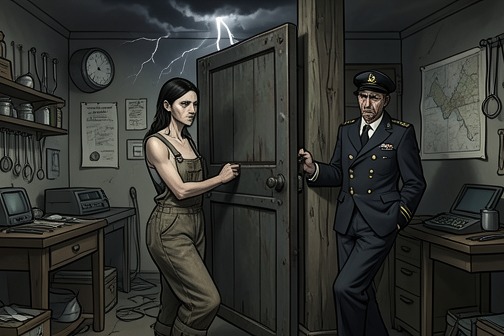
[Elizabeth Bennet marries Sir David Pentland](entity:event-recall-event-elizabeth-bennet-marrie-9dc47e400302) in a hurried common-law ceremony shaped by affection, inheritance, illness, and the urgent need to secure her future. The marriage is not presented as a conventional romantic culmination: Sir David is dying, Elizabeth accepts the burden of becoming Mistress of [Grenadine Reef](entity:location-recall-location-grenadine-reef-ad0be7a0e4a4), and the wedding binds personal sacrifice to the preservation of an estate and the people dependent upon it.
## Causes and Background
The marriage grows out of the long relationship between [Elizabeth Bennet](entity:character-recall-character-elizabeth-bennet-f97b53a479cc) and the Pentland household. [Lady Radha Pentland](entity:character-recall-character-lady-radha-pentland-8550d21cca9a) had survived displacement, kidnapping, attempted enslavement, piracy, severe injury, forced religious seclusion, and repeated cultural dislocation before marrying [Sir David Pentland](entity:character-recall-character-sir-david-pentland-9d7df8c780b8). Born Radha Bhimani in [Kutch](entity:location-recall-location-kutch-9cd484dc0f71), she was rescued off the [Arabian Peninsula](entity:location-recall-location-arabian-peninsula-f00d52e55f25) by a Spanish ship, forced into a nunnery outside [Cadiz](entity:location-recall-location-cadiz-6779628989a5) for six years, and later brought to [Barbados](entity:location-recall-location-barbados-a285bae3d98a), where Sir David nursed her back to health. He abandoned his naval career after Radha was shunned and condemned for surviving the violence inflicted upon her; they converted to the [Church of Scotland](entity:organization-recall-organization-church-of-scotla-c72c453213dc) and married before settling in Britain.
Sir David’s own fortune and title were likewise connected to danger and salvage. In [1770](entity:time-recall-time-1770-48b20ad9bba3), as captain of HMS Glory, he recovered treasure from a Spanish treasure galleon wrecked on a reef near the [Grenadine Islands](entity:location-recall-location-grenadine-islands-7ca836dbcab2) during hurricane season. The exploit earned him a knighthood and provided the money with which the Pentlands purchased Grenadine Reef. The estate’s name therefore preserves a maritime origin: its wealth began in naval service, wreck, and imperial circulation, and later became the material foundation for household security, investment, and refuge.
By the time of the marriage, Sir David has terminal stomach cancer. He tells Elizabeth that the doctor doubts he will survive the year, that a growing lump is pressing in his stomach, and that he suffers a constant ache with occasional spikes of pain. He takes a diluted preparation of laudanum before retiring to help him sleep. The diagnosis converts an existing emotional bond into an immediate legal and moral crisis: there is no longer time for a gradual plan, and Elizabeth’s majority and escape from Mrs. Bennet make the securing of her independence urgent.
## The Proposal and Settlement
Sir David explains that Lady Radha may have begun imagining this future within a year of meeting Elizabeth. His earlier will left everything to his twin brother, but Radha’s death made his own mortality more pressing. After the events of the previous autumn, he began considering how to help Elizabeth, especially because she needed to reach legal adulthood and escape the control of Mrs. Bennet. Cancer then compressed every long-term possibility into weeks.
The proposed marriage is consequently both intimate and transactional, though the transaction is designed to protect Elizabeth rather than purchase her compliance. Sir David asks Elizabeth and [Fitzwilliam Darcy](entity:character-recall-character-fitzwilliam-darcy-ad3b1ecc1d50) to place their personal happiness on hold for a year. If they agree, his brother [James Pentland](entity:character-recall-character-james-pentland-f74c1d84a81a) will witness the new will, the marriage settlement, and the wedding. The arrangement creates an agonizing conflict for Darcy: he wants to support Elizabeth and recognize the generosity of Sir David’s plan, yet he also resents the intrusion into his relationship with her.
Elizabeth accepts without treating the proposal as a mere financial bargain. She tells Sir David that he has done her the greatest honour by entrusting the estate’s future to her hands and promises to maintain the legacy he and Lady Radha created. Her acceptance makes stewardship, rather than possession, the defining principle of the marriage. The settlement is prepared in a rush as Sir David rapidly weakens. The will and marriage settlement leave nearly everything, apart from specific bequests, to his widow; ordinary provisions for a widow’s treatment and for unmarried children are unnecessary because the arrangement is being made for Elizabeth alone. James Pentland, his named children, Sir David’s valet, and other long-serving servants receive specific bequests, while James’s agreement prevents a family challenge to the plan.
## The Wedding
Elizabeth and Sir David marry six days after his proposal by common licence. The ceremony is physically marked by illness: Sir David must be carried into the church in a chair because he can no longer walk, and the journey between the carriage and the church is a trial that he bears stoically. His brother serves as groomsman. [Edward Gardiner](entity:character-recall-character-edward-gardiner-ff481a4f187c) walks Elizabeth down the aisle, while her young cousin [Lily](entity:character-recall-character-lily-96089ba009e2) acts as maid of honour.
The ceremony also reflects the Pentlands’ complicated religious history. Lady Radha had converted to the Church of Scotland when she married Sir David. After her death, Sir David sought counsel from a local vicar and converted three years before the wedding so that he could worship in the local church. Elizabeth therefore marries him under the rites of the Church of England, in a short and functional service performed by a vicar who is his friend. When the registry has been signed, Sir David gently kisses Elizabeth on the forehead.
The congregation makes the event larger than a private legal arrangement. The Gardiner family and Fitzwilliam Darcy attend, but so do many servants and tenants from the estate. The small church is unexpectedly full, and the gathering expresses approval of Elizabeth as the new Mistress of Grenadine Reef. The wedding breakfast is less a conventional bridal celebration than a tenant celebration, with genuine relief visible on many faces. The estate’s dependent community therefore participates in the ceremony as if its own future were being decided there.
## Death and Immediate Aftermath
Sir David cannot remain at the breakfast for long. His face is etched with pain, and after taking a large dose of laudanum he retires to his room. Elizabeth escorts him there while holding his hand. He never leaves the bedroom alive. During Friday and Saturday she sits with him for long periods and reads aloud quietly, uncertain whether he remains lucid enough to know that she is present but determined to accompany the man she regards as exceptionally kind.
Elizabeth goes to bed late on Saturday night in her cottage and wakes the following morning a widow. The abruptness of the change gives the marriage its tragic shape: the wedding secures her legal position, but it scarcely provides a married life before bereavement begins. After services, the vicar, the local magistrate Sir Frederick, James Pentland, Fitzwilliam Darcy, and Edward Gardiner confirm Sir David’s identity and death. He is buried beside Lady Radha in the small chapel that holds her grave.
The days after the burial impose the practical meaning of Elizabeth’s new status. She returns quietly to the chapel to give thanks for Sir David and Lady Radha and to reflect on the tumultuous changes in her life. The reading of the recently completed will still strikes her with force, not because its contents surprise her but because it makes her responsibility unmistakable. She must now govern the estate and answer for the welfare of many people. James Pentland is kind but distant, and his willingness to accept Sir David’s plan rather than simply inherit or challenge it becomes the final act that allows the settlement to stand.
## Significance
The marriage joins several forms of survival. Lady Radha’s history links India, the Arabian Peninsula, [Spain](entity:location-recall-location-spain-336a02c89dc7), Barbados, piracy, forced religious life, and Britain; Sir David’s history links the [Royal Navy](entity:organization-recall-organization-royal-navy-31f3701ac194), hurricane wreckage, Spanish treasure, knighthood, and landed wealth. Elizabeth inherits not an untouched English estate but a legacy made by displacement, violence, rescue, care, and reinvention.
It also turns marriage into partnership in an unusual and painful form. Sir David’s proposal is constrained by illness and inheritance, yet Elizabeth is not passive: she evaluates the responsibility, accepts it openly, and defines her role through the preservation of the Pentland legacy. The arrangement protects an adult woman from domestic dependence while transferring to her the unpaid emotional, managerial, and social labour of an estate. Her marriage is therefore both an instrument of legal independence and a demand that she assume the burdens of governance.
The wedding’s emotional value lies in its refusal to separate love from practical duty. Sir David’s care for Lady Radha had once rejected the social condemnation attached to her survival; his final plan extends that ethic to Elizabeth. In turn, Elizabeth’s acceptance honours both Pentlands by promising to preserve what they built. The marriage ends almost at once in death, but its consequence is durable: Elizabeth becomes the living custodian of Grenadine Reef, its servants, tenants, investments, and refuge, carrying forward a household founded by two people whom society repeatedly treated as outsiders.
Event 47
Death of Sir David Pentland
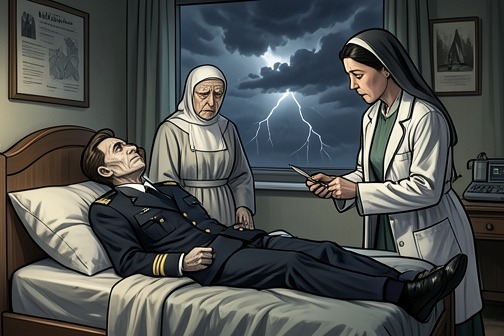
[Death of Sir David Pentland](entity:event-recall-event-death-of-sir-david-pent-9af96d8ac32b) is the pivotal event that makes [Elizabeth Bennet](entity:character-recall-character-elizabeth-bennet-f97b53a479cc) a widow almost as soon as she becomes Lady Pentland. It is not an isolated loss: Sir David’s terminal illness compresses courtship, marriage, inheritance, and the transfer of authority into a few desperate weeks, so that his death simultaneously ends a marriage and begins Elizabeth’s independent life as mistress of [Grenadine Reef](entity:location-recall-location-grenadine-reef-ad0be7a0e4a4).
## Illness and the Urgency of the Arrangement
Sir David tells Elizabeth plainly that he is dying. His doctor has diagnosed cancer and doubts that he will survive the year; a growing lump in his stomach produces a constant ache punctuated by sharper attacks of pain. He takes a highly diluted preparation of laudanum before retiring to help him sleep. The diagnosis gives physical certainty to what his weakened appearance has already made difficult to deny, and it changes the timetable of every decision around him.
His illness also explains why he abandons gradual plans for immediate legal and marital arrangements. After [Lady Radha Pentland’s death](entity:event-recall-event-lady-radha-pentland-s-d-7d3a68210142), his own mortality became more pressing, but he began considering Elizabeth’s future especially after the previous autumn’s events and the importance of her reaching legal majority so that she could escape Mrs. Bennet’s household. Cancer then reduced a long-term project to a matter of weeks. Sir David arranged for [James Pentland](entity:character-recall-character-james-pentland-f74c1d84a81a) to witness a new will, the marriage settlement, and the wedding, while a doctor and the local magistrate confirmed that he was of sound mind. The plan depended on Elizabeth and [Fitzwilliam Darcy](entity:character-recall-character-fitzwilliam-darcy-ad3b1ecc1d50) setting their personal happiness aside for a year, making the proposal an emotional demand as well as a financial one.
## Marriage Before Death
The preparations accelerated into a “flurry of activity” and then a “blizzard” as Sir David faded. The will and marriage settlement were nearly identical: after specific bequests to James Pentland and his named children, Sir David’s valet, and other long-serving servants, virtually everything was to pass to his wife. The ordinary provisions for a widow, unmarried children, and routine household settlement were unnecessary because the arrangement had been designed specifically for Elizabeth’s position.
Six days after his proposal, Sir David married Elizabeth Bennet by common licence. He was too weak to walk and had to be carried into the church in a chair; even the movement between the carriage and the church tested his strength. James served as his groomsman, [Edward Gardiner](entity:character-recall-character-edward-gardiner-ff481a4f187c) walked Elizabeth down the aisle, [Lily](entity:character-recall-character-lily-96089ba009e2) acted as maid of honour, and the rest of the Gardiner family and Fitzwilliam Darcy attended. Servants and tenants filled the small church alongside the family, turning the ceremony into a public declaration that Elizabeth had been accepted as the new mistress of the estate.
The ceremony was performed under the rites of the Church of England. Although Sir David had previously converted after Lady Radha’s death so that he could worship at the local church, he had done so after counselling with a local vicar, a friend who was willing to conduct the short and functional service. At its conclusion, Sir David gently kissed Lady Pentland on the forehead. The wedding breakfast became less a conventional wedding feast than a celebration among the tenants, whose genuine relief showed how strongly they approved of the new household arrangement.
## The Final Days and Funeral
Sir David could not remain at the celebration for long. His face was marked by pain, and he withdrew to his room after taking a large dose of laudanum to endure the effort of leaving the house. Elizabeth escorted him to the bedroom while holding his hand. He never left that room alive again.
Elizabeth spent long stretches of Friday and Saturday beside him, reading aloud quietly. The narrative leaves uncertain whether he remained lucid enough to understand that she was present, but her act of reading is presented as a deliberate form of loyalty to the man she regarded as the kindest she would ever know. She returned late to her cottage on Saturday night and woke the following morning a widow. The abruptness of that change gives the event its particular cruelty: the marriage has been publicly completed, but the married life it promises has scarcely begun.
After the church services, the vicar, Sir Frederick, the local magistrate, James Pentland, Fitzwilliam Darcy, and Edward Gardiner formally confirmed Sir David’s identity and death. Elizabeth spent that time in the small chapel containing Lady Radha’s grave. Sir David was interred beside Lady Radha the next day, joining the two people whose shared history had first drawn Elizabeth into the Pentland household. Elizabeth did not pray; she reflected on the tumultuous changes that had overtaken her life and later returned quietly to the chapel to give thanks for both Sir David and Lady Radha.
## Inheritance and Immediate Consequences
The three days surrounding the burial took a severe emotional toll on Elizabeth. The reading of the will was not unexpected, since it had been written only a week earlier, yet its implications overwhelmed her. She was now responsible for a vast estate and for the people connected to it. James Pentland was kind but distant, and the meeting was likely the only time she would ever see him. His decision to accept Sir David’s plan rather than contest the will was significant: he and his family received £75,000, despite the possibility that a more aggressive heir might have challenged the arrangements on the grounds of Sir David’s illness.
Elizabeth’s distress deepened when she learned how much money remained after the bequests. She had feared that the estate might have little ready cash, but the scale of the resources finally became clear and she broke down in tears, releasing the emotions she had suppressed through the wedding, the death, and the burial. Her aunt needed more than an hour to calm her. The grief is therefore inseparable from a second shock: Elizabeth must mourn privately while learning that she has inherited obligations and wealth on a scale for which her former life has not prepared her.
The inheritance rests on the history of Sir David’s fortune. In [1770](entity:time-recall-time-1770-48b20ad9bba3), as captain of HMS Glory, he helped salvage a substantial amount of treasure from a Spanish treasure galleon wrecked on a reef near the [Grenadine Islands](entity:location-recall-location-grenadine-islands-7ca836dbcab2) during a hurricane. The exploit earned him a knighthood, and his share of the prize financed the purchase of Grenadine Reef. The estate’s name preserves the origin of that wealth even though the property lies more than fifty miles from the sea.
Sir David and Lady Radha then lived quietly and with near-frugality. They did not spend [London](entity:location-recall-location-london-420923d4a60a) seasons or maintain the expensive entertainments associated with fashionable wealth, and they had no children whose education, travel, horses, or dowries would consume the surplus. Their excess income was invested year after year. They later used accumulated funds to double the size of Grenadine Reef and purchase smaller estates, converting maritime prize money into landed property and long-term investment income. After the inheritance was settled, Elizabeth held £400,000 in assets producing almost £20,000 annually after tax, while Sir David’s brother received £50,000 in Consols and an additional £25,000.
## Long-Term Legacy
Death does not erase Sir David’s influence over Grenadine Reef; it tests whether Elizabeth can carry forward the structure he created. His will transfers not merely money but control, placing Elizabeth at the head of an estate sustained by disciplined investment, careful management, and the labour of servants and tenants. The event therefore gives material force to his earlier confidence in her intelligence, including her practical proposal that he investigate breweries and acquire hops and barley acreage near [Alton](entity:location-recall-location-alton-b149e804c75f) and [Lewes](entity:location-recall-location-lewes-e76396e796f2), with further inquiries in Southampton and Portsmouth. His death leaves her with the opportunity and burden of turning such ideas into policy.
The inheritance also shapes the later architecture of the family. Elizabeth and Fitzwilliam Darcy eventually divide their estates among their seven children, assigning Grenadine Reef to their daughter Helena rather than automatically giving it to their second-born son. The original estate is divided into portions, while the remaining land around the dower house becomes the setting for St. Vincent Lodge, named after the island nearest the wreck discovered by Sir David. The lodge preserves the connection between the family’s future and the maritime event that founded its fortune, while the dower-house lands continue the estate’s protective and domestic legacy.
As a narrative event, Sir David’s death is both a reversal and a transfer. It reverses Elizabeth’s immediate happiness by making her a widow after only a few days of marriage, but it transfers to her the independence that Sir David had tried to secure. The reader experiences the death first through bodily decline, then through accelerated legal preparation, and finally through Elizabeth’s waking realization that the future has arrived in the form of bereavement. His absence becomes the condition under which she must act: grief does not end her story, but makes her responsible for preserving the lives, property, and refuge entrusted to her.
Event 48
Darcy proposes to Elizabeth after Sir David's proposal
Darcy proposes to Elizabeth after Sir David’s proposal at the moment when Elizabeth’s private happiness is placed under an extraordinary public and familial obligation. Sir David’s terminal illness has made him ask Elizabeth to set aside her own wishes for a year and accept a marriage intended to protect [Grenadine Reef](entity:location-recall-location-grenadine-reef-ad0be7a0e4a4) after his death. Darcy therefore refuses to treat his love as a claim that can simply override her duty. His proposal acknowledges both the emotional cost of the arrangement and the future they may still build together.
## Causes and Background
Sir David’s request arises from the sudden contraction of time. He had once imagined longer-term plans, but the discovery of cancer turns the prospective end of the year into summer, then into weeks. He has no family able to contest his intended arrangements, and he has prepared a new will, a marriage settlement, and a wedding witnessed by James, a doctor, and the local magistrate. His proposal to Elizabeth is thus not merely romantic: it is designed to preserve the estate and its responsibilities when he dies. The demand nevertheless places emotional pressure on both Elizabeth and Darcy, because it asks them to suspend personal happiness for the sake of Grenadine Reef and its future inhabitants.
Elizabeth’s readiness to consider Sir David’s plan is inseparable from the history he has shared with her. Born Radha Bhimani in [Kutch](entity:location-recall-location-kutch-9cd484dc0f71), she was displaced by successive conflicts involving the Mughals, the Marathas, and the British, and was kidnapped for sale into slavery when she was only slightly older than Elizabeth. She was rescued off the [Arabian Peninsula](entity:location-recall-location-arabian-peninsula-f00d52e55f25) by a Spanish ship, forced into a nunnery outside [Cadiz](entity:location-recall-location-cadiz-6779628989a5) for six years, and later sent without consent on a mission to [Cartagena](entity:location-recall-location-cartagena-a586cc897c9b). Pirates captured that ship, and Sir David eventually took her into his house in Bridgetown on [Barbados](entity:location-recall-location-barbados-a285bae3d98a) while she recovered from wounds and infection. He later resigned from the British naval career after the hostile treatment directed at her, returned to Britain, married her, and bought the estate where they lived for thirty-two years. The proposal to Elizabeth therefore continues a life organized around rescue, protection, and the preservation of a refuge rather than around ordinary courtship alone.
## What Happens
After hearing Sir David’s terms, Darcy leaves to find Elizabeth. Their meeting avoids the awkwardness of one person following the other, and their tentative smiles establish a moment of mutual reassurance before Darcy speaks plainly. He tells Elizabeth that he loves her and explains that he has been trying to determine the proper time to propose. He recognizes the cruel irony that she is unlikely to receive two proposals in one day, yet he does not present his own proposal as a contest with Sir David’s.
Darcy says that they could marry soon, and that doing so would be easy, but not right. He understands that Elizabeth will accept Sir David’s proposal because it is right for her, for the estate, and for Sir David, who needs confidence that his property will be in good hands after his death. Darcy asks only that she consider six months of mourning and agree to marry him on the day after [Twelfth Night](entity:time-recall-time-twelfth-night-deeef3fa9741). His proposal consequently turns restraint into an expression of love: he does not ask Elizabeth to abandon duty, but asks whether their relationship can survive its delay.
Elizabeth responds with an action that carries unusual weight in their developing intimacy. She reaches out and takes Darcy’s hand, the first time she has made that gesture. She then observes that, just as it is abnormal to receive two proposals on the same day, it is even less normal to accept two proposals on the same day. Her reply confirms that she accepts Darcy while also accepting Sir David’s arrangement. The scene’s value shift is from apparent romantic postponement to shared certainty: love is not defeated by duty but given a future through it.
## Immediate Consequences
Darcy experiences genuine happiness, although he knows he will chafe against the slow passage of time before the marriage can occur. He and Elizabeth return to the drawing room to explain the situation to Sir David and to tell Elizabeth’s aunt and uncle. The private exchange therefore becomes a family announcement, and its unusualness is openly acknowledged when Elizabeth later states that Darcy proposed on the same day as Sir David, that she accepted him, and that they will marry after six months of mourning in January, as soon after Twelfth Night as possible.
The announcement unsettles the household because the preceding two weeks have already violated ordinary social expectations. Elizabeth’s double acceptance makes the breach explicit, but it also clarifies the moral structure of the choice. Sir David’s proposal secures the estate’s continuity; Darcy’s proposal secures Elizabeth’s emotional future. Neither man is treated as a rival to be defeated. Instead, Darcy’s willingness to wait allows Elizabeth to honor a dying man without surrendering the possibility of marriage grounded in love.
## Narrative and Thematic Significance
The event completes a distinctive romance pattern in which the obstacle is not a misunderstanding or a rival but the conflict between desire and responsibility. Darcy’s conduct marks a change from possessive or socially constrained courtship toward partnership: he states his love directly, identifies what is right for Elizabeth and Grenadine Reef, and accepts a timetable governed by mourning rather than impatience. Elizabeth’s handclasp gives physical form to a relationship that has reached mutual trust without erasing the claims of the vulnerable people dependent on the estate.
The proposal also gathers together the novel’s wider contrast between marriage as transaction and marriage as partnership. Elizabeth’s proposed union with Sir David is a marriage of convenience intended to protect a household and its refuge, while her union with Darcy represents the deepest love she has been able to choose. The event refuses to make those meanings mutually exclusive. Duty can be practical and costly; love can be patient and active. By accepting both proposals, Elizabeth turns what might have been a forced choice into a sequence of commitments, and Darcy proves that his love is strong enough to wait while she fulfills the obligation created by Sir David’s illness and impending death.
Event 49
The settlement of Grenadine Reef after Sir David's death
The settlement of [Grenadine Reef](entity:location-recall-location-grenadine-reef-ad0be7a0e4a4) after [Sir David Pentland](entity:character-recall-character-sir-david-pentland-9d7df8c780b8)'s death is the legal, financial, and social reorganization that follows [Elizabeth Bennet](entity:character-recall-character-elizabeth-bennet-f97b53a479cc)’s brief marriage to the dying Sir David Pentland. It makes Elizabeth the principal beneficiary of an estate producing nearly £20,000 a year, places explicit limits on [Fitzwilliam Darcy](entity:character-recall-character-fitzwilliam-darcy-ad3b1ecc1d50)’s future control of her property, invites [Edward Gardiner](entity:character-recall-character-edward-gardiner-ff481a4f187c)’s family to relocate to Grenadine Reef for her protection, and preserves the dower house as a secluded refuge for abused women. The settlement therefore does more than distribute wealth: it turns bereavement into an assertion of female authority within a society that normally transfers a married woman’s assets to her husband.
## Deathbed Planning and the New Will
Sir David Pentland’s decision was made under extreme time pressure. Six days after proposing to Elizabeth, he married her by common licence, although he had to be carried into the church in a chair because his illness had advanced so far that he could no longer walk. The ceremony was attended by Edward Gardiner, [Madeline Gardiner](entity:character-recall-character-madeline-gardiner-932ce19b654c), their children, Fitzwilliam Darcy, Sir David’s brother [James Pentland](entity:character-recall-character-james-pentland-f74c1d84a81a), servants, and tenants of Grenadine Reef. Its crowded church became an immediate public sign that the estate’s people accepted Elizabeth as its new mistress.
Sir David had prepared the transfer with unusual care. Edward Gardiner was to witness a new will, the marriage settlement, and the wedding itself. Sir David stated that Edward and his descendants were his only family and that he had made significant bequests to them, an arrangement that effectively secured James Pentland’s cooperation. The will and marriage settlement were almost identical. Apart from specified gifts to James Pentland and his named children, Sir David’s valet, and other long-serving servants, everything passed to his widow; provisions ordinarily made for an unmarried child or for the routine maintenance of a widow were unnecessary because Elizabeth was the sole intended future holder of the estate.
Sir David died without leaving his bedroom alive again. Elizabeth spent long periods reading quietly beside him on the Friday and Saturday, uncertain whether he remained lucid enough to recognize her presence. She went to bed late on Saturday and woke the next morning a widow. After his identity was confirmed, he was buried beside [Lady Radha Pentland](entity:character-recall-character-lady-radha-pentland-8550d21cca9a) in the small chapel at Grenadine Reef. Elizabeth returned there repeatedly during the following days, giving thanks for both lives and reflecting on the extraordinary reversal that had made her, almost overnight, responsible for the people and property Sir David had governed.
## Inheritance, Bequests, and Financial Scale
The reading of the will was painful even though its contents had been settled only a week earlier. Elizabeth understood that the inheritance imposed obligations rather than merely offering comfort, and she was distressed by the thought that James Pentland might have challenged the arrangements on the grounds of Sir David’s illness. Instead, James and his family received £75,000. The size of that bequest made Elizabeth briefly fear that little ready money would remain for the estate, but the accounts revealed a much larger fortune than she had understood.
Sir David’s wealth originated in his naval career. In [1770](entity:time-recall-time-1770-48b20ad9bba3), as the newly appointed captain of HMS Glory, he was sent to the West Indies after the ship’s refit in Plymouth. The vessel survived the edge of a hurricane, while a Spanish treasure galleon attempting to reach Havana was wrecked on a reef in the [Grenadine Islands](entity:location-recall-location-grenadine-islands-7ca836dbcab2). Sir David’s crew salvaged a significant portion of the treasure before the remaining hull was destroyed and sank. The exploit brought him a knighthood, and his share of the prize financed the purchase of the estate that was named Grenadine Reef after the reef where the galleon was lost.
Sir David and Lady Radha Pentland then preserved and enlarged that fortune through restrained living and sustained investment. They entertained little, did not spend [London](entity:location-recall-location-london-420923d4a60a) seasons, had no children, and incurred none of the expenses associated with additional horses, education, university, a Grand Tour, or daughters’ dowries. Surplus income was invested, returns increased the surplus, and accumulated funds were used to double the size of Grenadine Reef and purchase smaller estates. After the bequests, Elizabeth held £400,000 in assets generating close to £20,000 annually after tax. The inheritance thus joined global maritime wealth to quiet estate management and produced an income that placed Elizabeth on terms of financial equality with Fitzwilliam Darcy: he possessed more land, while she possessed more investments, and their annual incomes were nearly equal.
## Control, Marriage, and Protection
The settlement directly addresses the legal danger posed by marriage. Edward Gardiner explained that when a man married a woman, he ordinarily gained control of the assets she brought into the marriage. The marriage settlement therefore stipulated that anything connected with Grenadine Reef and the smaller estates could be transferred or otherwise dealt with only with Elizabeth’s explicit written permission. Whatever the formal legal position, Elizabeth would remain the real mistress of the estate during her and Darcy’s lifetimes. The clause transformed property ownership from an abstract inheritance into an enforceable structure of continuing control.
This arrangement also shaped Darcy’s role. Darcy could court Elizabeth without becoming the automatic master of her property, and the settlement required the couple to anticipate a range of possible future circumstances rather than rely on trust alone. The legal document recognized that affection and partnership did not erase the unequal rules governing married women’s property. Elizabeth’s authority had to be written into the settlement because social convention would otherwise expose it to absorption by her husband.
Elizabeth also asked the Gardiners to move permanently to Grenadine Reef. She wanted their children to grow up in the country and believed that the family’s presence in the manor house would prevent speculation that she had secretly inherited the estate. Their relocation would counter slanders about her marriage while providing practical security against the male fortune-hunters likely to surround a wealthy widow. Elizabeth feared becoming a prisoner in her own house, forced to avoid compromise at every turn, and the Gardiners’ presence would distribute public attention across an already married family whose children were too young to attract the same predatory interest. Darcy judged the proposal sensible because the household could care for the manor while the Gardiners cared for their family.
## The [Dower House](entity:location-recall-location-dower-house-c86305739b4c) and Estate Governance
Elizabeth insisted that the dower house continue operating as a refuge. Although she had never visited it and Sir David had never done so either, funding, food, provisions, transport, and day-to-day organization had been maintained without making it visible to the main house or neighboring farms. Elizabeth intended to consult [Mrs. Perkins](entity:character-recall-character-mrs-perkins-3c113395699b), [Vivian Harkness](entity:character-recall-character-vivian-harkness-4b541bfd881c), [Violet Harkness](entity:character-recall-character-violet-harkness-9bcb3ea8feb1), and the woman then handling daily administration, preserving the existing system rather than treating the refuge as an expendable charitable expense.
The refuge’s operating rules reflected Sir David’s practical concern for women’s safety. Young women arriving there were understandably afraid of men because of what they had endured. When one woman left, three traveled together so that two could return safely; Sir David even paid five post-coach fares so that Violet Harkness, Yvonne Smith, and Gladys Smith would not leave alone. The settlement therefore preserved not only land and income but also an institutional practice of protection, transport, secrecy, and recovery for abused women.
Elizabeth’s authority was grounded in knowledge as well as inheritance. Sir David had openly admitted that Lady Radha Pentland possessed a better head for business and investments than he did, and credited her attention with the couple’s success. Elizabeth had learned from Lady Radha’s example, from tenant visits at Grenadine Reef, and from Madeline Gardiner’s management of a household and business-oriented social life. Lady Radha’s history as an Indian woman kidnapped repeatedly, subjected to pirate violence, injured so severely that she could not bear children, and later marginalized despite surviving, made the refuge and its protections part of the estate’s moral inheritance as well as its financial one.
## Contrast with [Longbourn](entity:location-recall-location-longbourn-09a641b38d11) and Lasting Significance
The settlement’s consequences become clearer through its contrast with Longbourn. After Elizabeth’s departure, Longbourn revealed how much work she had previously performed behind the scenes. [Jane Bennet](entity:character-recall-character-jane-bennet-1913002c8ec6) and [Mary Bennet](entity:character-recall-character-mary-bennet-3ad0e066a036) worked tirelessly, but neither they nor the rest of the household had realized the extent of Elizabeth’s contribution. The estate still had enough food, yet everyone, including [Thomas Bennet](entity:character-recall-character-thomas-bennet-fdb1df6a4cdd), recognized an underlying sense that its production and management should have been better. Longbourn reflected its master’s indifference, whereas Grenadine Reef had been sustained by deliberate supervision, investment, and responsibility.
Fitzwilliam Darcy’s later management of [Netherfield Park](entity:location-recall-location-netherfield-park-5ab7b1301fde) reinforces the same distinction. He acquired the remainder of [Charles Bingley](entity:character-recall-character-charles-bingley-d470295e8e11)’s lease through solicitors while concealing his identity in the transaction, then devoted at least half of each day to the estate and the rest to correspondence with stewards and his secretary. He arranged additional spring plantings and worked through the harvest. In contrast to Longbourn’s neglect, estate work at Netherfield and Grenadine Reef is presented as purposeful rather than burdensome: effective authority depends on attention, information, and continuing labor.
The inheritance consequently changes Elizabeth’s social position without dissolving the dangers attached to it. She is wealthy enough to attract both female gossip and male fortune-hunters, yet the settlement gives her written control, trusted allies, and a functioning refuge. Its most important achievement is not that Elizabeth receives Grenadine Reef, but that the estate remains connected to the values by which Sir David and Lady Radha lived: restrained prosperity, competent management, gratitude toward tenants and servants, and protection for women whom respectable society has abandoned. The transfer makes Elizabeth an heir, widow, employer, landlord, and guardian of an institution, while ensuring that marriage to Darcy cannot simply turn those responsibilities and assets into his possession.
Event 50
The Gardiners relocate to Grenadine Reef
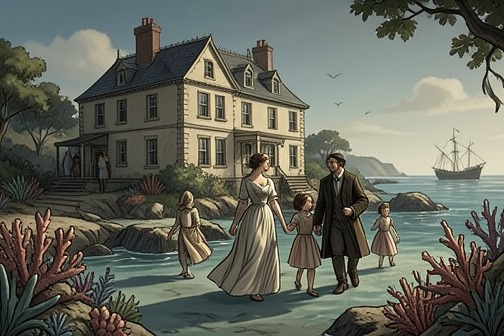
The Gardiners’ relocation to [Grenadine Reef](entity:location-recall-location-grenadine-reef-ad0be7a0e4a4) is a deliberate act of protection and estate-building rather than a simple change of residence. Proposed by [Elizabeth Bennet](entity:character-recall-character-elizabeth-bennet-f97b53a479cc) after the death of [Sir David Pentland](entity:character-recall-character-sir-david-pentland-9d7df8c780b8), it brings [Edward Gardiner](entity:character-recall-character-edward-gardiner-ff481a4f187c), [Madeline Gardiner](entity:character-recall-character-madeline-gardiner-932ce19b654c), and their children into the manor-house community, strengthens Elizabeth’s security, and helps transform Grenadine Reef from a vulnerable inheritance into a stable family and social base.
## Causes and Background
Elizabeth’s need for a safer household arises from the unusual history and public position attached to Grenadine Reef. The estate is connected to [Lady Radha Pentland](entity:character-recall-character-lady-radha-pentland-8550d21cca9a)’s life as Radha Bhimani, a woman born in [Kutch](entity:location-recall-location-kutch-9cd484dc0f71) whose childhood was disrupted by conflict among the Mughals, the Marathas, and the British. She was kidnapped for sale into slavery, rescued off the [Arabian Peninsula](entity:location-recall-location-arabian-peninsula-f00d52e55f25), taken to [Spain](entity:location-recall-location-spain-336a02c89dc7), forced into a nunnery outside [Cadiz](entity:location-recall-location-cadiz-6779628989a5), and later sent on a Spanish mission toward [Cartagena](entity:location-recall-location-cartagena-a586cc897c9b). After pirates captured the ship, she was wounded and left behind until Sir David Pentland brought her into his home in Bridgetown, [Barbados](entity:location-recall-location-barbados-a285bae3d98a), where she eventually recovered. Sir David later resigned from the navy because of the hostility directed at her, married her after her willing but superficial conversion to the [Church of Scotland](entity:organization-recall-organization-church-of-scotla-c72c453213dc), and established their life in Britain.
That history makes the estate more than a country property. Grenadine Reef embodies forced movement, imperial violence, rescue, marriage, and the conversion of maritime fortune into landed security. Elizabeth has also learned from Lady Radha’s example how an estate’s master or mistress bears responsibility for tenants and vulnerable people. Her understanding of household management was formed through her own walks and tenant visits at [Longbourn](entity:location-recall-location-longbourn-09a641b38d11), her education by Edward and Madeline Gardiner, and her sustained conversations with Sir David about business and investment.
The Gardiners already provide Elizabeth with an unusually dependable form of family support. Madeline Gardiner’s practical example as the wife of a [London](entity:location-recall-location-london-420923d4a60a) tradesman, mother of four young children, and hostess for Edward’s business stands beside Lady Radha’s very different example as a private, injured, childless survivor who rarely appeared in society. Elizabeth sees both women as teaching that a lady’s life consists not merely of display but of love, responsibility, and the daily work of sustaining others. Relocation therefore extends an existing relationship of mutual education into a permanent domestic arrangement.
## The Proposal and Its Logic
Elizabeth presents the plan to the Gardiners as a solution to several connected risks. She asks them to move permanently to Grenadine Reef so that their children can grow up in the country and the family can occupy the manor house. Their presence will make it less plausible that Elizabeth alone inherited the estate, weakening the gossip already directed at her. It will also shift attention away from her as an isolated wealthy woman and reduce the likelihood that male fortune-hunters will treat the estate as an invitation.
Elizabeth states that she does not want to become a prisoner in her own home, forced to fear compromise whenever she receives a visitor or conducts estate business. The relocation thus answers a social problem through household architecture: a married couple with children provides visible respectability, while Elizabeth gains a family household around her without surrendering control of her property or movements.
[Fitzwilliam Darcy](entity:character-recall-character-fitzwilliam-darcy-ad3b1ecc1d50) immediately recognizes the proposal’s strength. He describes it as elegant and sensible because the Gardiners can care for the manor while Elizabeth can care for her family. Their presence creates a protective social arrangement without making Edward and Madeline themselves objects of the same pursuit. Darcy also notes that [Lily](entity:character-recall-character-lily-96089ba009e2) and Eddy, though still too young to attract such attention, will eventually need to understand the risks surrounding the estate and its wealth.
## The Move and Household Arrangement
The Gardiners accept the proposal readily. Madeline responds physically before she answers, pulling Elizabeth to her feet and embracing her possessively; Edward then embraces her as well. His acceptance is practical as well as affectionate: the arrangement works for everyone, and he expects the children to enjoy country life. The family will retain its London house as a base for Edward’s business and as a residence for the wider family during visits, so the move does not sever the Gardiners from London or from their commercial world.
Elizabeth postpones any argument over rent, making clear that the arrangement is intended to be mutually useful rather than a one-sided gift. The Gardiners’ role is not that of passive dependants. They will manage and inhabit the manor house, maintain a visible family presence, and help make the estate socially defensible; Elizabeth, in turn, remains responsible for the property and continues to shape its future.
The move also preserves Elizabeth’s emotional boundaries during mourning. She asks that Sir David and Lady Radha’s suite remain unused throughout the mourning period and says that she will continue living in her cottage. The cottage contains her good memories, while living in the former master and mistress’s rooms would force her to confront the impression of trespassing upon a ghost. Because the Gardiners did not know Lady Radha, Elizabeth does not want their occupation of the manor to alter her own memories of that relationship. She plans to visit the suite in autumn, select the memorabilia she wishes to keep, and allow the Gardiners to decorate it as they choose after her marriage.
## Consequences and Significance
The relocation gives Grenadine Reef a form of domestic continuity after the death of Sir David. Instead of leaving Elizabeth isolated in a large inherited property, it places the estate within a functioning intergenerational household. The children bring ordinary family life into a property burdened by bereavement and public speculation, while Edward and Madeline provide adult supervision, social credibility, and practical assistance.
Its protection is both material and symbolic. Materially, Elizabeth is less exposed to unwanted visitors and the danger of being treated as an unguarded fortune. Symbolically, the manor ceases to appear as a mysterious estate possessed by a solitary woman and becomes visibly connected to a married family. The arrangement therefore counters slander without requiring Elizabeth to deny her wealth, conceal her authority, or retreat from active estate management.
The event also completes a pattern running through Elizabeth’s life. At Longbourn, she escaped the noise of the house by walking north from the kitchen, circling away from the parlour window, and finding safety along the brook at the estate boundary. At Grenadine Reef, safety is no longer achieved by slipping out of sight. It is constructed through people, space, and recognized household forms. The family relocation turns refuge from a hidden personal retreat into a durable social institution, preserving Elizabeth’s independence while ensuring that she need not defend it alone.
Event 51
Lydia Bennet's attempted elopement with Lieutenant Denny
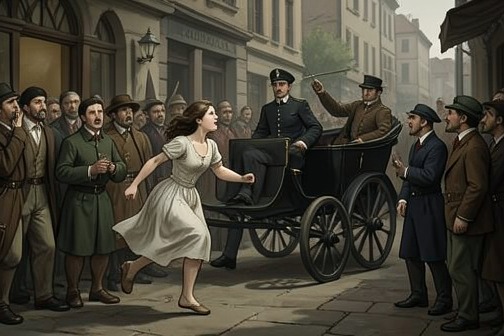
[Lydia Bennet's attempted elopement with Lieutenant Denny](entity:event-recall-event-lydia-bennet-s-attempte-8f3f0e7caed0) turns adolescent flirtation into a family emergency. The plan is intercepted before the couple can disappear, but Lydia is nevertheless left compromised: she has admitted to a continuing secret relationship, believed herself in love, and entered a hired coach with an officer whose motives appear sexual rather than matrimonial. The episode makes visible the unequal consequences of sexual conduct in Regency society, where Lydia's reputation and the Bennet family's survival are endangered while Lieutenant Denny can bargain over whether to marry her.
## Causes and Background
Lydia's crisis grows from a long history of neglect and miseducation. She has been encouraged by [Fanny Bennet](entity:character-recall-character-fanny-bennet-32517e125a1f) to treat her heedless, attention-seeking behavior as mere liveliness, while [Thomas Bennet](entity:character-recall-character-thomas-bennet-fdb1df6a4cdd) has been too detached to provide effective supervision. Her three older sisters have tried to educate her as a young woman, but their efforts have been ignored. Lydia possesses a figure that attracts the attention of dishonorable men, yet lacks the education, judgment, wealth, connections, and cunning that might have allowed a more calculating woman to protect herself within the same society. Her movement among soldiers in a town full of competing temptations therefore becomes dangerous rather than liberating.
The attempted elopement also belongs to the broader pattern of women being made responsible for circumstances created by male power and family failure. Lydia is legally and socially vulnerable, but her family has little practical authority with which to retrieve her or compel Lieutenant Denny. Thomas Bennet explains that the entail prevents him from borrowing against [Longbourn](entity:location-recall-location-longbourn-09a641b38d11) and that he does not have enough ready money to induce Denny to marry. The estate's legal structure thus converts a domestic scandal into a financial crisis: the family possesses property in theory, but cannot freely use it when a daughter's reputation requires immediate protection.
## The Attempt and Interception
The news arrives at Longbourn in an express delivered two days after midsummer. [Colonel Foster](entity:character-recall-character-colonel-foster-0bf33f183a35) reports that Lydia attempted to elope with Lieutenant Denny, an officer under his command, and that regular soldiers intercepted them at the first coaching inn north of [Brighton](entity:location-recall-location-brighton-198006e5b23f). They had been alone in the hired coach for nearly two hours. Lydia admitted that she had been meeting Denny regularly and had agreed to the elopement because she believed herself in love. Denny, by contrast, appears to have had no intention of marrying her and to have been pursuing a baser objective.
The interception prevents the immediate disappearance but does not undo the damage. Colonel Foster describes Lydia as thoroughly compromised and asks the Bennets to come to Brighton, warning that only a marriage may prevent her ruin. The episode therefore changes value from romantic possibility to public danger: what Lydia imagines as an escape becomes evidence that can be used against her. The soldiers' intervention is protective in one sense, yet it also confirms that her private conduct has entered the realm of military, familial, and social judgment.
## Brighton and the Marriage Bargain
[Jane Bennet](entity:character-recall-character-jane-bennet-1913002c8ec6) travels with Thomas Bennet to Brighton, stopping at [Gracechurch Street](entity:location-recall-location-gracechurch-street-4070ca0d2619), while one sister remains at Longbourn to control Fanny Bennet and another accompanies the journey. The contrast between Lydia's mood and the family's fear is stark. On arrival, Lydia is bored because Brighton on a Friday night offers the very entertainments she wants but she is confined indoors. She still does not understand the harm she has done, and continues to think of herself as a favorite among the officers. Jane recognizes that Lydia's apparent romantic excitement has not matured into responsibility.
Thomas Bennet's meeting with Denny produces the expected but devastating result. Denny accepts that he may be obligated to marry Lydia, but refuses to do so without a sufficient inducement. Marriage has become a transaction in which the compromised woman and her family must purchase the man's cooperation. Jane weeps on the Saturday night, imagining that Lydia, she, and their sisters have all been ruined. Attendance at three Sunday services and sustained prayer provide no answer before Monday, emphasizing how little moral consolation can accomplish when the immediate problem is money, reputation, and male bargaining power.
## Immediate Consequences
The express produces pandemonium at Longbourn. Fanny Bennet's earlier hysteria proves only a pale imitation of the real disturbance; she must be nearly dragged to bed and given laudanum before she calms. Thomas Bennet orders Jane Bennet and [Mary Bennet](entity:character-recall-character-mary-bennet-3ad0e066a036) to decide which will remain with her, instructs [Kitty Bennet](entity:character-recall-character-kitty-bennet-e68b587aa3bf) to assist the sister who stays, and prepares to return to Brighton with the other. His sudden assumption of practical command contrasts with the passivity that helped leave Lydia unprepared.
The episode also exposes the limits of the Bennet family's social position. Lydia's conduct threatens every sister because a compromised daughter's reputation can contaminate the marriage prospects and public standing of the whole household. Yet Thomas Bennet cannot freely mortgage Longbourn, and Denny's willingness to marry depends on inducement rather than affection. The family is therefore forced to navigate a system in which property law, gendered reputation, military discipline, and marriage commerce converge against them.
## Narrative and Thematic Significance
As an event, the attempted elopement is both a failed escape plot and a revelation of domestic failure. Lydia is not simply an isolated wrongdoer: the narrative presents her as selfish and foolish, but also as a girl set up to fail by an absent father, an indulgent mother, inadequate instruction, and a social environment that rewards male attention while withholding meaningful agency from women. Her belief that she is in love does not protect her from the consequences of a relationship in which Denny controls the final terms.
The crisis also sharpens the book's recurring contrast between genuine partnership and marriage as a defensive transaction. Lydia's romantic language cannot alter the material facts, while Denny's demand for an inducement demonstrates how easily a woman's future can be priced once her reputation is endangered. The event's full significance lies in that collision: an impulsive attempt to choose love independently becomes the occasion on which Lydia's lack of protection, the family's financial weakness, and the society's double standard are made unmistakable.
Event 52
Lydia Bennet's forced marriage and departure for Canada
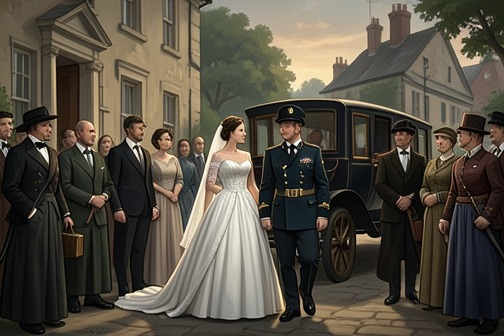
[Lydia Bennet's forced marriage and departure for Canada](entity:event-recall-event-lydia-bennet-s-forced-m-d42ed19c944e) is the decisive containment of [Lydia Bennet](entity:character-recall-character-lydia-bennet-0020f0bd0490)'s social crisis: Lieutenant [Cyrus Denny](entity:character-recall-character-cyrus-denny-bd956830f0f9) is compelled to marry her, receive a purchased commission in the [41st Regiment of Foot](entity:organization-recall-organization-41st-regiment-of-1bea7a62c4f8), and leave Britain for [Canada](entity:location-recall-location-dc0088f9b440). The arrangement preserves the appearance of respectability while functioning as punishment and exile. Lydia Bennet gains a husband and a formal status, but loses the protected domestic life she had known at [Longbourn](entity:location-recall-location-longbourn-09a641b38d11) and is sent into the precarious world of a junior military officer's family.
## Causes and Background
The immediate cause is Lydia Bennet's attempted elopement with Lieutenant Cyrus Denny. When Mr. Bennet and [Colonel Foster](entity:character-recall-character-colonel-foster-0bf33f183a35) are summoned to the Militia headquarters, the senior officers disclose that Lieutenant Denny has made a proposal of marriage to Lydia Bennet. The proposal is not presented as the result of a settled romantic decision. It is the institutional answer to a scandal that could otherwise damage Lydia's reputation and expose Lieutenant Denny to military punishment.
The arrangement is shaped by a wider history of coercive displacement. [Lady Radha Pentland](entity:character-recall-character-lady-radha-pentland-8550d21cca9a) had been kidnapped as a child in [Kutch](entity:location-recall-location-kutch-9cd484dc0f71) and intended for slavery, rescued near the [Arabian Peninsula](entity:location-recall-location-arabian-peninsula-f00d52e55f25), forced into a Spanish nunnery outside [Cadiz](entity:location-recall-location-cadiz-6779628989a5), and later carried across the Atlantic after being assigned to a mission without meaningful consent. Her eventual marriage to [Sir David Pentland](entity:character-recall-character-sir-david-pentland-9d7df8c780b8) followed years of captivity, injury, and social condemnation. That history gives the Denny marriage a grim contrast: formal marriage may offer protection, but the narrative repeatedly distinguishes genuine partnership from a transaction imposed on a vulnerable woman.
[Elizabeth Bennet](entity:character-recall-character-elizabeth-bennet-f97b53a479cc) understands the issue in precisely those terms. In discussing her refusal of [William Collins](entity:character-recall-character-william-collins-a95fe9afaea4), she insists that she refused to be sold and argues that a bride cannot be forced to marry. Lydia Bennet's case is different in its immediate mechanics, but not in its underlying exposure of women's limited agency. The family and the authorities seek a solution to a public problem; Lydia's own wishes are absorbed into that solution rather than treated as its governing principle.
## Military Pressure and the Marriage Settlement
Mr. Bennet explains that someone has purchased a commission for Lieutenant Denny, probably [Edward Gardiner](entity:character-recall-character-edward-gardiner-ff481a4f187c), at an estimated cost of between £500 and £1,000. The commission is the carrot. The stick is the threat that, if Lieutenant Denny does not complete the stated marriage plan, he will be court-martialled for desertion. If convicted, he could be shot. The officers describe the punishment as an example intended to enforce discipline within the Militia, making the marriage part of a military disciplinary mechanism rather than a private family reconciliation.
The arrangement also directs Lydia Bennet's future geographically and socially. Lieutenant Denny will join the 41st Regiment of Foot in Canada, and the marriage must take place quickly before the couple's departure. Mr. Bennet travels to Longbourn to obtain a common licence; the wedding is fixed for Friday, followed by departure a week later. Lieutenant Denny is to be escorted to [Meryton](entity:location-recall-location-meryton-84bf7e41468e) by another officer of the regiment, and the newly married couple will then travel north to Liverpool for embarkation. Military administration therefore determines the timetable, route, employment, and destination of the couple's married life.
The threat is not merely symbolic. Lieutenant Denny offers immediately when confronted with the uncertainty of a court martial, the possibility of execution, and the opportunity to secure a commission in a regular Army regiment. The result is a forced choice between marriage and potentially fatal military consequences. The carrot-and-stick structure makes clear that the settlement protects public order and institutional discipline before it protects Lydia Bennet's happiness.
## The Wedding at Longbourn
The wedding of Lydia Bennet and Lieutenant Cyrus Denny takes place on Friday, July 3, at [Longbourn Chapel](entity:location-recall-location-longbourn-chapel-df8e6129f848). Mrs. Bennet must be sedated to prevent her reaction from disrupting the ceremony, and the disorderly beginning remains unknown to the residents of Meryton. Friends and neighbours attend both the church service and the wedding breakfast, allowing the event to acquire the outward form of an ordinary respectable marriage.
The speed of the ceremony attracts speculation. Some guests suspect that the haste indicates something disreputable, but confirmation that Lieutenant Denny and Lydia Bennet are leaving immediately for Canada quiets most of the comments. Departure becomes the public explanation for urgency. It does not erase the scandal; it supplies a socially acceptable narrative that permits the community to stop asking questions.
Lydia Bennet responds with delight when she first hears that Lieutenant Denny has proposed. Her squeal of happiness and subsequent congratulations from [Jane Bennet](entity:character-recall-character-jane-bennet-1913002c8ec6) reveal her immediate excitement, but that excitement does not cancel the coercion surrounding the arrangement. The narrative holds both facts together: Lydia Bennet wants the marriage at the moment it is announced, while Lieutenant Denny has been driven to offer by the threat of military prosecution and death. Her emotional response is genuine, yet the circumstances governing the marriage remain forcibly arranged.
## Departure and Exile
On Monday, [July 6, 1812](entity:time-recall-time-1812-7-6-3b4541ab869f), Lydia Denny leaves Longbourn after stopping to say farewell. It is the last time any member of her family sees her. The departure is therefore more than a journey to a new posting. It is a permanent severing of Lydia Bennet from her family, her familiar home, and the social world in which her behaviour had produced the crisis.
Letters arrive only infrequently, and each contains a demand for money. Apart from Mrs. Bennet, no one sends additional funds. The material conditions of the marriage quickly replace the excitement associated with its announcement. Lydia Denny must live on the pay of a junior officer, reduced by deductions, with little entertainment and meagre rations. Longbourn had not been luxurious, but it had offered warmth, plentiful food, and a modest allowance. Canada thus becomes an imposed education in deprivation rather than a romantic adventure.
Lydia Denny does not blame herself for the resulting hardship. She believes that her family should have been more supportive and generous with money, and she does not change her view of her own conduct. This refusal of self-criticism prevents the marriage from becoming a conventional moral reform story. Lydia is not transformed into a more prudent or reflective woman by poverty; instead, the consequences confirm the family's judgment that she must be managed while also revealing how little protection the family was willing to provide.
## Consequences and Narrative Significance
The 41st Regiment of Foot is assigned to India after the war with the Americans, extending Lydia Denny's displacement from Canada into another imperial posting. She has at least two children who survive infancy, but Lydia Denny and her family eventually disappear after reaching India. The marriage therefore produces a family line without restoring Lydia Bennet to the emotional or social network from which she was removed.
The event exposes several competing systems of power. Family reputation demands a rapid public settlement; military discipline threatens Lieutenant Denny with court martial and execution; purchased commissions determine social and professional mobility; and imperial deployment carries the new household across the Atlantic and ultimately to India. Lydia Bennet's life is redirected by these systems, yet none of them provides lasting security. Marriage supplies a legal form, military service supplies a destination, and family money supplies only limited relief.
Set against Lady Radha Pentland's history, Lydia Bennet's departure also sharpens the book's distinction between rescue and recovery. Lady Radha was carried across continents by kidnapping, piracy, religious authority, and colonial transport before Sir David Pentland offered care and partnership. Lydia Bennet is carried away through scandal, military coercion, and family management. Both stories show women moved by institutions and men, but the outcomes differ: Lady Radha's later life becomes associated with refuge and protection, while Lydia Bennet's marriage leaves her isolated, materially strained, and finally lost from the family's view.
The event consequently serves as a critique of social double standards and women's lack of agency. Lydia Bennet is given the appearance of respectability only after her choices have become dangerous to others, and the price of that appearance is removal. The marriage closes the immediate scandal, but it does not repair the family relationships or create a humane future. Its final image is not reunion but disappearance: a bride sent abroad, letters reduced to requests for money, and a family line that fades into the imperial distance.
Event 53
Wickham's death
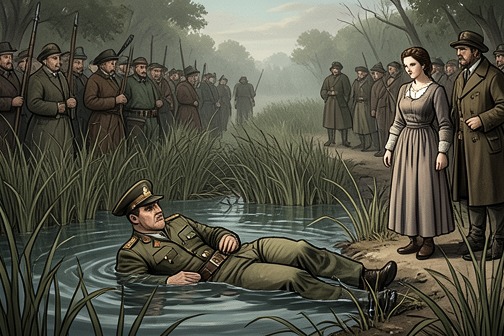
[Wickham's death](entity:event-recall-event-wickham-s-death-94fee69bbce7) is a decisive reversal in the story's treatment of justice. Initially reported as a drunken accident, the drowning appears to remove a dangerous man through chance; later disclosures reveal that Lieutenant Wickham was pushed into the [River Lea](entity:location-recall-location-river-lea-67a35fdb05b8) by [Violet Harkness](entity:character-recall-character-violet-harkness-9bcb3ea8feb1) after Gladys Chambers helped confront him, completing a pattern of retaliation against men who had raped or ruined women. The event therefore changes from apparent providence into concealed human vengeance, while leaving [Elizabeth Bennet](entity:character-recall-character-elizabeth-bennet-f97b53a479cc), [Fitzwilliam Darcy](entity:character-recall-character-fitzwilliam-darcy-ad3b1ecc1d50), [Georgiana Darcy](entity:character-recall-character-georgiana-darcy-1674b422333a), and [Sir David Pentland](entity:character-recall-character-sir-david-pentland-9d7df8c780b8) to confront what justice means when respectable institutions have failed.
## The Public Account: An Apparent Accident
Wickham's death is first explained to Elizabeth by Fitzwilliam Darcy after his return to [London](entity:location-recall-location-london-420923d4a60a). He reports that Lieutenant Wickham had been drinking at a village inn, stole a bottle of brandy while leaving, and consumed it on the road back to the militia camp. The physical evidence seemed to support an accident: Wickham had fallen down the river bank, scraps of his coat were caught on two branches, the brandy bottle lay at the foot of the bank, and his body was discovered three miles downstream, trapped by the weir.
The timing places the death two weeks after Darcy left [Hertfordshire](entity:location-recall-location-hertfordshire-3be0dd22bb53), probably on December 11. By the time Darcy hears the news, Wickham has been dead for three months, and Darcy has learned of the drowning only through Elizabeth. The delay matters because Wickham's disappearance has already begun to alter the lives of those he threatened. His body is recovered, his fate is publicly settled, and the story can initially preserve the language of misfortune rather than accusation.
## The Danger Wickham Leaves Behind
The apparent accident cannot be separated from Wickham's record of abuse. Elizabeth knows that he had fathered three natural children with three different mothers and had ruined more than ten other women. Some had not willingly entered relationships with him; they had believed his declarations of love and discovered too late that his charm concealed predation. Elizabeth also remembers that Darcy had known the truth, at least in broad outline, yet had allowed Wickham to remain among the people of [Meryton](entity:location-recall-location-meryton-84bf7e41468e).
This knowledge intensifies Elizabeth's anger toward Darcy. His family had excused, concealed, and enabled Wickham's conduct for years, then left him to continue harming women while treating local shopkeepers and ruined daughters as beneath their concern. When Darcy earlier assumed that Elizabeth might have believed Wickham's account, she accused him of arrogance, pomposity, and disdain for ordinary people's feelings. Wickham's death thus arrives within an already established moral crisis: the issue is not merely whether one man has died, but whether social rank has protected a violent man until the women he harmed must secure their own safety.
## The Hidden [Vengeance](entity:concept-recall-concept-vengeance-c2a58c5cf2e0)
The later account changes the event's meaning. Elizabeth's suspicions about Wickham's death are almost entirely correct, although she does not know the precise chain of action. Sir David Pentland had already accepted that the residents of the dower house might seek vengeance if they wished. [Vivian Harkness](entity:character-recall-character-vivian-harkness-4b541bfd881c) dealt with the women, while Violet Harkness acted directly in the case of the man who had raped her sister.
Violet knocked Wickham unconscious before pushing him down the river bank. The subsequent three-mile fall over rocks helped conceal the initial assault and made the death appear accidental. Gladys Chambers, whose abuse had been avenged, left for a new life in [Canada](entity:location-recall-location-dc0088f9b440) the following day. The drowning therefore functions as a planned killing disguised by the landscape and by the victim's established reputation for drunkenness. It is not an isolated outburst but one act in a wider campaign: seven rapists have been sent to face divine judgment with Vivian Harkness's assistance and with Sir David's full knowledge and support.
The concealed facts also complicate the narrative's fairness. Elizabeth receives the clues—the bottle, torn coat, river bank, and recovered body—without being given the complete explanation. The reader is first invited to accept the accidental version and only later learns that the apparent evidence has been made to serve as cover. The event's mystery is therefore social rather than supernatural: the hidden solution lies in the refuge's network of abused women and in the protection extended to them by Sir David.
## Consequences for Darcy and Georgiana
Darcy's reaction reveals the intimate stakes of Wickham's disappearance. He should not feel joy at another person's death, yet he does, because Wickham can no longer expose the mistake that had endangered Georgiana Darcy. Darcy says that he mourns the boy Wickham had been, not the man he became, distinguishing private grief from relief that a continuing threat has ended.
When Darcy tells Georgiana that Wickham can no longer harm her, she weeps. The tears provide a catharsis, and from that point she begins to recover the emotional confidence that had been damaged by the earlier danger. Darcy observes that she has changed remarkably in a month: confiding his intention to seek and visit Elizabeth has helped mature her and strengthen their bond, while the news of Wickham's death releases her from immediate fear. A remark that would once have produced self-doubt now brings a radiant smile. Georgiana is no longer merely the younger sister to be protected; she is becoming an adult able to help Darcy.
## Elizabeth, Sir David, and the Meaning of Justice
Elizabeth's response remains morally unsettled. The law and her religious upbringing oppose what she recognizes as the rightness of natural justice, and the uncertainty is sharpened by her knowledge that Wickham harmed women whom powerful men failed to protect. The later revelation does not erase that conflict. Instead, it exposes the cost of a system in which formal respectability shields an abuser and leaves survivors dependent on secrecy, collective action, or retaliation.
Sir David's role makes the same contradiction visible. He is not merely unaware of the women's actions: he has reconciled himself to assisting them when they choose vengeance. His support turns [Grenadine Reef](entity:location-recall-location-grenadine-reef-ad0be7a0e4a4)'s protective community into something more formidable than a charitable refuge. It offers recovery and safety, but it also permits retribution when the ordinary structures of justice have proved inadequate. The killing therefore binds protection to danger and compassion to violence.
The event also gains force from its contrast with [Lady Radha Pentland](entity:character-recall-character-lady-radha-pentland-8550d21cca9a)'s death. Her sudden death from apoplexy leaves Sir David bereft, and Elizabeth comes to Grenadine Reef to discover how profoundly her loss has extinguished his vitality. Against that scene of unavoidable, unexplained mortality, Wickham's drowning is a death made by human hands and then narrated as chance. Together, the two deaths distinguish grief from vengeance: one removes a beloved woman without warning, while the other removes a predator after years of injury.
Wickham's death consequently closes one threat but opens a larger ethical question. It protects Georgiana, gives Gladys Chambers the possibility of a new life, and prevents Wickham from harming more women. Yet it also leaves Elizabeth and Darcy confronting the distance between legal justice, religious restraint, aristocratic responsibility, and the survivors' demand for redress. Its decisive value shift is from fear to safety, but that safety is purchased through an act the characters cannot comfortably name as either murder or justice.
Event 54
The intimidation of Caroline Bingley on New Bond Street

[The intimidation of Caroline Bingley on New Bond Street](entity:event-recall-event-the-intimidation-of-car-964d384a3687) is both a covert act of protection and a calculated escalation in the struggle over [Elizabeth Bennet](entity:character-recall-character-elizabeth-bennet-f97b53a479cc)’s reputation. Ordered by the increasingly frail but still commanding [Sir David Pentland](entity:character-recall-character-sir-david-pentland-9d7df8c780b8), the operation uses a crowded [London](entity:location-recall-location-london-420923d4a60a) street, a staged disturbance, and [Violet Harkness](entity:character-recall-character-violet-harkness-9bcb3ea8feb1)’s concealed knitting needles to terrify Caroline without openly exposing its authors. Its immediate purpose is to silence Caroline’s lies; its wider consequence is Caroline’s social collapse, her departure for [Scarborough](entity:location-recall-location-scarborough-225d56329e7d), and her permanent disappearance from London society.
## Causes and Design
Sir David learns from Elizabeth Bennet’s letter to [Vivian Harkness](entity:character-recall-character-vivian-harkness-4b541bfd881c) that Caroline has been spreading damaging falsehoods about Elizabeth. Although Sir David is seventy-one and increasingly frail, the information prompts an immediate, military response: he orders the carriage prepared and demands that the warning be delivered as soon as possible. His instruction is precise rather than murderous. Caroline is to be frightened, not hurt, and must understand that the threat is her only warning.
The plan depends on confusion and controlled proximity. Vivian proposes creating a scene involving the horses and carriage so that screams and commotion draw every eye away from Caroline. Alison Jones, moving through the street as a lady, is to confront Caroline directly, while Vivian and Violet Harkness accompany her in the guise of maids. The intended gesture is to press Caroline against a wall or shop window, let her feel a sharp point at her back, deliver the warning, and disappear before she can identify those responsible. When Vivian remarks on the danger of using a knife, Violet supplies the practical alternative: knitting needles, an ordinary object unlikely to provoke questions when carried by a young woman.
## The New Bond Street Operation
Elizabeth Bennet had identified the location of [Charles Bingley](entity:character-recall-character-charles-bingley-d470295e8e11)’s townhouse on Curzon Street, allowing the women to determine the precise address and follow Caroline’s movements. Charles leaves before midday, but Caroline’s carriage returns, and Caroline then goes shopping with her maid. New Bond Street is crowded, which makes the operation easier to conceal. Jones, Vivian, and Violet position themselves behind Caroline and wait for the theatrical disturbance to begin.
The diversion nearly becomes genuine when a loud bang and the resulting scream cause the horses to panic. Caroline’s maid and footman are drawn toward the commotion, leaving Caroline exposed. Jones shoves Caroline against a wall, Vivian covers her mouth before she can cry out, and Violet presses both knitting needles into her back. Caroline sees only Jones’s face. The three women then dissolve into the crowd as quickly as they appeared, leaving no obvious trail and preserving the secrecy of the wider group.
Jones tells Caroline that she has been spreading lies throughout London and that the conduct must stop immediately. The warning describes the present assault as a restraint rather than the full threat: this time Caroline is pushed against a wall; next time, she is told, the attackers will merely stand and watch her body be trampled by horses. The language is deliberately brutal, and the command to remain silent makes the scene as much an exercise in psychological domination as a physical threat. Vivian later reports that Violet may have drawn blood when Caroline recoiled, but the injury is not inflicted by a deliberate stab from the attackers. Caroline pushes herself backward onto the points.
## Caroline’s Fear and Recognition
The attackers’ success rests on the gap between what Caroline knows and what the reader later learns. Vivian Harkness does not know that Caroline, as a child, witnessed a small boy being trampled to death. The suppressed memory returns when Jones invokes the possibility of a body beneath horses’ feet. Caroline’s terror therefore comes from more than the immediate danger: the warning reaches into a buried experience that she has not consciously carried into the present.
After her maid helps her undress, Caroline dismisses her and examines her own back in the mirror. She finds two small marks above her right hip, precisely where she felt the points. The apparent knives were Violet Harkness’s exceptionally sharp knitting needles, normally protected by small pieces of cork when not in use. Their harmless domestic appearance makes them an effective instrument of concealment, while the marks give Caroline physical confirmation that the threat was real.
Caroline’s response also exposes the reversal at the heart of the event. She has spent the week deriding and debasing Elizabeth Bennet, and she immediately understands that the warning refers to those lies. Yet the woman who threatened her is unknown to her and does not appear to be anyone she met in [Hertfordshire](entity:location-recall-location-hertfordshire-3be0dd22bb53). Caroline wants to accuse Elizabeth and heap further misery upon her, but fear and uncertainty prevent the simple retaliation she might otherwise attempt. The bully, accustomed to controlling others through humiliation, cannot manage the same experience when power is turned against her.
## Social Consequences
Caroline’s decision about whether to report the assault is overtaken by Charles Bingley’s return. Charles is no longer angry; instead, he is saddened that the conflict has reached this point. He tells Caroline about his conversation with [Fitzwilliam Darcy](entity:character-recall-character-fitzwilliam-darcy-ad3b1ecc1d50), and Caroline learns that the [Countess of Matlock](entity:character-recall-character-countess-of-matlock-1d746f6b845a), [Lady Maitland](entity:character-recall-character-lady-maitland-18908ab235b8), and Darcy intend to give Charles the cut direct if Caroline continues to accompany him into society. The social penalty extends beyond Caroline herself: Charles must understand that his tolerance of his sister has damaged his own standing.
Caroline asks whether all three will truly refuse to acknowledge Charles. He confirms that they will. She weeps silently and does not mention the attack. When Charles tells her to pack, she agrees. Two days later, on Monday morning, the Bingley carriage leaves at first light for the long journey north to Scarborough. [Caroline Bingley](entity:character-recall-character-caroline-bingley-9475b9ccc779) is never seen in London again. Her disappearance is therefore produced by two pressures working together: the private terror of New Bond Street and the public exclusion imposed by the people whose approval sustains her social position.
## Narrative Significance
The event changes the balance of the larger conflict without becoming a public spectacle. Sir David Pentland’s order treats reputation as a matter requiring active defense, but the defense is carried out through secrecy, disguise, and intimidation rather than formal accusation. The scene also complicates any simple distinction between protection and violence: the women are instructed not to hurt Caroline, yet the warning deliberately invokes death, physical danger, and the possibility of being trampled. Its restraint is real, but so is its menace.
The knitting needles give the episode its sharpest irony. A domestic implement associated with quiet female labor becomes, in Violet Harkness’s hands, a covert weapon capable of producing blood and lasting fear. The crowded street, the panicking horses, and the hidden needles form an assemblage in which social performance and physical danger are inseparable. Caroline’s maid and footman see only confusion, while the reader is shown how carefully the scene has been constructed.
The aftermath confirms that Caroline’s defeat is not merely bodily or emotional. She is forced to confront the lies she has circulated, the memory she has suppressed, the unknown reach of the women opposing her, and the fragility of her brother’s willingness to shield her. Elizabeth Bennet does not appear at the scene, yet the attack is caused by the information she passes to Vivian, and its resolution clears Caroline from Elizabeth’s social horizon. When Fitzwilliam Darcy later explains his discussion with Charles, Elizabeth is able to smile at the knowledge that Caroline has gone and move on, while the public nature of Elizabeth and Darcy’s renewed association becomes easier to sustain without Caroline’s interference.
Event 55
Elizabeth Bennet’s marriage to Sir David Pentland

[Elizabeth Bennet’s marriage to Sir David Pentland](entity:event-recall-event-elizabeth-bennet-sir-da-97f8d94b68c6) is both an act of protection and a stark confrontation with mortality. Proposed when Sir David’s terminal stomach cancer has reduced his future from months to weeks, the marriage gives Elizabeth legal and domestic independence from Mrs. Bennet while allowing Sir David to settle [Grenadine Reef](entity:location-recall-location-grenadine-reef-ad0be7a0e4a4) and its dependants according to his considered wishes. Its brevity does not make it inconsequential: the ceremony converts a private promise of care into an inheritance, a public identity, and a burden of stewardship that Elizabeth must carry after becoming a widow almost immediately.
## Causes and Background
Sir David’s decision grows from two connected histories. He had known Elizabeth for years through her relationship with [Lady Radha Pentland](entity:character-recall-character-lady-radha-pentland-8550d21cca9a), whose life had already taught Elizabeth how social respectability could conceal cruelty and how practical care could become a form of moral action. Lady Radha had been born Radha Bhimani in [Kutch](entity:location-recall-location-kutch-9cd484dc0f71), lost her mother in childbirth, endured repeated displacement amid conflict involving the Mughals, the Marathas, and the British, and was kidnapped when she was scarcely older than Elizabeth. Rescued off the coast of the [Arabian Peninsula](entity:location-recall-location-arabian-peninsula-f00d52e55f25), she was carried to [Spain](entity:location-recall-location-spain-336a02c89dc7) aboard a Spanish ship, compelled into a nunnery outside [Cadiz](entity:location-recall-location-cadiz-6779628989a5), and later sent on a mission from Cadiz to [Cartagena](entity:location-recall-location-cartagena-a586cc897c9b) with twenty-nine other members of her order. After pirates captured the ship, she was badly wounded and left behind, surviving only because Sir David took her into his house in Bridgetown, [Barbados](entity:location-recall-location-barbados-a285bae3d98a), and arranged sustained care.
That earlier rescue became the basis of a marriage marked by unusual loyalty. Sir David continued to care for Radha after she had been abandoned as too sick to move, and he later courted her after she had been transferred to the home of a widow for propriety. When she disclosed the violence inflicted on her during four days in pirate hands, he told her that it did not alter his regard for her. The couple returned to Britain after the treatment Radha received in Barbados helped persuade him to resign his naval commission; they married near Edinburgh after his willing but superficial conversion to the [Church of Scotland](entity:organization-recall-organization-church-of-scotla-c72c453213dc), moved to [London](entity:location-recall-location-london-420923d4a60a), and eventually bought Grenadine Reef. Elizabeth therefore enters the marriage not as a stranger seeking fortune, but as the younger woman formed by Radha’s example and by the household’s long moral history.
Sir David’s immediate motive is more urgent. After Lady Radha’s death, his own mortality became pressing, and Elizabeth’s vulnerability within the Bennet family made the problem practical as well as emotional. He believed that Elizabeth needed to reach legal adulthood in order to escape Mrs. Bennet, and he had begun considering how to assist her even before his illness was diagnosed. Once the doctor identified cancer and doubted that Sir David would survive the year, the long-term arrangements he had imagined became impossible. The marriage was consequently devised as a rapid legal settlement, not as the ordinary culmination of a leisurely courtship.
## Proposal and Legal Arrangement
Sir David explained that his original will had left the estate to his twin brother, [James Pentland](entity:character-recall-character-james-pentland-f74c1d84a81a). After Lady Radha’s death, however, and especially after the previous autumn’s events, he sought another way to protect Elizabeth. His new plan required Elizabeth and Darcy to put their personal happiness on hold for a year. James would witness the new will, the marriage settlement, and the wedding; he and his descendants would receive significant specific bequests, while the wider estate would pass to Sir David’s widow. The arrangement placed Darcy in an agonizing position because supporting Elizabeth meant accepting an interference with their own developing relationship.
The plan also shows how illness alters the meaning of consent and choice. Sir David did not merely offer Elizabeth financial security; he asked her to assume a marriage, a title, and the governance of a large estate while his death was imminent. His illness made delay impossible, but the narrative presents the decision as an ethical demand rather than a romantic fantasy. The new will and settlement were prepared in a rush, with a doctor and the local magistrate attesting that Sir David was of sound mind. They were nearly identical, and ordinary provisions for a widow or unmarried children were unnecessary because the principal purpose was to make Elizabeth the protected recipient of the estate.
## The Wedding at St Andrew’s
Six days after Sir David’s proposal, he married [Elizabeth Bennet](entity:character-recall-character-elizabeth-bennet-f97b53a479cc) by common licence. The ceremony took place at St Andrew’s, the same church in which Elizabeth would later marry [Fitzwilliam Darcy](entity:character-recall-character-fitzwilliam-darcy-ad3b1ecc1d50). Sir David was no longer able to walk and had to be carried into the church in a chair; even the journey between the carriage and the church was physically difficult. His brother served as groomsman, [Edward Gardiner](entity:character-recall-character-edward-gardiner-ff481a4f187c) walked Elizabeth down the aisle, and [Lily](entity:character-recall-character-lily-96089ba009e2) acted as maid of honour. The Gardiner family and Darcy attended, as did servants and tenants from the estate, filling the small church with a public display of approval for Elizabeth as the new mistress of Grenadine Reef.
The ceremony also resolves a question of religious and social legitimacy. Lady Radha had converted to the Church of Scotland when she married Sir David, but Sir David himself later sought counsel from a local vicar and converted three years before the wedding so that he could worship at the local church. The marriage was therefore conducted under the rites of the Church of England. The vicar, a friend of Sir David, did not enthusiastically endorse the match, but neither did he oppose it, and he performed the short, functional ceremony. After signing the register, Sir David gently kissed Elizabeth on the forehead before the congregation returned to Grenadine Reef.
The wedding breakfast was less a conventional wedding celebration than a gathering of tenants. The relief visible on many faces testified to the estate’s dependence on a stable succession and to the tenants’ acceptance of Elizabeth. Yet Sir David could not remain long: pain forced him back to his room, where laudanum helped him endure the consequences of leaving the house. The wedding thus joins public celebration to private bodily decline, making the estate’s future visible at precisely the moment when the bridegroom’s own future is disappearing.
## Death and Immediate Aftermath
Sir David never left his bedroom alive again. Elizabeth sat with him for long periods on Friday and Saturday, reading aloud quietly even though it was uncertain whether he remained lucid enough to know she was present. He died early on Sunday morning, and Elizabeth woke as a widow. The marriage had lasted barely thirty-five hours, a fact she later stated plainly when her sisters asked about her first wedding.
After services, the vicar, Sir Frederick the local magistrate, James Pentland, Darcy, and Edward Gardiner confirmed Sir David’s identity and death. Elizabeth spent the interval in the small chapel containing Lady Radha’s grave, reflecting rather than praying. Sir David was buried beside Radha, joining the two people whose care and example had transformed Elizabeth’s life. The following three days brought a severe emotional strain, but Elizabeth returned quietly to the chapel after the interment to give thanks for both their lives and for their having entered her own.
The reading of the will made the consequences unavoidable. Elizabeth was now responsible for many people, while James, though kind, remained distant and would probably never meet her again. His acceptance of the arrangement mattered because he could have refused it, inherited the estate, or potentially challenged the will on the grounds of Sir David’s illness. Instead, the settlement gave Elizabeth the position Sir David intended: not merely a widow with money, but the person answerable for Grenadine Reef and those who depended upon it.
## Identity, Memory, and Significance
Elizabeth initially kept her title secret in London. When she returned after [Michaelmas](entity:time-recall-time-michaelmas-e862228a352d), she was legally Elizabeth, Lady Pentland, but she continued to be introduced and addressed as Miss Bennet. The practical reason was security: a very rich young widow would attract rakes and fortune hunters. The emotional reason was stronger. Elizabeth did not think of herself as the true Lady Pentland because Lady Radha had been married to Sir David for thirty-five years, whereas Elizabeth had been married to him for barely thirty-five hours. She believed that the memories attached to the title should remain Radha’s, and she was ready to relinquish it and become Mrs. Elizabeth Darcy.
The marriage therefore resists the idea that duration alone determines significance. Sir David’s first marriage represents endurance, recovery, and a long partnership built after violence and displacement; his marriage to Elizabeth represents a final act of guardianship that converts affection into legal protection. Elizabeth’s later explanation to her sisters makes the contrast explicit without diminishing either union. She preserves Radha’s place in the household’s history while acknowledging that Sir David’s last decision changed the course of her life.
The event also completes the practical lessons Elizabeth has drawn from Radha and [Madeline Gardiner](entity:character-recall-character-madeline-gardiner-932ce19b654c). Elizabeth had learned from both women that being a lady involved daily responsibility, hospitality, and care rather than rank alone. Through Sir David’s settlement, those lessons become institutional: the young woman once threatened with being treated as a commodity becomes the mistress responsible for tenants, servants, and the refuge associated with Grenadine Reef. His dying body, the hurried legal documents, the crowded church, and the empty bedroom together turn marriage into a test of agency. Elizabeth does not receive a conventional romantic ending from the union, but she receives the means to act, protect others, and later choose Darcy for what she understands as the deepest love.
Event 56
Darcy and Elizabeth reunite in London and begin courting

[Darcy and Elizabeth reunite in London and begin courting](entity:event-recall-event-darcy-elizabeth-a943a2467d2e) after Elizabeth’s return from [Grenadine Reef](entity:location-recall-location-grenadine-reef-ad0be7a0e4a4), where she has become Lady Pentland through her marriage to [Sir David Pentland](entity:character-recall-character-sir-david-pentland-9d7df8c780b8). The reunion is significant because it joins two identities that Elizabeth must keep publicly distinct: in [London](entity:location-recall-location-london-420923d4a60a) she is still generally known as Miss Bennet, while privately she is a wealthy widow whose history and security make concealment necessary. Their renewed relationship therefore begins not with a simple return to flirtation, but with an effort to build trust around altered circumstances, public misunderstanding, and the possibility of marriage.
## Circumstances of the Reunion
Elizabeth’s changed position is inseparable from the history she has inherited and survived. [Lady Radha Pentland](entity:character-recall-character-lady-radha-pentland-8550d21cca9a) had been born Radha Bhimani in [Kutch](entity:location-recall-location-kutch-9cd484dc0f71), lost her mother in childbirth, and spent her childhood moving amid conflict involving the Mughals, the Marathas, and the British. At the age of eleven she was kidnapped for sale into slavery, rescued off the coast of the [Arabian Peninsula](entity:location-recall-location-arabian-peninsula-f00d52e55f25), carried to [Spain](entity:location-recall-location-spain-336a02c89dc7) aboard a ship transporting priests, and forced into a nunnery outside [Cadiz](entity:location-recall-location-cadiz-6779628989a5) for six years. Later, while travelling from Cadiz to [Cartagena](entity:location-recall-location-cartagena-a586cc897c9b) with a religious mission, she was captured by pirates and left gravely wounded after the surviving members of the order continued onward.
Sir David Pentland’s care for Radha created the marriage and estate whose consequences now shape Elizabeth’s courtship with Darcy. He took Radha into his house in Bridgetown on [Barbados](entity:location-recall-location-barbados-a285bae3d98a), where a housekeeper and nurse helped him keep her alive through repeated infections. He later courted her after she had moved to the home of a widow for propriety, and accepted the truth of her pirate captivity without treating it as a reason to reject her. When Barbados subjected Radha to cruel judgments about the violence committed against her, Sir David resigned his naval commission; they returned to Britain, joined the [Church of Scotland](entity:organization-recall-organization-church-of-scotla-c72c453213dc), married near Edinburgh, and eventually bought Grenadine Reef.
The estate’s wealth originated in Sir David’s naval career. In [1770](entity:time-recall-time-1770-48b20ad9bba3), as captain of HMS Glory, he survived a hurricane and later salvaged treasure from a Spanish treasure galleon wrecked on a reef near the [Grenadine Islands](entity:location-recall-location-grenadine-islands-7ca836dbcab2). The prize earned him a knighthood and provided the money to buy the estate, which was named for the reef. Decades later, Sir David and Radha’s quiet, frugal life and sustained investment of surplus income had expanded the property and generated the fortune Elizabeth inherited. Their wealth was not merely ornamental: it gave Elizabeth financial independence while also binding her to a history of imperial warfare, maritime danger, forced migration, and social prejudice.
## The London Courtship
After [Michaelmas](entity:time-recall-time-michaelmas-e862228a352d), Elizabeth plans to return to [Gracechurch Street](entity:location-recall-location-gracechurch-street-4070ca0d2619) so that she will not accidentally encounter Mrs. Bennet. She proposes continuing the courtship with Darcy in London through October and November, when she expects to be in half-mourning and able to attend suitable events. She imagines museums, bookshops, walks, and eventually the theatre, although the theatre outing is postponed until after their marriage. Darcy accepts the general plan, while warning that winter weather might delay his return with [Georgiana Darcy](entity:character-recall-character-georgiana-darcy-1674b422333a) from [Pemberley](entity:location-recall-location-pemberley-6985fcf27de4).
Their London time is deliberately quiet and respectable. Elizabeth resumes volunteering at the [Asylum for Female Orphans](entity:location-recall-location-asylum-for-female-or-4f260edd15a7) on Wednesdays and Fridays, while her association with [Lady Maitland](entity:character-recall-character-lady-maitland-18908ab235b8) is interrupted because Lady Maitland is caring for her husband after his return from Spain. Darcy and Elizabeth spend their permitted social time on museums, bookshops, and walks in the less fashionable park near Gracechurch Street. These activities make the courtship visible enough to continue but restrained enough to accommodate Elizabeth’s half-mourning and protect her from unnecessary scrutiny.
The relationship is also practical rather than purely theatrical. Elizabeth and Darcy discuss the timing of their marriage, the possibility of winter delays, the arrangements for a small ceremony, and the attendance of Georgiana Darcy and one or both of Darcy’s guests. They plan to speak with the vicar at St Andrew’s about a suitable date. Their courtship consequently functions as preparation for a partnership: affection is present, but so are schedules, propriety, travel, mourning, household arrangements, and the need to control the conditions under which their union becomes public.
## Identity, Secrecy, and Reputation
Elizabeth’s public name becomes a central complication. Because none of the Bennet sisters is in London, she is widely treated as Miss Bennet, the identity she used after leaving [Longbourn](entity:location-recall-location-longbourn-09a641b38d11). Although she is actually Elizabeth, Lady Pentland, she does not correct the mistake during the autumn. Correcting it would invite attention, and the additional scrutiny could threaten her safety. The apparent error therefore becomes a protective disguise: social misrecognition allows her to move through London without exposing the wealth, widowhood, and hidden life associated with Grenadine Reef.
This concealment explains [Lady Catherine de Bourgh](entity:character-recall-character-lady-catherine-de-b-81c73654629a)’s later confusion. Lady Catherine assumes that Darcy is courting a Miss Bennet because Darcy had courted Elizabeth before her return to Grenadine Reef. When Elizabeth came back to London after Michaelmas, however, she was no longer simply Miss Bennet; she was Lady Pentland. The change in title obscures the continuity of the relationship and allows Lady Catherine to interpret Darcy’s courtship through the wrong social identity.
Elizabeth ultimately insists that her sisters must tell their parents the truth about the courtship without discussing the Pentlands. They may say that Darcy and Elizabeth met again in London, renewed their acquaintance, that Darcy redeemed himself in Elizabeth’s eyes, and that they spent nine months courting before marrying. Elizabeth specifically reminds them that the renewed acquaintance began at the Asylum for Female Orphans. The instruction balances honesty against protective silence: her sisters must not lie, but neither must they disclose the information that could expose her to danger.
## Consequences and Narrative Significance
The London reunion marks a value shift from guarded separation to chosen intimacy. Elizabeth’s return as a widow and heiress could have made the relationship impossible to interpret plainly, while Darcy’s earlier courtship and Lady Catherine’s investigation create the possibility of renewed conflict. Instead, the couple use London as a controlled space in which to test whether their acquaintance can survive changed names, altered rank, public rumor, and the demands of mourning. The courtship is therefore a second beginning, but not a return to the innocence of their first meetings.
The relationship also gains force from the example of the Pentland marriage. Elizabeth has learned from Lady Radha and from [Madeline Gardiner](entity:character-recall-character-madeline-gardiner-932ce19b654c) that being a gentle-born lady consists less in display than in love and the practical responsibilities of daily life. Radha’s life joins cultures and geographies that British society prefers to keep separate: Kutch, the Arabian Peninsula, Spain, Barbados, and Britain. Her marriage to Sir David converts survival and social rejection into a durable household, while Elizabeth’s inheritance converts that household into the material basis for her own independence. Darcy’s renewed courtship consequently approaches Elizabeth not as a dependent young woman awaiting rescue, but as a person with experience, authority, money, obligations, and the capacity to choose.
The reunion leads to marriage, but its effects extend beyond the wedding. Elizabeth and Darcy later divide and plan their estates for their seven children, reserving Grenadine Reef for their daughter [Helena Darcy](entity:character-recall-character-helena-darcy-dc76883425b1) rather than automatically giving it to a son. They divide the original estate into four portions, assign Pemberley to Bennet, lands at Grenadine Reef and the former Longbourn estate to David and Richard, and allocate other properties to Andrew, Michael, and Bartholomew. On the remaining land around the dower house they build St. Vincent Lodge, named after the island nearest the wreck where Sir David found the treasure. The future estate planning shows that the London courtship develops into a marriage capable of revising inherited succession patterns and carrying the Pentland legacy into a new generation.
Event 57
Darcy rejects the purported engagement to Anne de Bourgh
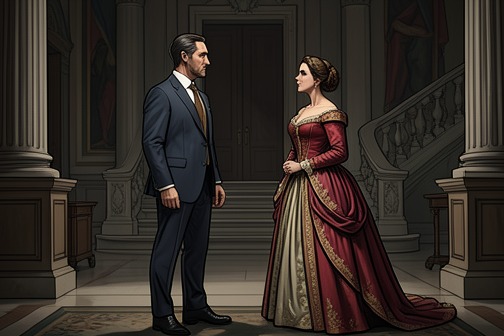
[Darcy rejects the purported engagement to Anne de Bourgh](entity:event-recall-event-darcy-anne-de-bourgh-85aa19124ace) when [Lady Catherine de Bourgh](entity:character-recall-character-lady-catherine-de-b-81c73654629a) confronts him in [London](entity:location-recall-location-london-420923d4a60a) over his courtship of another woman. He refuses to treat an alleged childhood promise as a binding obligation, challenges the family’s attempt to command his marriage, and identifies the material interests concealed beneath its language of duty and family unity. The confrontation marks a decisive assertion of personal and legal independence: Darcy declares himself head of the Darcy family rather than an instrument of the Fitzwilliam relatives, and makes clear that the supposed engagement will not prevent his future with [Elizabeth Bennet](entity:character-recall-character-elizabeth-bennet-f97b53a479cc).
## The Alleged Engagement and Its Demand
Lady Catherine presents Darcy’s courtship as an outrage because, in her view, he is already betrothed to [Anne de Bourgh](entity:character-recall-character-anne-de-bourgh-675bd7be220d). She invokes the wishes of Anne’s mother and Darcy’s own parents, treating the supposed engagement as an inherited family duty that Darcy must now perform. The [Earl of Matlock](entity:character-recall-character-earl-of-matlock-54e80ec38ed2) reinforces that argument by claiming that a marriage between Darcy and Anne would unite two branches of the family. Their language turns marriage into a dynastic arrangement: the individual couple matters less than the consolidation of family connections.
Darcy refuses to accept that premise. He states that he never heard either of his parents mention or confirm a childhood engagement, and he points out that no documentation or paperwork supports the claim. The timing of the assertion makes it still more suspect to him. According to Darcy, the alleged agreement was not mentioned after his father’s death, nor during the decade that followed his mother’s death. What is presented as a longstanding obligation therefore appears, from his perspective, as a claim revived only when it becomes useful.
## Confronting Family Authority
The scene becomes a direct struggle over who has the right to determine Darcy’s life. When the Earl appeals to family unity, Darcy answers pointedly that the Earl has two unmarried sons but is not proposing either of them as the means of achieving that unity. The retort exposes the asymmetry of the demand: the sacrifice is expected from Darcy because his position and estate make him the most valuable matrimonial asset.
Darcy then rejects the identity imposed upon him by his mother’s family. He declares that he is his own man and head of his family, not a Fitzwilliam, while also observing that Anne is not one either. Lady Catherine insists that both are grandchildren of the former Earl of Matlock and therefore Fitzwilliams, but Darcy refuses to let genealogy override his authority. His response is not merely an objection to one marriage; it is a refusal to be governed by relatives who invoke bloodline as a substitute for consent.
The confrontation also reveals Darcy’s controlled anger. Lady Catherine’s shouting and the Earl’s rebuke attempt to place him in the position of an impertinent younger man who must submit to elders. Darcy answers that if his mother’s brother and sister may harangue him, he must be permitted to respond. The irony is lost on Lady Catherine, but the exchange makes the power struggle unmistakable. Darcy’s eventual departure, with cries of his name following him, ends the immediate encounter without reconciliation, yet his position is unmistakable.
## Power, Money, and [Rosings Park](entity:location-recall-location-rosings-park-189e4c085a74)
Darcy interprets the purported engagement as part of a broader financial scheme. He argues that if Anne married him, she would live at [Pemberley](entity:location-recall-location-pemberley-6985fcf27de4), leaving Lady Catherine free to exercise control at Rosings Park. He further accuses his aunt of exceeding her income and selling productive land not protected by the entail on the main estate. These specific financial details transform what might appear to be a quarrel about romantic duty into an argument about property management and economic dependence.
Darcy does not make the accusation casually. He says that he can produce paperwork supporting both his claim about Lady Catherine’s expenditure and the sale of farmland, whereas she can do little beyond shouting. His insistence on documentary proof contrasts with the family’s reliance on an undocumented oral tradition. The conflict thus places evidence, legal authority, and inherited custom against one another: the alleged engagement is treated as real because powerful relatives repeat it, while Darcy demands written confirmation before accepting an obligation that would determine his future.
The episode also connects marriage politics with the novel’s wider concern with estates and succession. Elsewhere, Elizabeth Bennet explains that she refused [William Collins](entity:character-recall-character-william-collins-a95fe9afaea4) because she would not be sold for the sake of [Longbourn](entity:location-recall-location-longbourn-09a641b38d11), and she identifies the unequal expectations placed upon parents and children by contrasting commands to children with the neglected injunction that parents should not provoke their children to anger. [Sir David Pentland](entity:character-recall-character-sir-david-pentland-9d7df8c780b8) likewise considers his estate, mortality, and succession while seeking a solution for Elizabeth’s future. Against that background, Darcy’s refusal belongs to a recurring pattern: marriage and inheritance are repeatedly used by families to control women and men, while the protagonists attempt to turn those arrangements back toward consent and personal responsibility.
## The Boundary Darcy Sets
Darcy does not immediately make the dispute public. He tells his relatives that the matter remains in their hands and that there has been no public breach as yet. This qualification shows that he understands the social consequences of open family conflict and is still attempting to limit the damage, particularly for himself, [Georgiana Darcy](entity:character-recall-character-georgiana-darcy-1674b422333a), and Anne. His restraint is therefore strategic rather than submissive.
At the same time, he leaves no room for renewed pressure. He says that he hopes the matter will not become a public scandal for the sake of all three women and family members implicated, but he insists that the supposed childhood engagement is never to be raised in his presence again. He then walks out. The finality of that exit converts private resistance into a settled decision: whatever the family may claim, Darcy will not marry Anne on the strength of an agreement he has never acknowledged and cannot verify.
## Consequences and Narrative Significance
Darcy’s rejection removes the principal family obstacle to his relationship with Elizabeth Bennet. It establishes that his courtship is not an act of disobedience followed by eventual submission, but a deliberate choice made after examining the claims of duty, kinship, property, and reputation. The scene also prepares the later conflict in which family authority tries to prevent Darcy’s marriage, while Darcy’s response anticipates his broader development into a man willing to separate legitimate responsibility from coercive tradition.
The event’s significance lies in its reversal of the expected social script. A marriage supposedly arranged in childhood is treated by Lady Catherine as binding, yet Darcy recognizes that an undocumented family assertion cannot replace consent. His refusal protects not only his own freedom but the principle that marriage cannot be imposed for money, land, or dynastic convenience. In that sense, the confrontation joins Elizabeth Bennet’s refusal of William Collins and the later breaking of the Bennet entail: each episode challenges the idea that property and family continuity may rightfully purchase a person’s future.
Event 58
Lady Catherine travels to Hertfordshire to investigate Miss Bennet
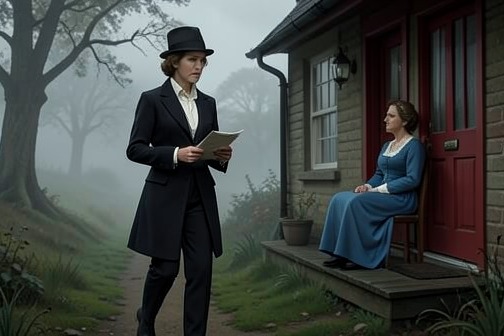
[Lady Catherine travels to Hertfordshire to investigate Miss Bennet](entity:event-recall-event-lady-catherine-miss-ben-4e56b9d39cd0) after learning that [Jane Bennet](entity:character-recall-character-jane-bennet-1913002c8ec6) recovered at [Netherfield Park](entity:location-recall-location-netherfield-park-5ab7b1301fde) and that [Fitzwilliam Darcy](entity:character-recall-character-fitzwilliam-darcy-ad3b1ecc1d50) had also met [Elizabeth Bennet](entity:character-recall-character-elizabeth-bennet-f97b53a479cc) there. What begins as an aristocratic inquiry driven by jealousy and assumptions becomes a carefully staged examination of Darcy’s prolonged return to the neighbourhood, his sister’s presence, and the Bennet family’s access to him.
## The Suspicion That Initiates the Journey
Lady Catherine’s information is indirect and incomplete. During a conversation at [Matlock House](entity:location-recall-location-matlock-house-0af934db1f16), the [Earl of Matlock](entity:character-recall-character-earl-of-matlock-54e80ec38ed2) hears that Miss Bennet accompanied Darcy’s party to the theatre and to several other events, although he remembers little of the discussion on returning home. He does, however, pass the name to his sister. The report that matters to Lady Catherine is that the eldest Miss Bennet became ill and recovered at the house where her nephew was staying, and that Darcy had probably met the second daughter, Elizabeth.
Lady Catherine immediately converts this limited evidence into certainty. She decides that Jane Bennet has used her “arts and allurements” to seduce Darcy, and treats the supposed danger as intolerable. Her reaction reveals the event’s central value shift: ordinary social contact is reclassified as a threat to aristocratic control over Darcy’s marriage. Rather than waiting for fuller evidence, she orders [William Collins](entity:character-recall-character-william-collins-a95fe9afaea4) to return to [Hunsford](entity:location-recall-location-hunsford-e96bd24a1307) and accompany her, announcing that they will leave as soon as daylight permits.
## A Journey Made Difficult by Weather and Rank
The journey from [Rosings Park](entity:location-recall-location-rosings-park-189e4c085a74) to [Hertfordshire](entity:location-recall-location-hertfordshire-3be0dd22bb53) is repeatedly delayed by winter conditions. Freezing rain slows the first stage, and Lady Catherine is forced to spend a night at a coaching inn far from [London](entity:location-recall-location-london-420923d4a60a), a discomfort she voices to every servant who enters her room. The following day brings little improvement. Although the travellers eventually reach Matlock House, they cannot continue the next day because it is the Sabbath.
When travel resumes, the weather is again cold and miserable. Lady Catherine’s anger at these obstacles becomes part of the journey’s character: her authority can command servants and relatives, but it cannot command roads, seasons, or the calendar. The Earl of Matlock finally sees her off while her fulminations still ring in his ears. Four days after leaving Kent, she reaches [Meryton](entity:location-recall-location-meryton-84bf7e41468e). The trip has taken three days of hard driving to cover the seventy miles between Rosings Park and Meryton, turning her investigation into a physically arduous assertion of social will.
## The Inquiry at [Lucas Lodge](entity:location-recall-location-lucas-lodge-3dce5c103331)
William Collins has sent an express ahead to request accommodation from his in-laws, so the carriage arrives at Lucas Lodge as the last winter daylight fades. Lady Catherine remains outwardly controlled, avoiding outright rudeness, but reserves her interrogation of [Sir William Lucas](entity:character-recall-character-sir-william-lucas-d96a797b4b8a) for dinner. Her first demand is to hear about Elizabeth Bennet’s behaviour while she was recovering at Netherfield Park.
The inquiry quickly expands. Sir William explains that Darcy took over the remainder of the Netherfield Park lease from the middle of April until [Michaelmas](entity:time-recall-time-michaelmas-e862228a352d). Darcy had been occupied with estate matters during the spring, but [Georgiana Darcy](entity:character-recall-character-georgiana-darcy-1674b422333a) joined him in June, after which Jane Bennet and other local ladies became regular visitors. [Maria Lucas](entity:character-recall-character-maria-lucas-145929415d63), Sir William’s youngest daughter, learned much while in the company of Georgiana Darcy. Lady Catherine is rendered briefly speechless by this account: Darcy had returned to what she considers an insignificant neighbourhood for more than five months and had brought his sister with him.
Her silence does not signal doubt. It marks the moment when her suspicion acquires a second target. She has long disliked Georgiana Darcy’s guardianship being entrusted to two young gentlemen, and now imagines that the girl’s presence in Hertfordshire may provide an opportunity to correct what she sees as an intolerable arrangement. Yet Lady Catherine postpones that matter and returns to Elizabeth, ordering Maria Lucas to describe every occasion on which she visited Georgiana Darcy.
## Evidence, Misreading, and the Wider Context
Maria’s stammering account establishes that Elizabeth and Darcy were never alone together on the visits at which Maria was present. It also indicates that many local ladies visited Netherfield Park in various groups during the months the Darcys lived there. The evidence therefore weakens the charge of secret intimacy, but Lady Catherine’s method is not neutral fact-finding. She begins with a conclusion and treats each new detail as material to be arranged around it. The investigation is driven less by what Elizabeth has done than by Lady Catherine’s conviction that Darcy’s choice must remain subject to family supervision.
The event also gains force from the history Elizabeth has learned from [Radha Bhimani Pentland](entity:character-recall-character-radha-bhimani-pentl-686fbe966898). Radha was born in [Kutch](entity:location-recall-location-kutch-9cd484dc0f71) in western India, lost her mother in childbirth, and grew up amid repeated displacement caused by conflict involving the Mughals, the Marathas, and the British. At an age only a year older than Elizabeth was during the disclosure, she was kidnapped for sale into slavery. Rescued off the coast of the [Arabian Peninsula](entity:location-recall-location-arabian-peninsula-f00d52e55f25) by a Spanish ship carrying priests, she was taught rudimentary Spanish and then forced into a nunnery outside [Cadiz](entity:location-recall-location-cadiz-6779628989a5) for six years. At twenty-one she was sent without consent toward [Cartagena](entity:location-recall-location-cartagena-a586cc897c9b) with twenty-nine other members of her order; pirates captured the vessel, and Radha suffered a stomach wound that nearly killed her.
Radha’s later life exposes the inadequacy of the social judgments that Lady Catherine represents. [Sir David Pentland](entity:character-recall-character-sir-david-pentland-9d7df8c780b8) cared for her in Bridgetown on [Barbados](entity:location-recall-location-barbados-a285bae3d98a) when she had been left behind as too ill to travel, and he continued nursing her until she recovered. Despite the crimes committed against her, she was subjected to hostile comments and treated as though her survival were an embarrassment. Sir David eventually resigned his naval commission, returned to Britain, converted with Radha to the [Church of Scotland](entity:organization-recall-organization-church-of-scotla-c72c453213dc), married her near Edinburgh, and settled with her in England. Elizabeth later identifies Radha, alongside [Madeline Gardiner](entity:character-recall-character-madeline-gardiner-932ce19b654c), as one of the two principal sources of her understanding of what it means to be a lady: not birth alone, but love, practical responsibility, and the daily care of others.
## Narrative Significance
Lady Catherine’s expedition is therefore both an investigation and a collision between competing definitions of female worth. She approaches Elizabeth as a socially dangerous girl whose presence near Darcy must be explained, while Elizabeth’s moral education has taught her to judge women through endurance, responsibility, and action rather than pedigree. The journey’s delays, the interrogation at Lucas Lodge, and the testimony about Netherfield convert rumour into a public sequence of questions, but they do not give Lady Catherine the control she expects.
The event prepares the larger confrontation between Lady Catherine’s possessive model of family authority and Elizabeth’s insistence on independent judgment. Its irony lies in the contrast between the evidence Lady Catherine seeks and the history the novel places beside it: a woman who survived forced migration, enslavement, piracy, religious coercion, and social shunning is remembered by Elizabeth as a model of genuine gentility, while Lady Catherine’s inherited rank produces suspicion, interrogation, and attempted control. The investigation thus makes social power visible precisely by showing how quickly it mistakes ordinary association for transgression.
Event 59
Lady Catherine mistakes Jane for Darcy’s courtship target at Longbourn
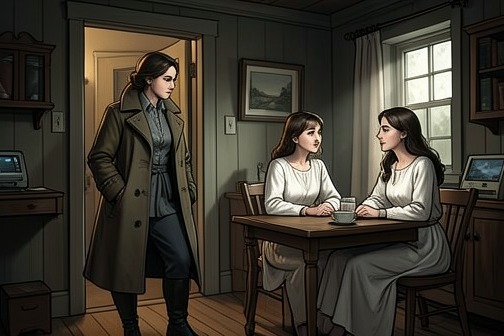
[Lady Catherine mistakes Jane for Darcy’s courtship target at Longbourn](entity:event-recall-event-lady-catherine-longbour-3ac130fed6c3) is a confrontation driven by aristocratic certainty, incomplete information, and the divided public identities of the Bennet sisters. [Lady Catherine de Bourgh](entity:character-recall-character-lady-catherine-de-b-81c73654629a) arrives determined to prevent what she believes is an impossible and scandalous match, but addresses the wrong sister and leaves [Longbourn](entity:location-recall-location-longbourn-09a641b38d11) with the mystery unresolved. The episode exposes how quickly reputation, marriage, and family status can be manipulated by rumour, while giving [Jane Bennet](entity:character-recall-character-jane-bennet-1913002c8ec6) a rare opportunity to defend her dignity in her own house.
## Lady Catherine’s Arrival and Assumption
Mrs. Bennet and her three remaining daughters are together in the dining room when an unfamiliar carriage approaches Longbourn. The hour is early, and the equipage belongs to neither a neighbour nor an expected visitor. Lady Catherine enters alone, while [William Collins](entity:character-recall-character-william-collins-a95fe9afaea4) remains in the carriage at her instruction. Her manner is more than usually ungracious, and although Mrs. Bennet is flattered by the presence of so important a guest, Lady Catherine refuses refreshment because she has waited more than a week to deliver her accusation and will not postpone it.
Lady Catherine announces that Jane must understand why she has come and insists that Jane’s own heart and conscience should reveal the answer. Jane, genuinely astonished, says that she cannot account for the honour of the visit. Lady Catherine then identifies the rumour: she has been told that Jane Bennet will soon be united to her nephew, [Fitzwilliam Darcy](entity:character-recall-character-fitzwilliam-darcy-ad3b1ecc1d50). She calls the report a scandalous falsehood, declaring that she would not injure him by supposing it possible, yet her immediate journey to Longbourn shows that the rumour has already acquired enough force to demand direct intervention.
## The Confrontation in the Dining Room
Lady Catherine treats the supposed courtship as an offence against family obligation and social order. She accuses Jane of using arts and allurements to make Fitzwilliam Darcy forget what he owes to himself and to his family. The charge is not merely a request for information; it attempts to place Jane in the position of a socially ambitious woman who must defend herself before an aristocratic authority.
Jane refuses that position. Her anger becomes cold fury when Lady Catherine speaks in this manner before Mrs. Bennet and the younger sisters, and she stands to demand that Lady Catherine leave. When Lady Catherine insists that she has the right to know whether Jane is courting Fitzwilliam Darcy, Jane answers that Lady Catherine has no right to demand anything. She nevertheless gives a clear and happy denial: she is not courting him and cannot imagine why she would wish to join a family that includes Lady Catherine. Her response changes the balance of the scene. Lady Catherine arrives expecting submission, but Jane’s directness makes the accusation impossible to sustain against the person actually before her.
## The Rumour’s Misidentification
Lady Catherine remains confused because the circulating report concerns a Miss Bennet, and Jane is indeed Miss Bennet in Longbourn. The family then supplies the missing distinction. Another sister, [Elizabeth Bennet](entity:character-recall-character-elizabeth-bennet-f97b53a479cc), has lived in [London](entity:location-recall-location-london-420923d4a60a) throughout the year and is also known there as Miss Bennet. [Mary Bennet](entity:character-recall-character-mary-bennet-3ad0e066a036) explains that the last time Elizabeth and Fitzwilliam Darcy were together, Elizabeth threatened to slap his face. The detail is too specific to be dismissed as a polite family correction, and it immediately separates Jane from the woman Lady Catherine has been seeking.
The revelation reverses Lady Catherine’s certainty without giving her the full truth. Elizabeth’s hostility toward Fitzwilliam Darcy is known to the family, while her recent London life remains private. Jane later reflects that Fitzwilliam Darcy spent much of the spring and summer at [Netherfield Park](entity:location-recall-location-netherfield-park-5ab7b1301fde) or at his northern estate, yet appeared to pay no particular attention to anyone locally. If he is now courting, she reasons, the courtship must be recent; it might involve Elizabeth, or Elizabeth might herself be receiving another suitor, while Lady Catherine has confused two separate reports. Jane concludes that this unlikely explanation is nevertheless the best account of the morning’s extraordinary events.
## Consequences and Narrative Significance
The immediate consequence is not a marriage negotiation but the exposure of a communication gap. Lady Catherine has acted on a rumour, travelled to Longbourn, and insulted the wrong Bennet sister. Jane’s refusal protects her household’s dignity, while Mary’s intervention redirects Lady Catherine’s suspicion toward London and Elizabeth. The scene therefore converts aristocratic authority into uncertainty: Lady Catherine can command attention, but she cannot command accurate knowledge.
For the reader, the episode also sharpens the contrast between Elizabeth’s public and private lives. Her letters to Jane are regular and lively, yet they omit Fitzwilliam Darcy, the Pentland family, and the fact that Elizabeth is now Elizabeth Lady Pentland, a widow. Jane’s ignorance is not caused by indifference; Elizabeth keeps silent because the subject is too private and because she does not want her sisters forced to lie to their parents. The Longbourn confrontation thus dramatizes the cost of secrecy. A rumour about a Miss Bennet is close enough to the truth to create social danger, but the family’s incomplete knowledge leaves even Jane unable to identify the real courtship.
The event also belongs to the novel’s broader examination of women’s agency and social double standards. Lady Catherine assumes that a young woman can be morally and socially controlled through accusation, rank, and family claims. Jane answers with speech, posture, and expulsion: she stands, rejects the demand, and orders the intruder from her house. The mistaken identity makes the scene comic, but the underlying stakes remain serious. A woman’s name, residence, and marital prospects are treated as public property, while the woman herself must struggle to preserve the right to define her own relationships. Lady Catherine leaves without the submission she expected, and Longbourn is left to interpret the consequences of a rumour that has finally revealed more than its originators intended.
Event 60
Lady Catherine is expelled from Grenadine Reef by Elizabeth

[Lady Catherine is expelled from Grenadine Reef by Elizabeth](entity:event-recall-event-lady-catherine-grenadin-8766930538bf) in a confrontation that converts an attempted aristocratic intervention into a public defeat. Arriving in snowy weather with [William Collins](entity:character-recall-character-william-collins-a95fe9afaea4), Lady Catherine expects to command access to Elizabeth and forbid her relationship with [Fitzwilliam Darcy](entity:character-recall-character-fitzwilliam-darcy-ad3b1ecc1d50). Instead, Elizabeth treats her as an unwelcome intruder, summons legal authority, and makes [Grenadine Reef](entity:location-recall-location-grenadine-reef-ad0be7a0e4a4)’s boundaries—and Elizabeth’s authority within them—the decisive instruments of the scene.
## Causes and Background
Lady Catherine’s journey begins after she hears that Miss [Elizabeth Bennet](entity:character-recall-character-elizabeth-bennet-f97b53a479cc) will probably marry her nephew, Fitzwilliam Darcy. Convinced that the report must be a scandalous falsehood, she travels through the [Hertfordshire](entity:location-recall-location-hertfordshire-3be0dd22bb53) countryside to investigate and make her objections known. During the journey, she questions William Collins about the Bennet sisters and identifies Elizabeth as the true source of the difficulty, rather than [Jane Bennet](entity:character-recall-character-jane-bennet-1913002c8ec6). Snow begins to fall as the carriage reaches Grenadine Reef, and Lady Catherine allows Collins to accompany her into the manor house so that she can confirm Elizabeth’s identity.
Her assumptions are already shaped by a rigid hierarchy. She approaches Elizabeth as Miss Elizabeth Bennet, a socially inferior woman whose conduct can be corrected by an older aristocratic relation. She also treats Darcy’s possible marriage as a family arrangement over which she possesses veto power. The scene therefore carries two overlapping disputes: Lady Catherine wants to prevent a marriage, while Elizabeth must defend both the relationship itself and her right to refuse Lady Catherine’s authority.
## The Confrontation at Grenadine Reef
Mrs. Gardiner receives Lady Catherine and Collins in the parlour but does not offer them seats or tea. When Lady Catherine demands to see Elizabeth “at once,” Mrs. Gardiner denies that Elizabeth is living there and refuses to disclose her [London](entity:location-recall-location-london-420923d4a60a) address. Mrs. Gardiner has already guessed that Lady Catherine has heard about the courtship between Elizabeth and Darcy, and her controlled discourtesy denies Lady Catherine the social deference on which the visitor relies.
Elizabeth enters the manor house aware of Lady Catherine’s presence. She sees Perkins hurrying toward her, signals him to remain silent, and follows two of her guards into the parlour, with the remaining guards and the Harkness sisters close behind. Her entrance makes the balance of power visible before she speaks: Lady Catherine has arrived with rank and indignation, while Elizabeth possesses the household, its personnel, and physical protection.
Elizabeth addresses the visitor as an “ill-mannered harpy” and asks why she has invaded her aunt’s parlour. William Collins attempts to assert the dignity of his clerical position, but Elizabeth does not permit him to turn the encounter into a debate on his terms. She orders John and Peter to escort him to the carriage and instructs them to hold him for trespassing if he returns to the house before the local magistrate arrives. Collins is dragged away, spluttering indignantly, rather than ceremonially received as Lady Catherine’s companion.
Lady Catherine then tries to establish superiority by announcing that she is the daughter of the previous [Earl of Matlock](entity:character-recall-character-earl-of-matlock-54e80ec38ed2) and the sister of the current Earl. She is taller and heavier than Elizabeth and steps toward her in an effort at physical intimidation. Elizabeth’s bodyguards and companions step forward as well, twice, making clear that rank will not be allowed to become physical domination. Lady Catherine recognizes that the opposing party is prepared to resist her and is not foolish enough to ignore the warning.
## The Dispute over Darcy
Lady Catherine declares that she has received an alarming report that Elizabeth Bennet will soon be united to Darcy. She calls the report a scandalous falsehood and says that she has come to make her sentiments known. Elizabeth refuses to hear those sentiments and tells Lady Catherine that it is time for her to leave. Lady Catherine answers that she will not go and says that she will not allow her nephew to be seduced by Elizabeth’s arts and allurements; she expressly forbids the arrangement Elizabeth supposedly seeks.
Elizabeth responds with deliberate mockery, suggesting to [Violet Harkness](entity:character-recall-character-violet-harkness-9bcb3ea8feb1) that the newspapers should be alerted because the news is wonderful. The joke reverses Lady Catherine’s intended drama. What Lady Catherine presents as a private aristocratic prohibition becomes, in Elizabeth’s treatment of it, evidence of a marriage that might be publicly celebrated. Elizabeth does not offer the assurance Lady Catherine demands, because giving it would concede that Lady Catherine has any authority over her choice.
Lady Catherine refuses to leave until Elizabeth promises not to marry Darcy. Elizabeth has already asked her to depart twice, and she now describes the situation to Sir Frederick Wright, who arrives after a groom has been sent for the local magistrate. Elizabeth explains that Lady Catherine has been asked to leave but insists on remaining until she receives an assurance Elizabeth is unwilling to give. She asks Sir Frederick to persuade Lady Catherine to leave quietly while retaining what little dignity remains to her.
## Legal and Social Reversal
Sir Frederick tells Lady Catherine that she has been ordered to leave and threatens to arrest her for trespass if she does not comply. Lady Catherine invokes the privilege of peerage, relying once again on the language of rank to resist ordinary consequences. Sir Frederick rejects the claim: the privilege applies to peers and their wives or widows, not to the children or siblings of a peer. As a baronet and ordinary knight, he cannot claim that privilege himself, but he makes clear that Lady Catherine cannot use a legal term she does not understand as a shield against expulsion.
The correction strips Lady Catherine’s authority of its theatrical force. The title and family connections that have enabled her to bully others do not make her immune from the law, and her relationship to the Earl of Matlock does not give her ownership of Grenadine Reef. Lady Catherine is therefore compelled to leave not because she has been persuaded about Darcy, but because she has lost the right to remain in Elizabeth’s house.
Elizabeth softens the immediate consequence for William Collins because of the weather. Although she has asked for him to be charged with trespass, she agrees to let the offence go on this occasion and arranges for a groom to escort the carriage to the inn at [Pepperstock](entity:location-recall-location-pepperstock-03702999351b). Sir Frederick then gives both visitors the final warning: neither Lady Catherine nor Collins is welcome at Grenadine Reef, and if either returns, both will be charged with trespass. Their carriage proceeds down the snowy drive for the one-mile journey to the inn.
## Significance and Aftermath
The expulsion establishes Grenadine Reef as a protected space in which Elizabeth can act rather than submit. Lady Catherine’s visit is an attempted invasion of both domestic territory and female choice, but Elizabeth answers it through wit, guards, household management, and lawful procedure. The scene’s decisive reversal is that the supposedly powerless Miss Bennet controls the door, the servants, the security, and the summons to the magistrate, while the aristocratic intruder must retreat under escort.
The confrontation also belongs to the larger transformation of Elizabeth’s identity. Lady Catherine does not know that the woman before her is Elizabeth Lady Pentland, widow of [Sir David Pentland](entity:character-recall-character-sir-david-pentland-9d7df8c780b8) and mistress of Grenadine Reef. Elizabeth’s authority has been built through a life far removed from Lady Catherine’s assumptions: Radha Bhimani was born in [Kutch](entity:location-recall-location-kutch-9cd484dc0f71), kidnapped for sale into slavery when she was scarcely older than Elizabeth, rescued off the [Arabian Peninsula](entity:location-recall-location-arabian-peninsula-f00d52e55f25), forced into a nunnery outside [Cadiz](entity:location-recall-location-cadiz-6779628989a5), attacked by pirates, and later cared for by Sir David in [Barbados](entity:location-recall-location-barbados-a285bae3d98a). Sir David’s wealth came from the treasure recovered from a Spanish galleon wrecked on a reef in the [Grenadine Islands](entity:location-recall-location-grenadine-islands-7ca836dbcab2), and that fortune purchased the estate called Grenadine Reef. Those histories make the estate a place where survival, displacement, and self-determination have been converted into material independence.
Elizabeth’s later stewardship of that inheritance gives the expulsion a broader social dimension. Lady Radha’s experiences and Elizabeth’s education at Grenadine Reef have taught Elizabeth to judge conduct through practical responsibility rather than inherited display. Elizabeth’s investment thinking extends from surveying workers’ preferences for beer to identifying breweries and possible acquisitions of hops and barley acreage near [Alton](entity:location-recall-location-alton-b149e804c75f) and [Lewes](entity:location-recall-location-lewes-e76396e796f2), while the Pentland fortune is preserved through quiet living and reinvestment. Grenadine Reef is thus not merely a grand house where Lady Catherine is turned away: it is the institutional result of naval risk, colonial movement, careful management, and a commitment to making resources serve lives beyond fashionable society.
In the immediate plot, Lady Catherine’s failed intervention confirms that she cannot prevent Elizabeth and Darcy from determining their own future. In the longer history of the estate, the same principle appears in the next generation: Elizabeth and Darcy later divide the property among their children, leave Grenadine Reef to their daughter Helena rather than automatically to their second-born son, and reserve the land around the dower house for St. Vincent Lodge and the women’s refuge. The scene at the door therefore anticipates a continuing redefinition of inheritance and authority. Lady Catherine arrives believing that family rank entitles her to command; Elizabeth sends her away under the ordinary law of trespass, preserving Grenadine Reef as a place governed by chosen obligations rather than inherited intimidation.
Event 61
William Collins’s death
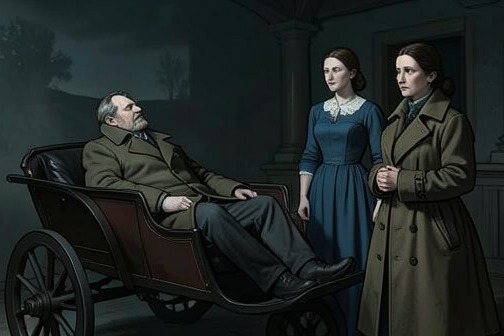
[William Collins’s death](entity:event-recall-event-william-collins-ca0b5a568ade) is both a personal loss and a decisive legal turning point. He dies of fever while travelling toward [Meryton](entity:location-recall-location-meryton-84bf7e41468e), leaving behind [Charlotte Collins](entity:character-recall-character-charlotte-collins-c26e720ace04) and a newborn daughter; because he has no male issue, the entail on [Longbourn](entity:location-recall-location-longbourn-09a641b38d11) ends, allowing the estate to pass outside the succession that had threatened the Bennet family.
## Illness and Death
[William Collins](entity:character-recall-character-william-collins-a95fe9afaea4) had already fallen ill on the Monday of his journey to Meryton. His condition worsened on Tuesday, particularly after he was made to remain in a cold carriage outside Longbourn. By Wednesday morning he was delirious, having been found by the staff of a small inn at [Pepperstock](entity:location-recall-location-pepperstock-03702999351b), the village west of [Grenadine Reef](entity:location-recall-location-grenadine-reef-ad0be7a0e4a4). He never regained consciousness and died there of a fever on Friday, 4 December [1812](entity:time-recall-time-1812-a60cc348934a).
His death occurred while his household was facing another crisis. Charlotte Collins had gone into arduous labour and safely delivered a baby daughter, but she became seriously ill from infection afterward. William Collins therefore died without learning that his child had survived, and Charlotte’s recovery remained uncertain, including whether she would ever be able to bear another child. The juxtaposition makes the event more than a simple change in inheritance: a husband dies as a father without knowing his daughter, while a new mother is forced into widowhood almost immediately after childbirth.
## The Collapse of the Entail
The legal consequence is announced with stark clarity: the entail is broken because the last heir has died without male issue. Longbourn may now be bestowed on any of the Bennet children, divided among them, or sold. The death consequently reverses the arrangement that had made Charlotte Collins’s marriage to William Collins strategically important to the Bennet family’s future.
Before William Collins’s death, his position as the male heir made the Bennet daughters vulnerable to displacement. His marriage had placed Charlotte in the line of succession, and [Sir William Lucas](entity:character-recall-character-sir-william-lucas-d96a797b4b8a) had been willing to see his daughter become the future mistress of Longbourn. Once William dies, however, Charlotte is no longer positioned to inherit the estate. Her father understands the change while holding his new granddaughter: Charlotte will never become Mistress of Longbourn, despite having been married for the purpose of securing that prospect.
## News, Mourning, and Charlotte’s Departure
The Gardiners and [Elizabeth Bennet](entity:character-recall-character-elizabeth-bennet-f97b53a479cc) do not learn of the death through a private family message. Their first knowledge comes from a prayer for William Collins at church two days after he dies. The delayed and indirect announcement underscores the distance between the household at Pepperstock and the people whose lives his death immediately alters.
[Edward Gardiner](entity:character-recall-character-edward-gardiner-ff481a4f187c) then travels to [Lucas Lodge](entity:location-recall-location-lucas-lodge-3dce5c103331) to inform Sir William Lucas, who leaves the following morning for [Hunsford](entity:location-recall-location-hunsford-e96bd24a1307). Six days after William Collins’s death, Sir William tells Charlotte that her husband has died. He is delighted by the birth of his granddaughter, but the child’s arrival cannot soften the change in Charlotte’s position. She is now a widow after less than eleven months of marriage, with the expected inheritance gone and her future unsettled.
Charlotte leaves Hunsford for the last time after the parsonage staff help her pack her possessions. The departure closes the brief household created by her marriage to William Collins and separates her from the social and legal identity that had been attached to becoming mistress of Longbourn. Her survival and motherhood remain, but the material future promised by the marriage disappears with her husband.
## Wider Consequences
William Collins’s death forms part of a sequence in which mortality repeatedly forces private relationships into legal and economic decisions. [Sir David Pentland](entity:character-recall-character-sir-david-pentland-9d7df8c780b8)’s terminal stomach cancer had already made death an immediate administrative problem: his illness led to a new will, a marriage settlement, and a hurried marriage to Elizabeth Bennet, who became his widow only days later. In that earlier case, impending death transfers an estate to a chosen adult woman. In William Collins’s case, death removes the male heir whose existence had preserved the entail and releases Longbourn from it.
The contrast also clarifies the different kinds of agency available to women. [Lady Radha Pentland](entity:character-recall-character-lady-radha-pentland-8550d21cca9a)’s earlier life had been shaped by kidnapping, forced religious confinement, piracy, and relocation across India, the [Arabian Peninsula](entity:location-recall-location-arabian-peninsula-f00d52e55f25), [Spain](entity:location-recall-location-spain-336a02c89dc7), [Barbados](entity:location-recall-location-barbados-a285bae3d98a), and Britain; Elizabeth Bennet later draws on Lady Radha’s example when thinking about women’s endurance and practical responsibility. Charlotte Collins has less power over the legal structure surrounding her, but William’s death still alters her circumstances through the ending of the male succession. The result is not triumph for Charlotte, but an unintended opening through which Longbourn can be reassigned.
## Narrative Significance
The death removes the mechanism that has kept Longbourn destined for a male relative and turns inheritance into a matter of choice. Its consequences extend beyond William Collins’s inn room: Charlotte becomes a widow, her daughter is born without her father’s knowledge, Sir William must carry the news to Hunsford, and the Bennet estate can finally be directed to one or more of the Bennet children or sold.
The event is narrated as a chain of bodily decline, birth, delayed notification, and legal release. Fever, delirium, labour, infection, and widowhood bring the domestic cost of inheritance law into view, while the broken entail converts that cost into a structural change. William Collins dies believing in neither the altered future nor the child who survives him; the living must interpret his death, distribute its consequences, and decide what Longbourn will become.
Event 62
The end of the Bennet male succession and the解除 of the Longbourn entail

[The breaking of the Bennet entail](entity:action-recall-action-the-breaking-of-the-be-3d3be93effbb) at [Longbourn](entity:location-recall-location-longbourn-09a641b38d11) removes the rule that had tied the estate to male-line succession. [William Collins’s death](entity:event-recall-event-william-collins-ca0b5a568ade) without a son prompts the family to verify the Bennet genealogy, and the finding changes Longbourn from an inheritance fixed by the entail into property [Thomas Bennet](entity:character-recall-character-thomas-bennet-fdb1df6a4cdd) may dispose of at his discretion. The legal change resolves a long-running constraint on the family while exposing the difference between inheriting an estate and managing it well.
## Background and the pressure of inheritance
[The entail](entity:concept-recall-concept-the-entail-d4a772dde87e)’s importance had long exceeded the technical question of who would inherit. Because Longbourn was restricted to male heirs, the Bennet daughters’ futures were bound to a property they could not inherit through the existing arrangement. Elizabeth had explained that her refusal of [William Collins](entity:character-recall-character-william-collins-a95fe9afaea4) was not a refusal rooted in love: she would not be forced into marriage for the sake of Longbourn, particularly when she believed her mother valued the estate more than her. The entail thus made marriage a potential instrument for preserving property, sharpening the conflict between a woman’s consent and her family’s financial security.
Longbourn’s condition also makes the question of succession one of stewardship, not merely title. According to the estate steward, [Mr. Case](entity:character-recall-character-mr-case-37f8b3b4f91f), Thomas had an academic bent, had thrived at Oxford, and loved books; he did what the estate required but did not make it his central concern. After Elizabeth left, Jane and Mary worked hard, yet the household did not understand how much Elizabeth had previously contributed behind the scenes. There was still enough food with two fewer people in the house, but the estate seemed to produce less than it should. The eventual freedom to choose an heir or sell the property therefore arrives against a record of underused potential.
## The inquiry into the Bennet line
The determination is made at a gathering around Thomas’s dining table. Present with him are his brothers-in-law Philips and Gardiner, [Sir William Lucas](entity:character-recall-character-sir-william-lucas-d96a797b4b8a), and Clive Bredason, the vicar of [Longbourn Chapel](entity:location-recall-location-longbourn-chapel-df8e6129f848). They begin with Martin Bennet and trace each subsequent generation through the legal documents kept since the original entail, parish records, and the Bennet Family Bible. The investigation joins family memory to documentary proof: the history of Longbourn’s ownership is followed through records capable of establishing who can legally inherit it.
The inquiry connects the estate to an old royal grant. Martin Bennet had received the thanks of Charles II for loyal support between 1651 and 1660, and that recognition included the deed to Longbourn and its attendant lands. The researchers conclude that there are no male heirs in any line going back to Martin. Their finding is not simply that Thomas has no son; it is that the chain of eligible male succession has run out across the documented family history.
## Collins’s death and the legal result
The inquiry follows the death of William Collins, the last heir under the arrangement. Collins died of a fever on Friday, December 4, [1812](entity:time-recall-time-1812-a60cc348934a), at a small inn in [Pepperstock](entity:location-recall-location-pepperstock-03702999351b), west of [Grenadine Reef](entity:location-recall-location-grenadine-reef-ad0be7a0e4a4). He had been ill earlier in the journey to [Meryton](entity:location-recall-location-meryton-84bf7e41468e); his condition worsened after he was made to sit in a cold carriage outside Longbourn, and inn staff found him delirious on Wednesday morning. He never regained consciousness.
Collins did not live to hear that his wife had delivered a daughter, Angela, after a difficult labour. [Charlotte Collins](entity:character-recall-character-charlotte-collins-c26e720ace04) had also been seriously ill but recovered from the infection, and it remained uncertain whether she could have further children. The child’s birth does not preserve the entail: the rule depends on a male heir, and Collins has died without male issue. At the family gathering, the conclusion is stated plainly: the entail is broken because the last heir died without a son.
## Consequences and significance
Once the finding is established, Thomas asks what it permits him to do. Philips explains that he may give Longbourn to any of his children, divide it among them, or sell the estate. Thomas asks whether the appropriate paperwork will be filed with the [Court of Chancery](entity:organization-recall-organization-court-of-chancer-554eb5b648af), and Philips agrees. The legal change therefore transfers the decision about Longbourn’s future from the entail’s prescribed line of succession to Thomas’s own choice; it does not, by itself, determine what he will choose.
The episode also throws into relief the distinction between formal authority and practical control. Elsewhere, Sir David acknowledges that Lady Radha is better at business and investments, crediting her attention for their success. A proposed marriage settlement for Elizabeth similarly provides that decisions concerning Grenadine Reef and its smaller estates require her explicit written permission, making her the real mistress in practice despite the formal legal position. These arrangements offer a contrast to Longbourn’s history: property rules can restrict women’s options, while careful management and contractual protections can give them meaningful authority. The breaking of the entail opens a new legal possibility for the Bennet family, but the estate’s future remains a question of choice, responsibility, and who will actually care for the land.
Event 63
Darcy proposes acquiring Longbourn and incorporating it into Grenadine Reef
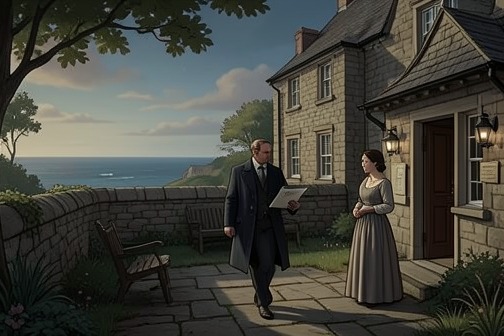
[Darcy proposes acquiring Longbourn and incorporating it into Grenadine Reef](entity:event-recall-event-darcy-longbourn-grenadi-13939f1fbd87) as a solution to the Bennet family’s financial vulnerability and inheritance problem. The proposal is not merely a land purchase: it is a deliberate restructuring of ownership, management, residence, and dowry provision. By placing [Longbourn](entity:location-recall-location-longbourn-09a641b38d11) under the stronger administration of [Grenadine Reef](entity:location-recall-location-grenadine-reef-ad0be7a0e4a4) while protecting the Bennet parents and endowing the daughters, the plan turns a declining family estate into part of a larger and more viable patrimony.
## Causes and Background
The proposal arises from the condition of Longbourn and from the limitations imposed by the entail. [Thomas Bennet](entity:character-recall-character-thomas-bennet-fdb1df6a4cdd) has never treated the estate as his principal concern. He is described as academically inclined, with books as his first love, doing what is necessary for the property but no more. [Mr. Case](entity:character-recall-character-mr-case-37f8b3b4f91f), the steward, visits him only once a year, and the estate’s management is therefore presented as limited rather than energetic. Elizabeth understands that dividing Longbourn among several daughters would leave each with only a small fragment of land, while the existing succession system threatens the family’s security because the estate cannot simply be distributed according to the daughters’ needs.
The contrast with Grenadine Reef is essential to the scheme. [Sir David Pentland](entity:character-recall-character-sir-david-pentland-9d7df8c780b8)’s fortune began with his command of HMS Glory in [1770](entity:time-recall-time-1770-48b20ad9bba3), when his ship encountered a Spanish treasure galleon wrecked on a reef near the [Grenadine Islands](entity:location-recall-location-grenadine-islands-7ca836dbcab2) during a hurricane. His crew salvaged a substantial portion of the treasure before the wreck was destroyed, and Sir David was knighted for the exploit. His share of the prize financed the purchase of Grenadine Reef. The estate’s later prosperity came from restrained expenditure, the Pentlands’ quiet and nearly frugal life, the absence of children, and the investment of annual surpluses. Those investments steadily increased their capital, enabling them to double the size of Grenadine Reef and acquire smaller neighboring estates.
The event also grows out of Elizabeth’s education in estate management. [Lady Radha Pentland](entity:character-recall-character-lady-radha-pentland-8550d21cca9a), a woman born in [Kutch](entity:location-recall-location-kutch-9cd484dc0f71) who was forced across several imperial and maritime worlds before reaching Britain, became one of Elizabeth’s principal models of practical authority. Elizabeth learned from Lady Radha’s example that the welfare of tenants was an estate owner’s responsibility. Sir David openly acknowledges that Lady Radha has the better head for business and investments, a reversal of the usual assumption that men are naturally superior in commercial affairs. Elizabeth’s own later investment thinking follows the same pattern: when she surveys servants, tradesmen, and workers about their beer preferences, she identifies breweries in [Alton](entity:location-recall-location-alton-b149e804c75f) and [Lewes](entity:location-recall-location-lewes-e76396e796f2) and then extends the inquiry toward hops, barley, Southampton, Portsmouth, merchant shipping, and the [Royal Navy](entity:organization-recall-organization-royal-navy-31f3701ac194). Her proposal for Longbourn belongs to this larger understanding of property as an actively managed system rather than a passive social ornament.
## The Proposed Arrangement
Elizabeth suggests using £100,000 as the working purchase price, based on Sir David’s earlier acquisition of a comparable 2,000-acre tract. She proposes that Darcy buy Longbourn’s lands and add them to Grenadine Reef, while Thomas and [Fanny Bennet](entity:character-recall-character-fanny-bennet-32517e125a1f) receive a life tenancy in Longbourn manor. They would therefore retain their home for the rest of their lives without continuing to bear the full responsibility of managing the estate. Elizabeth describes the arrangement as a way for her father to live as he has lived, but without the burden from which he has long remained detached.
The money would be divided to address the family’s immediate needs. Three of Elizabeth’s sisters would receive dowries of £25,000 each, while the remaining £25,000 would serve as principal to support the Bennet family. Elizabeth calculates that an eight-percent return would provide Thomas Bennet with approximately the same £2,000 annual income he currently receives from Longbourn. The proposed dowries would give the sisters a much stronger chance of marrying well, while the parents’ lifetime tenancy would protect them from dispossession. The land itself would remain intact instead of being reduced to several inadequate pockets of property.
Elizabeth refuses to treat her own share as another dowry. She explains that there is no point in endowing her with money because it is already hers. Since she is about to marry Darcy, the settlement would make it appear that Darcy is acting for the benefit of his new sisters at her request, allowing Elizabeth’s concealed wealth to remain less conspicuous. She further proposes that the final £25,000 be willed to her after the death of her last parent, potentially thirty or forty years later. When the question of Lydia is raised, Elizabeth assumes that Fanny Bennet will direct her own dowry toward Lydia, revealing both Elizabeth’s unsentimental judgment and her unwillingness to pretend that every sister has contributed equally to the family’s future.
## Negotiation and Approval
The proposal requires Thomas Bennet’s consent. Elizabeth advises that the Gardiners should approach him on the Monday after her marriage, tell him the truth—though not necessarily every detail—and speak bluntly. Her argument is practical: he can remain at Longbourn, obtain the same annual income without managing its lands, and be relieved of the problem of dividing the estate among four or five daughters. The purchase would also prevent the land from breaking into smaller and less profitable portions.
Elizabeth expects Darcy to approve. She had already intended to endow [Jane Bennet](entity:character-recall-character-jane-bennet-1913002c8ec6), [Mary Bennet](entity:character-recall-character-mary-bennet-3ad0e066a036), and [Catherine Bennet](entity:character-recall-character-catherine-bennet-fd85a5a03a60) herself, but the purchase would return the responsibility for those dowries to Thomas Bennet, where she believes it properly belongs. It would also enlarge Grenadine Reef by 2,000 acres. Elizabeth anticipates that Mr. Case’s eldest son, who is ready to become an assistant steward, will strengthen the management of the added land, and she expects the income from Longbourn to double within five years. The proposal therefore joins moral correction with economic calculation: the father who neglected the estate must finally provide for the daughters whose security depends on it, while Darcy assumes the role of purchaser and manager rather than simply benefactor.
The plan receives Darcy’s approval after he returns to [Hertfordshire](entity:location-recall-location-hertfordshire-3be0dd22bb53) with [Georgiana Darcy](entity:character-recall-character-georgiana-darcy-1674b422333a) and Colonel Fitzwilliam on January 4. On the following day, after hearing Elizabeth recount the events of early December directly, Darcy discusses her plans for Longbourn and is delighted by them. The narrative confirms that the arrangement is not a speculative idea left unresolved but an accepted part of the impending marriage settlement and the family’s future planning.
## Consequences for Property and Family
The acquisition transforms Longbourn from a vulnerable Bennet possession into an extension of Grenadine Reef. It preserves the land as a single working estate, places it within a management structure expected to produce higher returns, and gives the Bennet parents security without leaving them exposed to the estate’s administrative failures. The sisters receive capital rather than merely promises, and the family’s future becomes less dependent on advantageous marriages arranged under pressure.
The plan also redefines Darcy’s relationship to Elizabeth’s family. He does not simply rescue the Bennets through an unexplained act of generosity; he participates in a scheme Elizabeth has designed, one that recognizes her knowledge of her family, her understanding of property, and her desire to limit public attention to her wealth. The transaction allows Darcy to support Elizabeth’s sisters while making the public appearance that he is providing for his new relations. In this respect, marriage becomes a partnership in estate governance as well as an emotional union.
The long-term consequences reach beyond the immediate purchase. After Elizabeth and Darcy have seven children in their first ten years of marriage, they plan to divide their estates among the next generation rather than reproduce the destructive concentration and fragmentation produced by older inheritance rules. The original Grenadine Reef estate is divided into four portions: [Helena Darcy](entity:character-recall-character-helena-darcy-dc76883425b1) receives 3,000 acres; Bennet Darcy inherits [Pemberley](entity:location-recall-location-pemberley-6985fcf27de4); David Darcy receives 2,000 acres of Grenadine Reef; and Richard Darcy receives the lands formerly belonging to Longbourn. Other properties are assigned to Andrew Darcy, Michael Darcy, and Bartholomew Darcy, while the Essex estate is sold to strengthen the remaining three principal estates. The former Longbourn lands thus survive as a distinct inheritance within a carefully designed family structure rather than disappearing through uncontrolled division.
## Narrative Significance
The proposal is a material expression of Elizabeth’s movement from dependent daughter to adult woman capable of directing property, capital, and family policy. Longbourn has represented the insecurity created by the entail, by male-centered succession, and by Thomas Bennet’s failure to attend to his responsibilities. Elizabeth’s solution does not simply reject the estate system; it reorganizes it. She preserves land, reallocates income, protects residence, funds the daughters, and places management under people equipped to perform it.
Its significance also lies in the way the novel connects British country property to wider imperial and maritime histories. Grenadine Reef exists because naval violence, wartime risk, a wrecked Spanish treasure galleon, and Caribbean wealth have been converted into an English estate. The wealth is then expanded through investment and disciplined management, including the search for profitable links among breweries, agricultural acreage, ports, merchant vessels, and the Royal Navy. Acquiring Longbourn extends this process: a family crisis within Hertfordshire is answered through capital that originated across the Atlantic and through administrative practices shaped by experiences far beyond England.
Finally, the event makes inheritance a question of care and agency rather than bloodline alone. Elizabeth’s plan protects people who would otherwise be exposed to the weaknesses of the entail, while keeping the productive land together. It gives her sisters economic leverage, gives her parents a secure home, gives Darcy a larger and better-managed estate, and allows Elizabeth’s own concealed fortune to operate without becoming the public explanation for every family advantage. The acquisition therefore marks a decisive shift from inherited vulnerability toward deliberate stewardship, with Longbourn’s future secured by the very woman whom its traditional legal structure was designed to exclude.
Event 64
Elizabeth and Fitzwilliam Darcy’s wedding

[Elizabeth and Fitzwilliam Darcy’s wedding](entity:event-recall-event-elizabeth-fitzwilliam-d-f94ff9ff2cc3) is the culmination of Elizabeth’s movement from constrained daughter and secretive survivor to a legally secure woman choosing marriage for love. The ceremony does more than formalize the couple’s affection: it follows Elizabeth’s earlier marriage to [Sir David Pentland](entity:character-recall-character-sir-david-pentland-9d7df8c780b8), answers the emotional and social dangers that shaped her life, and places her new union within the continuing moral and practical legacy of Sir David and [Lady Radha Pentland](entity:character-recall-character-lady-radha-pentland-8550d21cca9a).
## Choice of Place and Form
The wedding is planned at St. Andrew’s Church rather than at [Pemberley](entity:location-recall-location-pemberley-6985fcf27de4). Elizabeth argues that there is no reason to make everyone travel north, particularly at that time of year, and the choice carries personal meaning because her marriage to Sir David took place at the same church. She calls the connection appropriate to Sir David’s Scottish heritage, while Darcy accepts the location without objection and indicates that it is also his preference. The second ceremony therefore occupies a space already marked by Elizabeth’s widowhood, grief, and first experience of marital commitment.
Elizabeth intends the ceremony to echo the earlier one while altering its emotional circumstances. She will again walk down the aisle on her uncle’s arm, and her sisters will attend, dressed through the generosity of Aunt Madeline, who plans to provide them with new [Christmas](entity:time-recall-time-christmas-a573265d0167) dresses. The Gardiner family will be present, and Darcy’s sister and the Colonel are among the guests considered from his side. Servants and tenants from [Grenadine Reef](entity:location-recall-location-grenadine-reef-ad0be7a0e4a4) will not be formally invited in the manner of private family guests, but they will be welcome to attend. This distinction preserves the ceremony’s social form while acknowledging the estate community whose approval has repeatedly mattered to Elizabeth.
## Family Reunion Before the Ceremony
The approach to the wedding includes a long-delayed reunion between Elizabeth and her sisters. When [Jane Bennet](entity:character-recall-character-jane-bennet-1913002c8ec6) sees Elizabeth after 50 weeks, she runs across the room and embraces her so fiercely that Elizabeth’s feet leave the ground. [Mary Bennet](entity:character-recall-character-mary-bennet-3ad0e066a036) and [Catherine Bennet](entity:character-recall-character-catherine-bennet-fd85a5a03a60) then join the embrace, with the same overwhelming happiness but more care for Elizabeth’s ribs. Their overlapping conversation registers not merely excitement about a wedding but the force of a sisterhood interrupted by secrecy, separation, and the consequences of Elizabeth’s hidden life.
Elizabeth plans to confess her history and explain the approaching marriage before the ceremony. The sisters are astonished when [Fitzwilliam Darcy](entity:character-recall-character-fitzwilliam-darcy-ad3b1ecc1d50) is announced alongside the Gardiners, since they had not expected to find him there. Jane’s eventual response places the marriage within the family’s renewed understanding of Elizabeth. She recognizes that Elizabeth rescued the family after [Lydia Bennet](entity:character-recall-character-lydia-bennet-0020f0bd0490)’s near-ruin, concealed and managed the consequences of Lydia’s stupidity, and has worked toward dowries of £25,000 for Jane, Mary, and Catherine. Jane interprets Elizabeth’s manner toward Darcy as evidence that the match satisfies the principle Elizabeth has always defended: she is marrying “[for the deepest love](entity:expression-recall-expression-for-the-deepest-lo-261f2b965a09).”
## The Shadow of the First Marriage
Elizabeth’s explanation of her first wedding makes the contrast with the Darcy ceremony explicit. Sir David and Elizabeth were married at St. Andrew’s on a Friday morning, but Sir David was already so ill that he had to be carried to the church. He bore the physical ordeal stoically, slipped into unconsciousness that evening, and died early on Sunday morning. Elizabeth became a widow almost immediately after becoming a bride, and the memory gives the repeated setting a double charge: St. Andrew’s represents both the tenderness of a life-saving marriage and the abruptness of its loss.
Sir David’s illness had also made the first marriage an act of urgent protection. He had told Elizabeth that he was dying of cancer, with a growing lump in his stomach, a constant ache, occasional spikes of pain, and diluted laudanum taken at night to help him sleep. He believed that Elizabeth’s achievement of majority and escape from Mrs. Bennet required immediate assistance, and he proposed a marriage of convenience whose financial arrangements could secure her. Because his cancer advanced from an expected survival of perhaps a year to months and then weeks, the will and marriage settlement had to be prepared with extraordinary speed. The eventual marriage to Darcy takes place after that crisis, but it cannot be understood without the protection Sir David created for Elizabeth.
## Ceremony and Public Meaning
The wedding itself is described as short, sweet, and filled with loving looks between Elizabeth and Darcy at the front of the church. Jane and Richard Fitzwilliam accompany them to the registry and sign the register as witnesses. Immediate family, invited guests, and the few people formally included occupy the first two pews, while the church is almost full with servants and tenants from the estate. The arrangement makes the marriage both intimate and public: its legal witness is concentrated among family and trusted companions, but its broader social witness comes from the people whose lives are connected to Grenadine Reef.
The congregation’s presence also affirms Elizabeth as the future mistress of the estate. Her wedding is not presented as a private escape from the Bennets alone; it is a public succession of care and responsibility. The future is secure, Mrs. Darcy is radiantly happy, and the legacy of Sir David and Lady Radha is explicitly to be honored and maintained. The wedding thus joins romantic fulfillment to estate governance, charitable obligation, and the continuity of a household shaped by rescue and refuge.
## Aftermath and Continuing Legacy
The wedding breakfast is again more a tenant celebration than the season’s grand social event. It is described as a [Boxing Day](entity:time-recall-time-boxing-day-2eb8df98b559) party held two weeks late, preserving the community-centered character associated with Elizabeth’s life at Grenadine Reef and with Sir David’s public standing there. The Darcys do not remain long because they want to reach [London](entity:location-recall-location-london-420923d4a60a) and [Darcy House](entity:location-recall-location-darcy-house-64c107ab30fe) without delay; they promise to return in a week, leaving the household to finish answering the questions that their new status has generated.
Elizabeth’s marriage to Darcy also coincides with a larger settlement of family and estate obligations. Darcy is delighted by her plan for [Longbourn](entity:location-recall-location-longbourn-09a641b38d11), through which responsibility for providing dowries returns to her father rather than remaining upon her. Elizabeth intends Jane, Mary, and Catherine to receive substantial dowries, while the expansion of Grenadine Reef by 2,000 acres and improved stewardship are expected to increase Longbourn’s income. The wedding therefore opens not into withdrawal from responsibility but into a reorganized network of family provision, land management, and female security. Its decisive significance lies in the way love, legal protection, public recognition, and inherited moral duty finally occupy the same structure.
Event 65
Elizabeth confesses her Pentland identity and hidden life to the Bennet sisters
[Elizabeth confesses her Pentland identity and hidden life to the Bennet sisters](entity:event-recall-event-elizabeth-bennet-pentla-12d5108e461a) in the final days before her marriage to [Fitzwilliam Darcy](entity:character-recall-character-fitzwilliam-darcy-ad3b1ecc1d50). The disclosure resolves more than eight years of concealment: it explains her absences, her unexpected authority and resources, her connection with [Grenadine Reef](entity:location-recall-location-grenadine-reef-ad0be7a0e4a4), her first marriage to [Sir David Pentland](entity:character-recall-character-sir-david-pentland-9d7df8c780b8), and her status as a wealthy widow. It also tests the sisters’ loyalty, forcing Elizabeth to confront whether an act of secrecy undertaken to protect them can still be forgiven when it has excluded them from the truth.
## Circumstances and Preparation
Elizabeth approaches the confession as both a duty and a risk. In the weeks before the wedding, she recognizes that her sisters may feel hurt or angry and fears that the revelation could rupture their relationships. She has corresponded with [Jane Bennet](entity:character-recall-character-jane-bennet-1913002c8ec6), [Mary Bennet](entity:character-recall-character-mary-bennet-3ad0e066a036), and [Catherine Bennet](entity:character-recall-character-catherine-bennet-fd85a5a03a60) on a three-week cycle, though the sisters share her letters, yet correspondence has not erased the central omission: they do not know the life she has lived beyond [Longbourn](entity:location-recall-location-longbourn-09a641b38d11). Elizabeth describes herself as having committed few sins of commission but many sins of omission, and the hidden Pentland life has weighed on her for years.
The timing gives the event particular pressure. Elizabeth’s marriage to Fitzwilliam Darcy is less than three weeks away, and her sisters are about to learn not only that she was previously married but that this marriage made her responsible for an estate and its people. The confession therefore stands between two identities: the sister they know as [Elizabeth Bennet](entity:character-recall-character-elizabeth-bennet-f97b53a479cc) and the woman who has become Elizabeth, Lady Pentland. It is also linked to her efforts to secure each sister a dowry of £25,000, an act of practical protection whose scale they cannot understand until the secret behind it is disclosed.
## The Confession at Grenadine Reef
When Jane Bennet, Mary Bennet, and Catherine Bennet arrive, Jane, ordinarily the most reserved and proper of the sisters, runs across the room and embraces Elizabeth so forcefully that Elizabeth’s feet leave the ground. Mary and Catherine follow with equally exuberant embraces, and the sisters talk over one another in their happiness at being reunited after 50 weeks. The warmth of the reunion establishes what is at stake before the disclosure begins: Elizabeth is not confessing to detached acquaintances but to sisters whose affection remains immediate even after a long separation.
Elizabeth announces that the story will last from lunch until dinner, and it does. Her account is lengthy enough to require repeated telling, and the sisters’ many questions make the scene an active examination rather than a one-sided speech. One question remains unasked but dominates the room: why Elizabeth did not tell them earlier. Elizabeth identifies the reason herself, observing the hurt in their eyes before any of them speaks. She explains that she did not want to force them either to lie to their parents or to reveal her secret. Her time with Sir David Pentland and [Lady Radha Pentland](entity:character-recall-character-lady-radha-pentland-8550d21cca9a) had been precious, offering respite from Mrs. Bennet, and she would make the same choice again despite the guilt it caused her.
The confession includes Elizabeth’s formal identity. When asked for her official name, she answers that she is Elizabeth, Lady Pentland. She explains that the title had been deliberately concealed because a very rich widow would attract rakes and fortune hunters, making it safer to remain Miss Bennet in [London](entity:location-recall-location-london-420923d4a60a). Yet prudence is only part of the explanation. Elizabeth does not emotionally claim the title as her own because Lady Radha Pentland had been married to Sir David for 35 years, whereas Elizabeth’s marriage lasted barely 35 hours. She considers Lady Radha the true Lady Pentland and regards her as the woman who changed Elizabeth’s life. Elizabeth therefore intends to relinquish the title within two days and become Mrs. Elizabeth Darcy.
## The Life Behind the Secret
The sisters’ disclosure also opens onto Lady Radha Pentland’s history, which Elizabeth has inherited as both knowledge and moral instruction. Radha was born Radha Bhimani in [Kutch](entity:location-recall-location-kutch-9cd484dc0f71) in western India. Her mother died in childbirth, and she was raised by her paternal grandmother and aunts while her father served as a minor district official. Political and military conflict repeatedly displaced the family: they fled when the Mughal conquest threatened their Hindu community, returned after the Mughals were defeated, and were displaced again as British power arrived. Her childhood memories remain fragmented by the instability and danger of those years.
At an age only a year older than Elizabeth was when hearing the account, Radha was kidnapped for sale into slavery. She was rescued before the sale, but the rescue began another sequence of forced movements. A Spanish ship carrying priests took her from the coast of the [Arabian Peninsula](entity:location-recall-location-arabian-peninsula-f00d52e55f25), taught her rudimentary Spanish, and carried her to [Spain](entity:location-recall-location-spain-336a02c89dc7). There she was compelled to enter a nunnery outside [Cadiz](entity:location-recall-location-cadiz-6779628989a5), where she remained cloistered for six years. At 21, she was selected, without meaningful choice, for a mission to South America and sailed from Cadiz toward [Cartagena](entity:location-recall-location-cartagena-a586cc897c9b) with 29 other members of her order.
That voyage ended in pirate capture. Radha suffered four days of pirate depredations and received a stomach wound that was considered nearly fatal. She was read the last rites, but continued fighting the infection after the surviving members of her order were landed under a white flag of neutrality. Too ill to be moved, she was left behind. Sir David Pentland took her into his large house in Bridgetown on [Barbados](entity:location-recall-location-barbados-a285bae3d98a), where his housekeeper and a nurse cared for her. She nearly died twice even under that personal care, but eventually recovered.
Radha’s survival did not protect her from social punishment. Although Sir David was a naval hero who had been knighted, Radha heard barbed comments almost as soon as her recovery appeared certain, including the claim that it would have been better if she had died. Her supposed fault was merely having lived near the coast in India and thereby becoming vulnerable to slavers. The treatment of her helped persuade Sir David to resign his naval commission. He and Radha returned to Britain, converted to the [Church of Scotland](entity:organization-recall-organization-church-of-scotla-c72c453213dc), married near Edinburgh, and eventually bought Grenadine Reef, where they lived for 32 years.
Elizabeth presents Radha’s life not as distant biography but as a source of lessons. Alongside [Madeline Gardiner](entity:character-recall-character-madeline-gardiner-932ce19b654c), Radha taught Elizabeth what it meant to be a lady through practical care rather than social display. Radha was born in India, endured repeated kidnapping and pirate violence, could not bear children because of her injuries, and rarely appeared in society; Madeline Gardiner was the wife of a London tradesman, the mother of four children, and a frequent hostess supporting [Edward Gardiner](entity:character-recall-character-edward-gardiner-ff481a4f187c)’s business. Their circumstances were radically different, yet Elizabeth learned from both that love was expressed through daily responsibilities. Tenant visits at Grenadine Reef helped her and Jane Bennet become more effective in caring for tenants at Longbourn, making estate welfare a concrete obligation rather than an abstract privilege.
## Marriage, [Widowhood](entity:state-recall-state-widowhood-bcb4bde2f58a), and Responsibility
Elizabeth’s first marriage is inseparable from the confession. Sir David, already in his sixties when Elizabeth entered his life, became increasingly concerned with what would happen to her after Lady Radha’s death and after Elizabeth reached adulthood. When his cancer was discovered, the longer-term plans he had considered could no longer be completed. The doctor doubted that he would live out the year; he suffered a constant ache, occasional spikes of pain, and a growing stomach lump, using a diluted laudanum solution at night to sleep.
Sir David proposed a marriage of convenience that would protect Elizabeth and preserve the estate’s future. He arranged for his brother [James Pentland](entity:character-recall-character-james-pentland-f74c1d84a81a) to witness the new will, the marriage settlement, and the wedding, while medical and magistrate statements established that Sir David remained of sound mind. The will and settlement directed almost everything, apart from specific bequests to James Pentland, his named children, his valet, and long-serving servants, to the widow. The arrangement depended on Elizabeth and Darcy putting their personal happiness on hold for a year, turning Sir David’s impending death into an emotional demand as well as a legal and financial one.
Six days after the proposal, Sir David married Elizabeth by common licence. He had to be carried into St. Andrew’s Church in a chair because he could no longer walk. Edward Gardiner escorted Elizabeth down the aisle, [Lily](entity:character-recall-character-lily-96089ba009e2) served as maid of honour, James Pentland acted as groomsman, and Fitzwilliam Darcy attended with the Gardiner family. Servants and tenants filled the small church, making the ceremony a public declaration that Elizabeth was accepted as the new mistress of the estate. Sir David had converted to the Church of England after Lady Radha’s death so that he could worship locally, and the wedding was performed under its rites.
The wedding breakfast became more a tenant celebration than a conventional private wedding. Sir David, visibly suffering, soon withdrew to his room after taking a large dose of laudanum. He never left that bedroom alive. Elizabeth sat with him through long stretches of Friday and Saturday, reading aloud quietly, and woke on Sunday as his widow. He was buried beside Lady Radha in the small chapel, while Elizabeth reflected on the upheaval of her life and gave thanks for both lives that had shaped her. The inheritance did not simply enrich her; it placed the welfare of many tenants, servants, and dependants in her hands, making the concealed marriage a source of immediate governance and moral responsibility.
## Family Response and Narrative Significance
Jane’s response converts the confession from a threatened family rupture into an affirmation of sisterhood. She reminds Elizabeth that Elizabeth rescued the family after [Lydia Bennet](entity:character-recall-character-lydia-bennet-0020f0bd0490) nearly ruined it, covering Lydia’s stupidity without anyone knowing the extent of what she had done. Jane also learns that Elizabeth is working to obtain £25,000 dowries for each of the three younger sisters, a provision that, together with time in London, may allow them to marry well. Jane interprets Elizabeth’s life through the standard Elizabeth has long defended: Elizabeth is finally marrying [for the deepest love](entity:expression-recall-expression-for-the-deepest-lo-261f2b965a09), not merely for security or social advantage. The sisters embrace again, and the discussion turns from accusation toward the upcoming wedding.
The sisters also ask about Sir David’s death and the ceremony that preceded it. Elizabeth explains that she and Sir David married at the same church where she and Darcy are to marry, that he was carried there in severe pain, and that he became unconscious on Friday evening before dying early Sunday morning. The repetition makes the two marriages echo one another while preserving their essential difference: the first was a brief act of care and protection at the edge of death, while the second is the marriage Elizabeth openly chooses for love.
The event changes the sisters’ understanding of Elizabeth’s social identity. She has not merely been absent or unusually self-possessed; she has been a widow, an estate holder, a benefactor, and the successor to Lady Radha’s moral legacy. Her secrecy is shown as both protective and costly. Elizabeth wanted to spare her sisters from lying to their parents, yet the same choice deprived them of the chance to know the person she had become. Their forgiveness does not erase the tension. Instead, it recognizes that the concealment arose from loyalty, that Elizabeth’s hidden work benefited the family, and that she would still repeat the decision under the same circumstances.
As a narrative event, the confession gathers several delayed revelations into one sustained family scene. Lady Radha’s transcontinental history, Sir David’s terminal illness and last-minute legal arrangements, Elizabeth’s widowhood, her concealed wealth, and her impending marriage to Darcy all become legible at once. The long-held silence finally becomes speech, but not a simple confession of wrongdoing. It is an argument that love may require secrecy, that inherited titles do not necessarily define inner identity, and that a woman’s authority can be built through survival, care, estate management, and deliberate choice. Elizabeth emerges from the scene not by recovering the old identity of Miss Bennet, but by choosing openly which parts of her past will accompany her into marriage as Mrs. Elizabeth Darcy.
Event 66
Jane Bennet meets and marries naval Captain Franklin in Gibraltar

[Jane Bennet meets and marries naval Captain Franklin in Gibraltar](entity:event-recall-event-jane-bennet-captain-fra-ccd69891ed2d) when an interrupted Mediterranean journey unexpectedly redirects her life. Invited to accompany [Lady Maitland](entity:character-recall-character-lady-maitland-18908ab235b8) to [Malta](entity:location-recall-location-malta-24a59bb3fa9f) in the summer of 1813, Jane is detained at [Gibraltar](entity:location-recall-location-gibraltar-f21480db6ca2) by an outbreak of plague in Malta; there, amid a port where men greatly outnumber women, she attracts the attention of a naval captain who courts her with striking speed and devotion. Before she ever reaches Malta, Jane is married, and the episode becomes one of the book’s clearest examples of chance, mobility, and personal choice combining to produce happiness.
## Causes and Background
At the end of the winter of 1813, Jane was staying with the Darcys when Elizabeth was finally able to renew her acquaintance with Lady Maitland. Lady Maitland was preparing to accompany her husband, General [Sir Thomas Maitland](entity:character-recall-character-sir-thomas-maitland-011ab301a706), to Malta. He had previously governed [Ceylon](entity:location-recall-location-ceylon-42512ecf2447), and Malta, newly made a colony rather than a protectorate, was to become his first posting as Governor. Lady Maitland invited Jane to travel with her, offering an opportunity that was both geographically extraordinary and personally urgent.
The invitation demanded a major decision. Jane had never seen the sea, yet she was being asked to undertake a Mediterranean voyage that might keep her away for years. She was also conscious of growing pressure from Mrs. Bennet, who repeatedly reminded her that she was not becoming younger. After receiving another letter from her mother, Jane made a sudden decision to accept Lady Maitland’s offer. The choice was therefore shaped by both adventure and constraint: Jane seized an opening for movement while responding to the persistent social anxiety surrounding an unmarried woman’s age.
## The Detour to Gibraltar
In the summer of 1813, the Maitlands and Jane set out for Malta. Their stop at Gibraltar revealed that Malta was suffering from plague. General Maitland continued onward alone, while Jane and Lady Maitland remained at Gibraltar until the danger had passed. What first appeared to be a disastrous interruption instead placed Jane in the setting where the decisive encounter occurred.
Gibraltar altered Jane’s social circumstances as sharply as the geography of the journey. Men outnumbered women there by several factors, and Jane’s beauty, wealth, and connection to the new Governor of Malta drew considerable attention. Her position was not merely that of a traveler stranded by disease: she was a beautiful heiress linked to an important colonial appointment, and the port community responded accordingly. The plague, an impersonal force of imperial travel and public danger, became the condition that kept her in place long enough for a new relationship to begin.
## Meeting and Marriage
A dashing naval Captain Franklin arrived in port and swept Jane into a courtship conducted with unusual speed. He won her through love and attention, and the resulting marriage took place before Jane ever set foot on Malta. The event is presented as a sudden reversal of expectation: the voyage seemed to have failed, but the delay delivered Jane the marriage she had not found at home.
The marriage also echoes the earlier history of the Pentland household. Elizabeth later recognized that Jane’s future depended on a chain of seemingly unrelated moments: Elizabeth’s volunteer work introduced her to Lady Maitland; that acquaintance made Jane’s invitation possible; the Malta plague forced the stay at Gibraltar; and the stay created the opportunity for Captain Franklin to meet Jane. The episode thus belongs to a larger pattern in which individual lives are shaped by accumulated contingencies rather than by a single planned design.
## Aftermath and Long-Term Consequences
Once the plague had been conquered, Jane and Lady Maitland joined their husbands in Malta. Jane then followed Captain Franklin through different naval stations for the next twenty years, remaining with him until he retired as a Vice-Admiral. The marriage was therefore not a brief portside romance with no continuation. Its rapid beginning led to a sustained life of movement alongside a naval career.
Jane’s Gibraltar marriage also expands the family’s geographical and institutional world. Her future is tied to the sea, military service, Malta, and the broader networks connecting Britain to its imperial stations. In contrast with the domestic pressures that had kept her within the orbit of [Longbourn](entity:location-recall-location-longbourn-09a641b38d11), the marriage gives her a life structured by travel and naval postings. The apparent confinement imposed by the plague becomes, paradoxically, the gateway to a wider existence.
## Narrative Significance
Elizabeth later describes Jane’s happiness as the result of many individual moments that had to coincide. The story gives that reflection concrete form. Jane’s marriage depends on an invitation, a letter from Mrs. Bennet, an impulsive acceptance, a colonial appointment, a disease outbreak, a forced separation from General Maitland, and Captain Franklin’s arrival at precisely the right time. Each circumstance is ordinary or external in isolation; together they redirect a life.
The event also contrasts with marriages treated as arrangements governed by property, inheritance, or family pressure. Jane’s connection to a naval officer begins with attention and affection in a place where the social balance has been radically altered by travel and military service. Her story does not erase the pressures surrounding marriage, but it shows those pressures being overtaken by opportunity and mutual attachment. In the family’s later reflection, Gibraltar becomes less a place of delay than the place where accident, desire, and movement finally aligned.
Event 67
The Malta plague strands Jane in Gibraltar
[The Malta plague strands Jane in Gibraltar](entity:event-recall-event-jane-9912e57aaa99) during the summer of 1813, interrupting her planned journey with the Maitlands but redirecting her life toward an unexpected marriage. What first appears to be a dangerous delay becomes the decisive link between [Jane Bennet](entity:character-recall-character-jane-bennet-1913002c8ec6)’s family pressures, imperial travel, and her eventual future as the wife of a naval officer.
## Causes and Background
At the end of the winter of 1813, Jane Bennet was staying with [Elizabeth Bennet](entity:character-recall-character-elizabeth-bennet-f97b53a479cc) and had renewed her acquaintance with [Lady Maitland](entity:character-recall-character-lady-maitland-18908ab235b8). Lady Maitland was preparing to accompany her husband, [Sir Thomas Maitland](entity:character-recall-character-sir-thomas-maitland-011ab301a706), to [Malta](entity:location-recall-location-malta-24a59bb3fa9f), where he was to become the first Governor after the island’s change from protectorate to colony. She invited Jane to travel with her, presenting Jane with a difficult choice: Jane had never seen the sea, and the voyage might keep her away for years, yet Mrs. Bennet repeatedly reminded her that she was not becoming younger.
Jane finally accepted the invitation. In the summer of 1813, she departed with Sir Thomas Maitland and Lady Maitland, leaving England for the Mediterranean. The journey was not simply a private excursion. It connected Jane to the movements of colonial administration, military authority, and naval society, while also placing her in circumstances far beyond the domestic world of [Longbourn](entity:location-recall-location-longbourn-09a641b38d11) and the social expectations that had previously constrained her.
## The Interruption at [Gibraltar](entity:location-recall-location-gibraltar-f21480db6ca2)
The party stopped at Gibraltar and discovered that Malta was suffering from an outbreak of plague. Sir Thomas Maitland continued onward alone, while Jane and Lady Maitland remained at Gibraltar until the danger had passed. The decision was initially regarded as a terrible setback, especially for Lady Maitland, because the intended journey had been broken apart by disease and political necessity.
For Jane, however, the delay altered the meaning of the entire expedition. Gibraltar had far more men than women, and Jane’s beauty, wealth, and connection with the incoming Governor of Malta attracted unusual attention. The isolation that had threatened to leave her stranded instead placed her at the center of a concentrated naval and military society. The plague therefore functioned as a reversal: it removed Jane from the route she had expected to follow while opening a new possibility that could not have arisen under the original plan.
## From Delay to Marriage
A dashing naval Captain arrived at Gibraltar and rapidly began courting Jane. His attention was so decisive that Jane married him before ever setting foot on Malta. The event is presented as a sudden romantic culmination, but it also completes a chain of earlier accidents and choices: Jane accepted Lady Maitland’s invitation after another letter from Mrs. Bennet, the plague forced her to remain at Gibraltar, and the concentration of naval men there made her meeting with Captain Franklin possible.
Jane’s marriage converted an apparent misfortune into a new beginning. Once the plague had been conquered, she and Lady Maitland joined their husbands in Malta. Jane Franklin then followed her husband through different stations for the next twenty years, until his retirement as a Vice-Admiral. Gibraltar was thus not merely a place of temporary refuge from disease; it became the point from which Jane entered a long naval life.
## Narrative Significance
Elizabeth later reflects on Jane’s marriage as one of the random moments that form the larger structure of a life. She describes the sequence as a series of individual bricks: her own friendship with Lady Maitland, Elizabeth’s earlier volunteering at the same charity as Lady Maitland, Jane’s invitation, Jane’s decision to accept, the plague outbreak, and Jane’s meeting with her future husband at Gibraltar. None of these moments alone guarantees a happy outcome, but together they produce one.
The event also parallels the history of [Radha Bhimani Pentland](entity:character-recall-character-radha-bhimani-pentl-686fbe966898), whose life was redirected across continents by kidnapping, rescue, religious confinement, piracy, and [Sir David Pentland](entity:character-recall-character-sir-david-pentland-9d7df8c780b8)’s intervention. Radha moved from [Kutch](entity:location-recall-location-kutch-9cd484dc0f71) through the [Arabian Peninsula](entity:location-recall-location-arabian-peninsula-f00d52e55f25), [Spain](entity:location-recall-location-spain-336a02c89dc7), [Barbados](entity:location-recall-location-barbados-a285bae3d98a), and Britain under largely coercive circumstances, while Jane’s movement begins as a choice but is redirected by disease. Both stories show lives shaped by forces larger than individual intention, yet neither woman is reduced to passive fate: Radha survives and remakes her identity, while Jane accepts the new path opened at Gibraltar.
The plague’s narrative value lies in its reversal of expected fortune. It threatens travel, separates the Maitlands, and delays Jane’s arrival in Malta, but the same delay enables her marriage and subsequent naval life. By the time Jane follows Captain Franklin to Malta, the event that seemed to block her future has become the condition that made that future possible.
Event 68
Lady Catherine de Bourgh dies of pneumonia
[Lady Catherine de Bourgh dies of pneumonia](entity:event-recall-event-lady-catherine-de-bourg-116c91480334) after a snowbound journey leaves her stranded at an inn and a worsening cough develops into a life-threatening infection. Although she survives the immediate illness, pneumonia permanently weakens her lungs, turns her accustomed anger into physical exhaustion, and confines the last fifteen months of her life to frailty, frustration, and declining authority.
## Illness and Interruption
At first Lady Catherine refuses to accept the indignity of staying at an inn roughly thirty miles from [London](entity:location-recall-location-london-420923d4a60a). A snowstorm makes further travel by carriage impossible, however, and even reaching the inn is difficult. When the weather warms, the roads become mud tracks rather than usable routes, prolonging her confinement. She remains there when [William Collins](entity:character-recall-character-william-collins-a95fe9afaea4) dies, and the worsening of her own cough finally requires medical attention.
By the following Monday, a doctor diagnoses pneumonia. The illness is presented as an intrusion into Lady Catherine’s plans and self-conception: she regards herself as a fighter who will not surrender to something she considers plebeian. Her determination allows her to recover sufficiently to be transported to London for [Christmas](entity:time-recall-time-christmas-a573265d0167), where [Anne de Bourgh](entity:character-recall-character-anne-de-bourgh-675bd7be220d) is summoned from [Rosings Park](entity:location-recall-location-rosings-park-189e4c085a74) and the family observes the season together.
## The Lasting Damage
Survival does not restore Lady Catherine to health. Her lungs have been seriously weakened, leaving her short of breath with very little exertion. The physical consequences alter the expression of her personality. Attempts to become annoyed or launch into one of her former rants produce coughing fits instead, so that the voice that once commanded rooms is reduced to little more than a wheeze.
After [Twelfth Night](entity:time-recall-time-twelfth-night-deeef3fa9741), Lady Catherine and Anne return to Rosings Park. When news arrives that her disobedient nephew, [Fitzwilliam Darcy](entity:character-recall-character-fitzwilliam-darcy-ad3b1ecc1d50), has married [Elizabeth Bennet](entity:character-recall-character-elizabeth-bennet-f97b53a479cc), Lady Catherine is confined to bed by persistent coughing and breathlessness. Her illness therefore coincides with the collapse of her ability to intervene directly in the marriage she opposed.
## Isolation and Death
Reduced to writing vicious letters, none of which receives a reply, Lady Catherine can no longer convert indignation into effective social action. The letters preserve her hostility but also emphasize her isolation: the old mechanism of command has become a one-sided act performed from a sickbed. Her survival of pneumonia thus prolongs, rather than resolves, the conflict surrounding her, while depriving her of the physical strength to pursue it in person.
The final fifteen months of her life are miserable. She is frail, highly susceptible to colds, and unable to recover the forceful public presence associated with her earlier conduct. Lady Catherine dies in the winter of 1814. The event closes an arc in which medical recovery proves temporary and incomplete: pneumonia does not kill her immediately, but it permanently reshapes the remaining years of her life and leaves her authority diminished before death.
## Narrative Consequences
Lady Catherine’s death follows a broader pattern in the narrative, where illness exposes the limits of social power and compels changes in family arrangements. Her decline contrasts with [Sir David Pentland](entity:character-recall-character-sir-david-pentland-9d7df8c780b8)’s terminal stomach cancer, whose diagnosis leads directly to urgent decisions about his will, marriage settlement, and marriage to Elizabeth Bennet. Lady Catherine’s illness produces a different kind of consequence: it blocks intervention, narrows communication to unanswered letters, and leaves the marriage of Elizabeth Bennet and Fitzwilliam Darcy beyond her control.
Her death also gives physical form to the book’s interest in the consequences of accumulated history. Radha Bhimani’s life is marked by forced movement from [Kutch](entity:location-recall-location-kutch-9cd484dc0f71) through the [Arabian Peninsula](entity:location-recall-location-arabian-peninsula-f00d52e55f25), [Spain](entity:location-recall-location-spain-336a02c89dc7), [Barbados](entity:location-recall-location-barbados-a285bae3d98a), and Britain, while Lady Catherine’s final years move in the opposite direction—from public mobility and verbal dominance into confinement and bodily limitation. Against these contrasting trajectories, pneumonia becomes more than a medical incident: it is the decisive condition that turns Lady Catherine from an active antagonist into an increasingly powerless witness to changes she cannot prevent.